
The Same Root
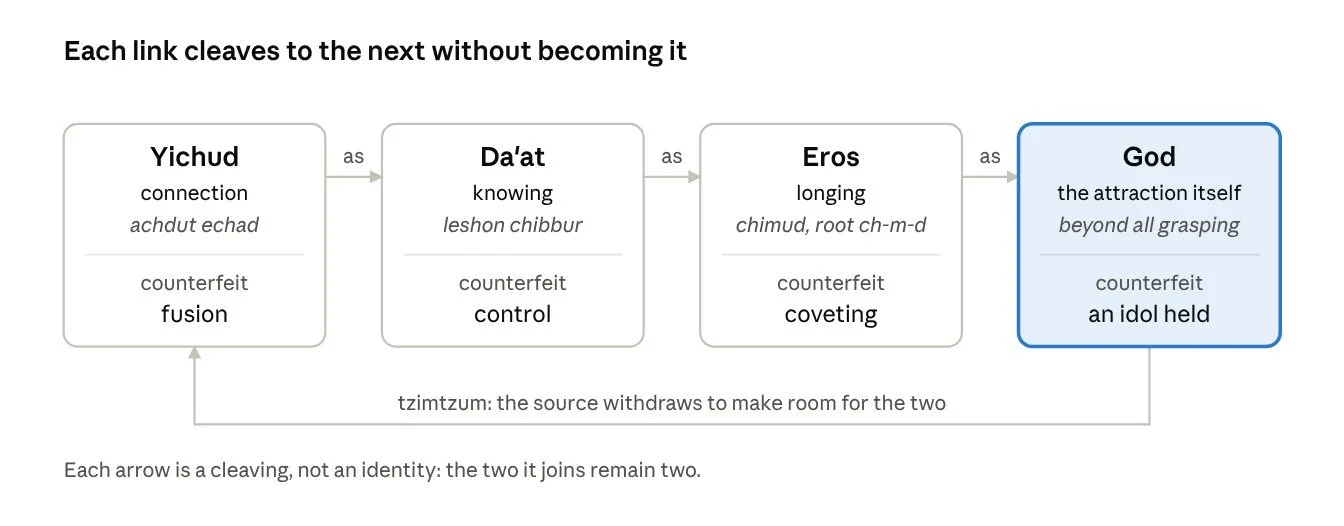
This essay tests a chain of four equations: yichud is connection, connection is da'at, da'at is eros, and eros is God. It argues that the chain holds only if each "is" is read as a cleaving rather than an identity, so that every union preserves the two it joins. Drawing on Genesis 1–3, the Me'or Einayim and the Degel Machaneh Ephraim, it shows that Hasidic sources already join knowledge and erotic union (da'at leshon chibbur; the joining of smallness to greater mind as zivug). The Hebrew root ch-m-d names both the trees God made desirable and the coveting the Decalogue forbids. Desire and possession share one root and diverge in what the hand does next. The most daring claim, that God is the attraction itself, is defended through tzimtzum, the union within the divine life, and the God whom no thought can grasp. It is set against Scholem, Idel, Green, Magid and Fishbane, and against the rabbinic myth of a God who is drawn as well as drawing (Berakhot 6a; Yoma 54a). The argument is then carried into clinical practice. It sets the physician's own longing between detached concern and over-identification (Halpern), reads the interrupted first sentence as the smallest act of possession, and marks where it departs from Charon's narrative medicine and Ofri's account of physicians' emotions and institutional exploitation. It follows the same structure through Freud's abstinence and Jung's coniunctio to Winnicott, Bion, Buber and Benjamin, and to the bond of tzaddik and hasid. It closes with a practical test: a longing is holy in the measure that it makes room for what it cannot own.