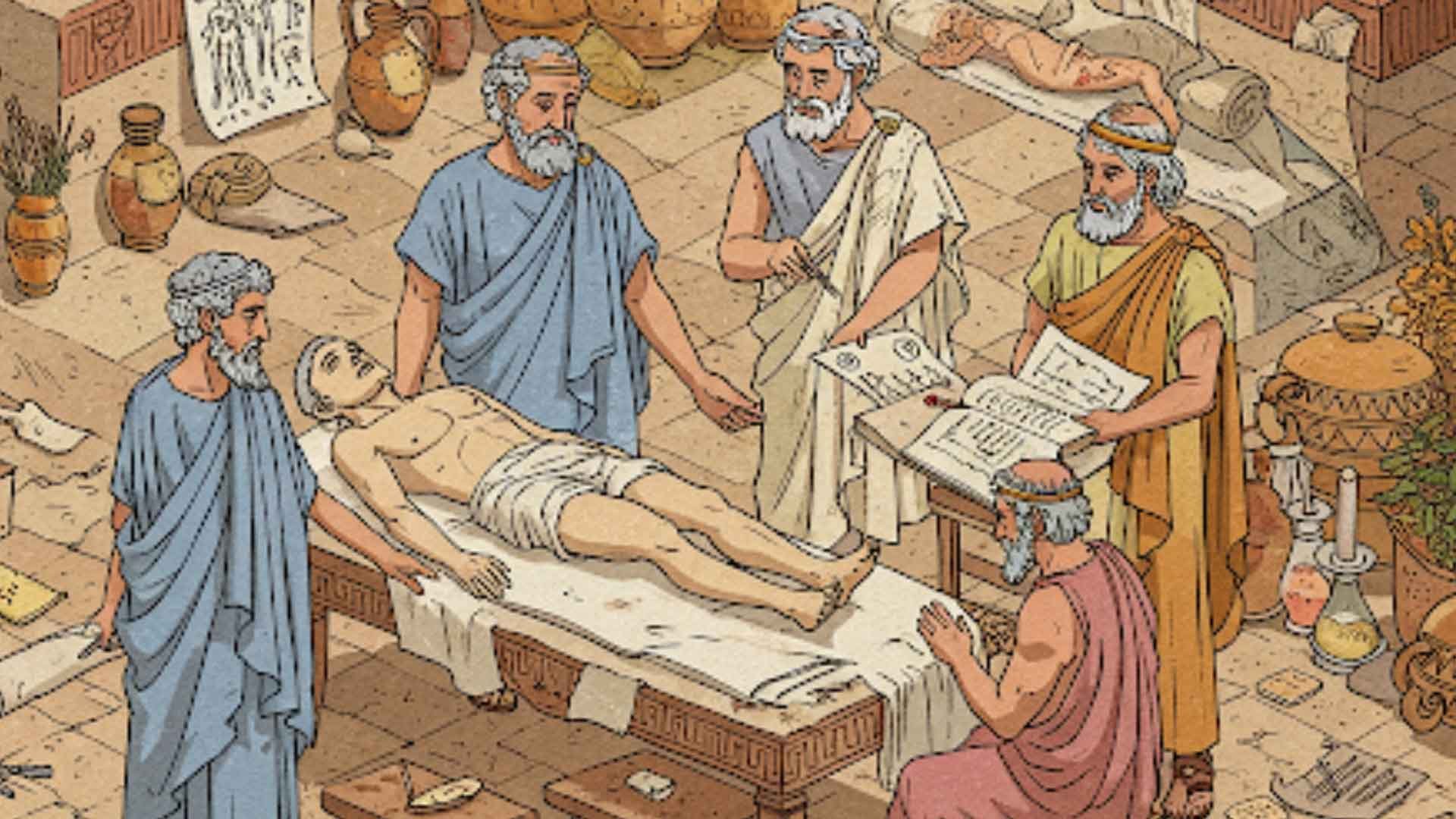
A Remedy Travels Alone
Galen of Pergamum (129–c. 216 CE) and Rabbi Yehudah ha-Nasi (c. 135–217 CE) were contemporaries. One produced the most systematically integrated account of the body composed in antiquity; the other presided over a legal corpus that treats the body constantly and has almost no physiology. This essay explains the divergence by a single mechanism: detachability. Rabbinic culture borrowed freely from Greek medicine whatever could be lifted clean of its cosmology — drugs, instruments, disease names, proven remedies, scholarly technique — and declined whatever arrived bundled with claims about what a body is and who made it: the humors, the tripartite soul, the teleological demiurge. The mechanism predicts the observed loanword distribution, absorbs Lieberman's evidence for Alexandrian influence on rabbinic exegesis, and recurs on the religious plane, where Asclepian remedies were taken and Asclepian piety refused. The argument distinguishes two Alexandrias — Herophilean anatomy and the late-antique Galenic curriculum — establishes that systematized Galenism postdates the tannaim, and reads b. Bekhorot 45a, where the evar counted is a halakhic and not an anatomical category and an anomalous empirical result is resolved by scriptural exegesis. Using Galen's own tripartition of Rationalists, Empirics, and Methodists, it locates the rabbis with the Alexandrian Empirics rather than with Galen. The essay serves a constructive question: whether antiquity holds a unified account of body and soul recoverable against the Cartesian settlement. The verdict is divided. A unified theory fails — Galen's nearest approach is the reductive horn of the same dichotomy. A unified practice succeeds; and the decisive rupture proves older than Descartes, its ancestor Alexandria.