Julian Ungar-Sargon

  • Home
  • Theological Essays
  • Healing Essays
  • Podcast
  • Poetry
  • Daf Ditty
  • Deep Dive Ditty
  • Videos
  • Publications
  • Military Service
  • Dominican University
  • Home
  • Theological Essays
  • Healing Essays
  • Podcast
  • Poetry
  • Daf Ditty
  • Deep Dive Ditty
  • Videos
  • Publications
  • Military Service
  • Dominican University
Julian Ungar-Sargon copy 3.jpg

Daf Ditty

A wide-ranging commentary on the daily page of Talmud.

Bava Metzia 6: שָׁלֹשׁ שָׁבוּעוֹת מַשְׁבִּיעִין אוֹתוֹ

jyungar March 5, 2024

For the source text click/tap here: Bava Metzia 6

To download, click/tap here: PDF

Rav Sheshet says: The judges administer three oaths to an unpaid bailee who claims that the deposit with which he was entrusted was stolen: I hereby take an oath that I was not negligent in safeguarding it; I hereby take an oath that I did not misappropriate the deposit; and I hereby take an oath that it is no longer in my possession, there is the same difficulty. Since the court raises these suspicions against the bailee, let us say that since he is suspected of financial dishonesty, he is suspected with regard to taking an oath.

We explore the use of oaths in antiquity, specifically Ancient Greece.

Tags 47th
Comment

Bava Metzia 5: שְׁבוּעָה זוֹ לָמָּה

jyungar March 4, 2024

For the source text click/tap here: Bava Metzia 5

To download, click/tap here: PDF

As we have learned, when someone claims that another person owes him money and the defendant denies that he owes all of the money, but admits that he owes part of it, then he is a modeh be-miktzat who must pay the amount that he admits to and then take an oath that he does not owe any more. The Gemara (daf 3a) brings the opinion of Rabbi Hiyya who rules that the same law would apply if the defendant denied owing any money but witnesses come and testify that he owes part of the money that is claimed. Here, too, according to Rabbi Hiyya, the defendant will have to swear that he does not owe the full amount, since the witnesses are no less believable than his own admission.

In Jewish law, oaths are not taken in court by witnesses, but by the defendant who, under certain circumstances, is obligated to either pay or satisfy the plaintiff by swearing that he does not owe money. The halakha is that if the defendant “owes” the plaintiff an oath, but he cannot take it for some reason (e.g. he is known to be untrustworthy), then the plaintiff would be permitted to swear that his claim is true, and the defendant will have to pay.

We explore the performative speech act inJewish Law with the analysis of Amir Mashiach.

Tags 47th
Comment

Men preparing for the mikveh, before the Sabbath 16th century

Bava Metzia 4: פִּיו יוֹכיִח

jyungar March 3, 2024

For the source text click/tap here: Bava Metzia 4

To download, click/tap here: PDF

Rebbi Chiya teaches that one is obligated to swear when witnesses testify that he owes half of the amount of money that his opponent claims. The Gemara derives Rebbi Chiya's ruling from a Tzad ha'Shaveh from Hoda'as Piv and Ed Echad. The Gemara asks that Rebbi Chiya's ruling should not be derived from this Tzad ha'Shaveh, since neither Hoda'as Piv nor Ed Echad makes the defendant "Huchzak Kafran," whereas when two witnesses testify that he owes half of the claim he is "Huchzak Kafran."

The Gemara answers that even when two witnesses contradict his word regarding the loan (and he is a "Kofer b'Milveh"), he retains the status of a valid witness. Therefore, even when witnesses testify against him, he is not "Huchzak Kafran.”

We explore the limits of testimony and the struggle between modesty and the need for 3 men to witness the immersion of a convert.

Tags 47th
Comment

From the Rebbe’s Reshimos reprinted by Kehos, first printed 5756.

Bava Metzia 3: שֶׁלֹּא תְּהֵא הוֹדָאַת פִּיו גְּדוֹלָה

jyungar March 2, 2024

For the source text click/tap here: Bava Metzia 3

To download, click/tap here: PDF

Our daf states that if the defendant denies a claim entirely, we believe him without requiring him to bring any further proof;

if he denies that he owes all of the money, but admits that he owes part of it, then he must pay the amount that he admits to and then take an oath that he does not owe any more.

Why do we trust the individual who denies it all, while making the person who admits that he owes some of the money take an oath?

This is the struggle of our sugya and we explore notions of Halacha vs metahalacha…with the help of Prof Moshe Halbertal.

Tags 47th
Comment

Bava Metzia 2: וַאֲנָא יָדַעְנָא דְּכוּלָּהּ שֶׁלִּי

jyungar March 1, 2024

For the source text click/tap here: Bava Metzia 2

To download, click/tap here: PDF

Steinsaltz "Tractate Bava Metzia ( “The Middle Gate”) is actually one section of an ancient Talmudic tractate – Masechet Nezikin – which deals with issues of civil law, and was eventually divided into three parts (bavot, or “gates”).

As is true of the other sections, Masechet Bava Metzia focuses on one main topic, which divides into a large number of different issues, as is common in Talmudic discussions. The main topic of this tractate involves business interactions between people that are informed by Torah laws that define and limit them. Thus, the discussion does not cover all areas of business and possessions, rather it is limited to those areas where the Torah adds unique commandments or prohibitions beyond the normal laws that apply to business interactions.

Because of this, we find the laws of Masechet Bava Metzia codified not only in Shulchan Aruch Choshen Mishpat (which deals with business relationships) but in Yoreh De’ah (whose focus is ritual law), as well. The topics covered include responsibilities towards lost and found objects, assisting in loading, and unloading animals, taking advantage of others in business, taking interest and usury, permitting a field worker to eat while working, the four types of shomrim (guards), the obligation to pay wages on time, among others.”

Tags 46th
Comment

In Memoriam: Shlomo ben Yehudah 1st yahrzeit

Bava Kamma 119: וּמָתָא מַחְסֵיָא – אַתְרָא דְּקָפְדִי הוּא

jyungar February 29, 2024

For the source text click/tap here: Bava Kamma 119

To download, click/tap here: PDF

As we complete the Masechta there appears to be no madras like most others, presumably because

The there Bava’s were one complete text….

So in memory of my father’s first yahrzeit I thought we might add some articles on midrasnhic theory.

Tags 46th
Comment

Bava Kamma 118: וּמָנוּ אֶת הַצֹּאן וְהִיא שְׁלֵימָה

jyungar February 28, 2024

For the source text click/tap here: Bava Kamma 118

To download, click/tap here: PDF

The Mishna on our daf lists a number of cases where it is forbidden to purchase things because we fear that they may be stolen goods.

The Mishna rules, however, that in all cases where the purchaser is told to hide what he bought, it is forbidden to purchase, since it is likely stolen property.

The Gemara quotes a baraita that expands on these rules, explaining, for example, that already sewn woolen clothing can be purchased from shepherds, since we assume that it belongs to them. The general principle taught by the baraita is that anything that the shepherd sells that the owner would notice can be purchased.

We explore the ethics of using other people’s money.

Tags 46th
Comment

Portrait of Frieda Belinfante,1943, reportedly dressed in men's clothing to disguise herself from Nazi informers. Belinfante was a half-Jewish lesbian member of a gay resistance group called the CKC. She participated in the planning of the destruction of the Amsterdam Population Registry in March 1943, and was also active in falsifying identity cards and arranging hiding places for Jews and others sought by the Nazis. In December 1943, Belinfante escaped to Switzerland via Belgium and France. After the war, she returned briefly to Amsterdam and then emigrated to the United States.

Bava Kamma 117: יִשְׂרָאֵל שֶׁאֲנָסוּהוּ גּוֹיִם

jyungar February 27, 2024

For the source text click/tap here: Bava Kamma 117

To download, click/tap here: PDF

During Talmudic times, one of the most disturbing elements in the Jewish community was a moser – someone who collaborated with the foreign government, informing on his fellow Jews. Such a person was perceived as being dangerous to the well-being of the society at large. This led to a ruling by the Sages that a moser could be killed in order to protect the community.

The Gemara relates another incident pertaining to one who informed gentiles of the whereabouts of another Jew’s property. There was a certain individual who showed Rabbi Abba’s silk [ametakesa] to gentiles, who later seized it. Rabbi Abbahu and Rabbi Ḥanina bar Pappi and Rabbi Yitzḥak Nappaḥa sat together to determine whether Rabbi Abba was entitled to compensation from the informer, and Rabbi Ile’a sat next to them.

The halacha is as follows: Someone who is Moser the money of his friend to a thief whether he was Moser it to a Jewish or a non-Jewish thief he is Chayav to pay from the best of his property everything that the thief took. Even though the Moser didn't pick it up and give it to the thief and only directed him to it he is Chayav. If he dies the money is collected from the inheritors of, he Moser just like other damages. (Shulchan Aruch CM 338:2)

We explore the world of the informant, from Petros Alphonse to Jacob Brafman.

Tags 46th
Comment

Bava Kamma 116: יְיָרֵשׁ הַצְּלָצַל

jyungar February 26, 2024

For the source text click/tap here: Bava Kamma 116

To download, click/tap here: PDF

If someone stole a field from his friend, and bandits stole it from him, if these second bandits are plaguing the area (stealing many fields in the area), the first thief can say to the original owner, “Here is your field.” If it was because of the first thief (explained in the Gemora), the first thief must give the original owner another field.

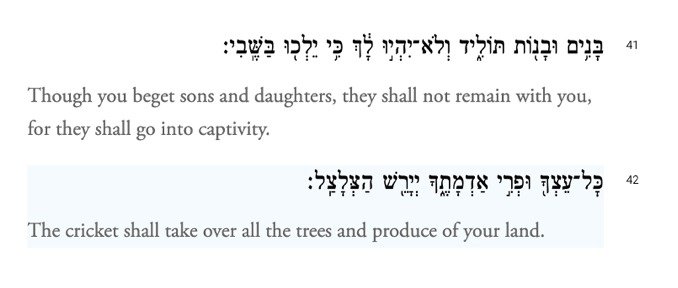
Rav Nachman bar Yitzchak says: The one who calls these bandits “masikin” did not make a mistake, nor did the one who has the text “matzikin.” The text matzikin has its roots in the verse, “b’matzor u’bimatzok” (matzok meaning “with pain”). The text masikin has its source in the verse, “yi’yarash ha’tzlatzal,” which is translated as “the locust will take over” (see Tosfos who argues). The Mishna concluded that if it was because of the first thief etc.

The reference is to Deut 28:42:

We explore the world of Orthoptera specifically locusts and their use as Divine punishment the Chumash (comparing the two Tochacha’s) as well as in the book of Joel.

Tags 46th
Comment

Bava Kamma 115: אֶרֶס שֶׁל נָחָשׁ דּוֹמֶה לִסְפוֹג

jyungar February 25, 2024

For the source text click/tap here: Bava Kamma 115

To download, click/tap here: PDF

Our sugya explains that our sages forbade use of water that remained exposed lest a snake drank thereof and left venom in it. The prohibition remains even if someone drank thereof and was unharmed as the specific gravity of one snake’s venom differs from another’s. Some types of venom sink to the bottom of a vessel while others float above or in the middle. Till all the water is drunk, therefore, we cannot know if it contains venom and danger persists (Tur, Y.D. 116).

What is the meaning behind the specific gravity of snake venom and its chemical properties? We explore the history and mythology of poison and its current uses for recreational drug purposes.

Tags 46th
Comment

Bava Kamma 114: יֵאוּשׁ כְּדִי קָנֵי

jyungar February 24, 2024

For the source text click/tap here: Bava Kamma 114

To download, click/tap here: PDF

Our new Mishna teaches that when a customs collector seizes a person's donkey and replaces it with one stolen from another Jew - or if a bandit does the same with a garment - then the stolen item now belongs to that person. The Rambam and the Rosh argue about whether or not such an item must be returned to its original owner or not. Similarly, it is permitted to keep items salvaged from a river or a fire. As long as the original owner considers the item to be lost to him/her, then the item need not be returned.

The Gemara opens by quoting a baraita that teaches that when the person receives an object in exchange for his own from the mokhes, he should return it to the original owner. The explanation for this ruling would be that simple ye’ush does not suffice to allow for transfer of ownership.

An alternative reading of the baraita suggests that although the recipient can keep the object because of the owner’s ye’ush, he would likely return it to the original owner, since a person does not want to keep property that does not really belong to him.

We focus on testifying, loyalty and secular courts.

Tags 46th
Comment

The Tax Collector, Pieter Brueghel Art Gallery of South Australia

Bava Kamma 113: בְּמוֹכֵס שֶׁאֵין לוֹ קִצְבָה

jyungar February 23, 2024

For the source text click/tap here: Bava Kamma 113

To download, click/tap here: PDF

Our Mishna teaches that a person cannot exchange money with tax collectors, implying that we must work with the assumption that the money they have is stolen.

With regard to this ruling, our Gemara points to Shmuel’s ruling that, “Dina d’malkhuta dina – we must follow the rules of the government,” and questions how the Mishna can assume that a person who works as a tax collector is likely involved in criminal activities.

The situation of a mokhes – a tax collector – was different in Talmudic times than it is today. In those days (and in some places this was true until fairly recently) the right to collect taxes was leased by the government to individuals who would then collect taxes in the name of the government. The individual who purchased this right from the government would then assign others to collect the taxes and pay him a percentage of the receipts. There was a lot of room for cheating and dishonesty given the situation that tax collection was a business, and the more that was collected, the more profit was made.

We explore the history of tax collection and the halachic vs moral duties to pay.

Tags 46th
Comment

Bava Kamma 112: יַחֲזִיר כְּעֵין שֶׁגָּזַל

jyungar February 22, 2024

For the source text click/tap here: Bava Kamma 112

To download, click/tap here: PDF

Steinsaltz writes:

While discussing the level of responsibility that children have regarding returning an object that their father stole, the Gemara turns its attention to other responsibilities that children may inherit from their father regarding things that belong to others. Rava teaches that if the father passes away and he has in his possession an animal that he has borrowed, the children can continue to use the animal for the duration of the agreed upon period. If the animal dies, they are not obligated to repay the owner, even though as a sho’el – a borrower – their father would have been responsible for any accidents that took place.

We continue discussing the burden of parental debt following loss.

Tags 46th
Comment

Victor Hugo

Bava Kamma 111: כִּי שָׁכֵיבְנָא – רַבִּי אוֹשַׁעְיָא נָפֵיק לְווֹתִי

jyungar February 21, 2024

For the source text click/tap here: Bava Kama 111

To download, click/tap here: PDF

The tenth perek of Massekhet Bava Kamma begins on our daf. Entitled ha-gozel u-ma’akhil (“he who steals and feeds”) it deals with a wide range of subjects but focuses on what is considered to be gezel (stolen) – when it must be returned and when it need not be returned.

The first Mishna in the perek teaches that when a man steals and feeds his children with his ill-gotten gains, his children will not be obligated to return the theft.

We discuss the morality of stealing a loaf for the sake of one’s starving children and the effect of the novel les Miserables on French society.

Tags 46th
Comment

Bava Kamma 110: נָתַן הַכֶּסֶף לְאַנְשֵׁי מִשְׁמָר

jyungar February 20, 2024

For the source text click/tap here: Bava Kamma 110

To download, click/tap here: PDF

If one steals from a convert and swears falsely to him, and he (the convert) died (without leaving any heirs), he pays the principal and chomesh (the extra fifth) to the Kohanim and he brings an asham to the Altar, as it is written: But if the man has no kinsman to whom restitution may be made for the guilt, the restitution for guilt which is made shall be for Hashem, for the Kohen, aside from the ram of atonement, whereby atonement shall be provided for him. If he was taking the money and the asham up (to Yerushalayim), and died, the money shall be given to the robber’s sons, and the asham shall graze until it gets a blemish, and it will be sold and its money shall fall to the free offering coffer.

If he gave the money to the men of the mishmar and he died (without bringing the asham), the heirs cannot take the money from their hands, as it is written: Whatever a man gives to the Kohen shall be his. If he gave the money to (the first mishmar of) Yehoyariv and the asham to (the second mishmar of) Yedayah, he has fulfilled his obligation (for the money is supposed to be given before the asham is brought on the Mizbe’ach).

We explore the history of the mishmarot from the Chumash and Tanach through to the medieval Piyutim until the Cairo Geniza fragments.

Tags 46th
Comment

The School of Athens by Raffaello Sanzio, 1509, showing Plato (left) and Aristotle (right)

Bava Kamma 109: גֶּזֶל הַגִּיּוֹרֶת

jyungar February 19, 2024

For the source text click/tap here: Bava Kamma 109

To download, click/tap here: PDF

Someone stole from a convert, swore falsely that he did not steal from him, and he then heard that the convert had died. While bringing up his money to Yerushalayim (to give to the Kohanim in lieu of the dead convert who had no relatives), he meets the convert (who is actually alive as well).

The convert tells him that he can owe the money to him as a loan. If the convert then dies, the thief can acquire the loan. These are the words of Rabbi Yosi ha’Glili. Rabbi Akiva says: He has not repented until he has the stolen money leave his hands.

We explore the exceptional case of stealing from a Ger with no relatives and compare our system with that of Aristotle’s utilitarian ethics.

Tags 46th
Comment

Bava Kamma 108: וְכִי יֵשׁ אָדָם בְּיִשְׂרָאֵל שֶׁאֵין לוֹ גּוֹאֲלִים

jyungar February 18, 2024

For the source text click/tap here: Bava Kamma 108

To download, click/tap here: PDF

The Gemara questions the mishna’s ruling that one who robs his father must return the stolen item to others even if he is the sole heir. Why must he do this? Let him forgive the debt to himself; as the heir, to whom payment is due, he should be able to forgive it.

Rabbi Yoḥanan explains: It is taught in a baraita (Tosefta 10:16) that the verse (Num 5:8) states with regard to one who steals from one who then died:

וְאִם־אֵ֨ין לָאִ֜ישׁ גֹּאֵ֗ל לְהָשִׁ֤יב הָאָשָׁם֙ אֵלָ֔יו הָאָשָׁ֛ם הַמּוּשָׁ֥ב לַיהֹוָ֖ה לַכֹּהֵ֑ן מִלְּבַ֗ד אֵ֚יל הַכִּפֻּרִ֔ים אֲשֶׁ֥ר יְכַפֶּר־בּ֖וֹ עָלָֽיו׃

If that party [is deceased and] has no kin to whom restitution can be made, the amount repaid shall go to יהוה for the priest—in addition to the ram of expiation with which expiation is made on their behalf.

The baraita asks: But is there any Jewish person who has no kinsmen?

Since every Jew descends from Jacob our forefather, all Jews have relatives to inherit from them.

Rather, it must be that the verse is speaking of robbery of a convert.

We explore recent genetics connecting Jews with the Ancient Israelites.

Tags 46th
Comment

Bava Kamma 107: מוֹדֶה בְּמִקְצָת הַטַּעֲנָה יִשָּׁבַע

jyungar February 17, 2024

For the source text click/tap here: Bava Kamma 107

To download, click/tap here: PDF

Steinsaltz writes: "One enigmatic rule in Jewish law is the law that distinguishes between two different responses to an accusation that one person owes money to another. The halakha is that if the defendant denies it entirely, we believe him without requiring him to bring any further proof; if he denies that he owes all of the money, but admits that he owes part of it, then he must pay the amount that he admits to and then take an oath that he does not owe any more.

Why do we trust the individual who denies it all, while making the person who admits that he owes some of the money take an oath?

In answer to this question, Rabba teaches, “Hazakah en adam me’is panav lifne ba’al hove – we work with the assumption that a person will not have the temerity to deny his obligation to the face of the lender.”

We review Yaakov Elman’s work on The Mishnah's Anthological Choices.

Tags 46th
Comment

Joseph being sold, Zygmunt Sokołowski, 1883

Bava Kamma 106: מהו לפדות בבן פקועה

jyungar February 16, 2024

For the source text click/tap here: Bava Kamma 106

To download, click/tap here: PDF

We have already learned that someone who steals an animal will have to pay back twice its value; if he sold it or killed it, he will have to pay back four or five times its value. Our Gemara investigates whether this same law will be true also in cases where someone did not steal the animal but received it to watch and then claims that it was stolen from him, intending to keep it for himself.

Another situation raised by the Gemara is of an animal that can actually be eaten without shehita – the case of a ben peku’ah. A ben pekua’ah is an animal that was still in its mother’s womb when its mother was slaughtered (as opposed to a yotze dofen, which is an animal that is delivered by way of a Caesarian section when the mother is still alive). Just as all an animal’s internal organs become kosher at the moment of shehita, similarly a viable animal that is removed from its mother after slaughter is considered by Jewish law to be a living, breathing kosher animal that can be eaten without shehita.

We explore the halachot of Ben Pakua as well as the ignorance of this Halacha when Joseph falsely accused his brothers of eating Ever min Hacahi.

Thomas mann’s adaptation of the Joseph cycle and his possible indebtedness to midrash.

Tags 46th
Comment

RABBINISCHER HUMOR AUS ALTER UND NEUER ZEIT: EINE SAMMLUNG VON ANEKDOTEN UND "GUTEN WÖRTCHEN" Kohn, Pinchas Jakob Publisher: Frankfurt Am Main, J. Kauffmann, 1930

Bava Kamma 105: דָּבָר הַגּוֹרֵם לְמָמוֹן – כְּמָמוֹן דָּמֵי

jyungar February 15, 2024

For the source text click/tap here: Bava Kamma 105

To download, click/tap here: PDF

The Gemara wonders if our last Mishna demonstrated concern about a stolen item that is worth less than one peruta appreciating in value. If the item gains in worth until it is more than one peruta, that could change whether or not the victim has to find the robber him/herself. In their discussion, they refer to Rava who wonders whether an item worth less than one peruta can in fact be stolen.

In a noteworthy exchange Rabba chides Rav Amran with a תְּדוֹרָא!! "Fool, when that baraita is taught, it is referring to a case where the robber said to the owner: Here you are, and presented the ox to him immediately, so that he did not profit by claiming that he was a bailee.”

Whichleads us to examine rabbinic humiliation and humor.

Tags 46th
Comment
  • Daf Ditty
  • Older
  • Newer

Julian Ungar-Sargon

This is Julian Ungar-Sargon's personal website. It contains poems, essays, and podcasts for the spiritual seeker and interdisciplinary aficionado.​