
From Desert to the Point of the Letter
Medicine has developed a sophisticated apparatus for the management of pain and almost none for the interpretation of suffering. Cassell's distinction between pain as a condition of bodies and suffering as a condition of persons remains incompletely absorbed into clinical practice, and narrative medicine, while supplying a vocabulary for how patients construct meaning from illness, offers the clinician no position on whether suffering admits of meaning at all. This paper addresses that gap by tracing a two-millennium trajectory through midrashic and kabbalistic sources, arguing that the shape of the tradition's movement is more clinically useful than any of its individual positions.
The trajectory is presented not as a history of belief about suffering but as a history of its location relative to the divine. Five successive relocations are identified: suffering as external punishment in the Deuteronomic inheritance, together with the canon's own dissent preserved in Job, Psalm 44, and the unresolved orthographic variants at Isaiah 63:9 and Job 13:15; suffering as accompanied rather than explained in the tannaitic sources, culminating in the Mishnah's identification of divine somatic distress with the body of an executed criminal, which establishes the guilty sufferer rather than the innocent one as the paradigm case; suffering as interior to the Godhead in early kabbalistic thought; suffering as antecedent to fault in the Lurianic doctrine of the shattered vessels, which converts illness from desert into displacement; and finally suffering as constitutively unanswerable in Rabbi Naḥman's teaching on the vacated space, which converges independently with the divine imperative to silence in the Talmudic narrative of Rabbi Akiva's death.
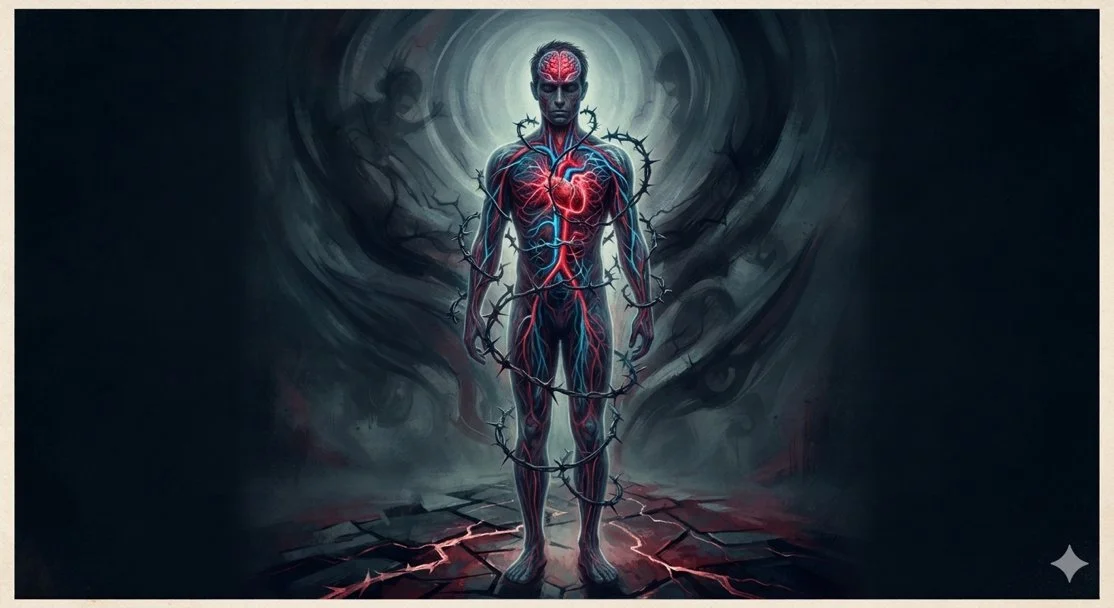
Attention is given to the Tikkunei Zohar's identification of the crown, the crownlet, and the thorn-point of the letter as a single symbolic locus dependent upon the indwelling divine presence. This yields the paper's central formulation: the mark that is a crown seen from above is a thorn felt from below, and no one standing below is under any obligation to see it from above. The Talmudic bedside exchange in which a doctrine of redemptive suffering is offered, refused by the patient, left undefended, and replaced by physical touch is proposed as a compressed description of clinical method.
The paper identifies one countermove that recurs at every station and must be refused at each: the conversion of unanswerability back into mission, exemplified in its most developed form by Sabbatian theology and its Hasidic derivatives. Four clinical propositions are derived. The paradigmatic sufferer in this tradition is the culpable one, which disarms the moralism latent in the management of self-implicated chronic disease. The physician's position in the Akiva narrative is that of the protesting Moses rather than the silencing deity, so that a clinician without an explanation has not thereby failed. Presence precedes and outlasts interpretation rather than substituting for it when treatment fails. And the thorn is never converted into a crown on the patient's behalf: the furthest defensible clinical statement is not that suffering happened for a reason, which is both theologically indefensible and clinically dangerous, but that suffering has not deprived this person of the possibility of meaning. The distinction between accompaniment and conscription is argued to be the practical yield of the entire trajectory.