
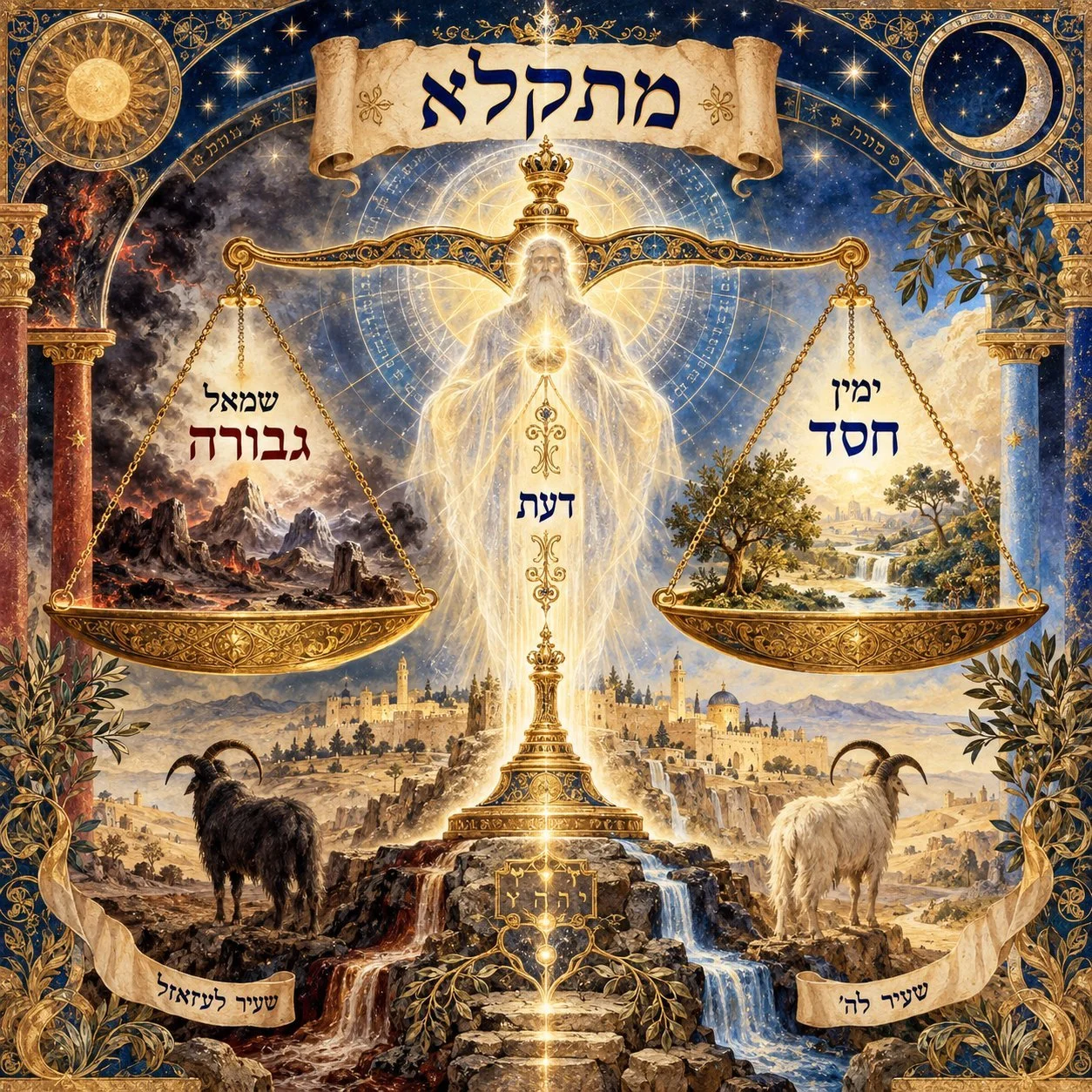
A Place That Is Not
The opening sentence of the Zohar’s Sifra de-Tzeni’uta names a balance (matkela) without which “face did not behold face” and “the primordial kings died.” R. Menaḥem Naḥum of Chernobyl, in the Me’or Einayim on Aḥarei Mot, identifies that balance with Jacob, with Da’at, and with the two goats of Yom Kippur, one “for the LORD” and one “for Azazel.” This essay traces the chain from the Zohar through its rabbinic substrate (Genesis 36:31, Bereshit Rabbah 65:15, Vayikra Rabbah 21:11), Sefer Yetzirah’s “tongue of decree,” and the Hasidic homily. It then asks what the chain offers the clinical encounter. My first instinct was to say that the physician stands on the fulcrum, like Jacob. I argue that the sources refuse this. The High Priest does not choose the goats’ destinies; the lot does. The balance “hangs in a place that is not.” And the tongue of a scale does not rule the pans; it is the part most moved by them. The clinician is therefore not the fulcrum but its host: one who wears Esau’s hands without losing Jacob’s voice, sends the unbearable to its boundary without making anyone a scapegoat, and whose authority is the authority of sensitivity. The essay closes with the claim that matkela completes the tzimtzum model: contraction makes otherness possible; measure makes relation among the differentiated possible.