
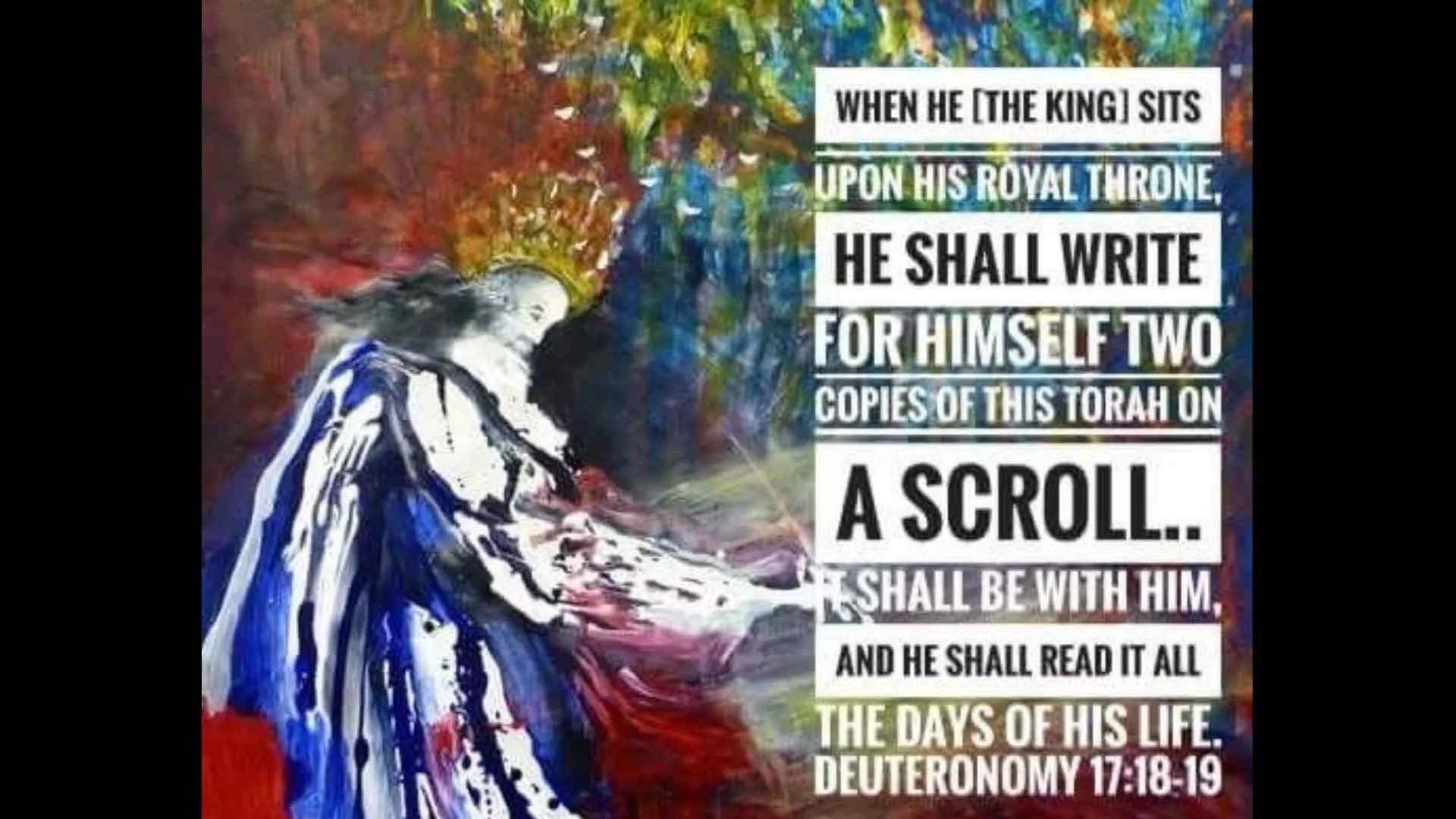
The Pristine Text and the Bloodied One
Deuteronomy 17:18 requires the king of Israel to write for himself mishneh ha-torah ha-zot — in the plain sense of the Deuteronomic legislator, a verified duplicate of the law, copied under priestly supervision and checked against a temple exemplar, so that the sovereign should stand permanently under a text he did not author.
The rabbis re-read mishneh as sheni, "a second," and generated two scrolls: one that goes out and comes in with the king, and one that lies in his treasury. A baraita at Sanhedrin 21b adds a startling detail: the travelling scroll is made k'min kamea, "in the manner of an amulet," and hung on his arm.
Rashi, commenting on the verse, transmits the doubling and omits the amulet; Maimonides, codifying the rule, retains the perpetual accompaniment and the bathhouse exclusion and likewise does not reproduce the simile.
This paper traces that trajectory — plain sense, midrashic doubling, thaumaturgic clause, pedagogical suppression — and argues that it maps with unusual precision onto a structural problem in clinical epistemology.
Medicine also keeps two texts: an archival exemplar that derives its authority from remaining uncorrupted by use (the textbook, the systematic review, the guideline in the library), and a working copy that derives its authority from wear (the compressed algorithm, the pocket card, the score, the clinician's own accumulated and unpublishable knowledge). Each fails without the other, and each fails characteristically: the archive becomes scholasticism, the worn text becomes talisman.
The halakhic apparatus surrounding the second scroll — it may be miniaturized to amulet size, it may go to war, it may not enter the privy or the bathhouse, because v'hayta imo v'kara vo requires "a place fit for reading in it" — supplies a transferable rule. What licenses compression is the preservation of readability. An instrument that can still be opened and checked is a text; one that is only carried is a charm.