
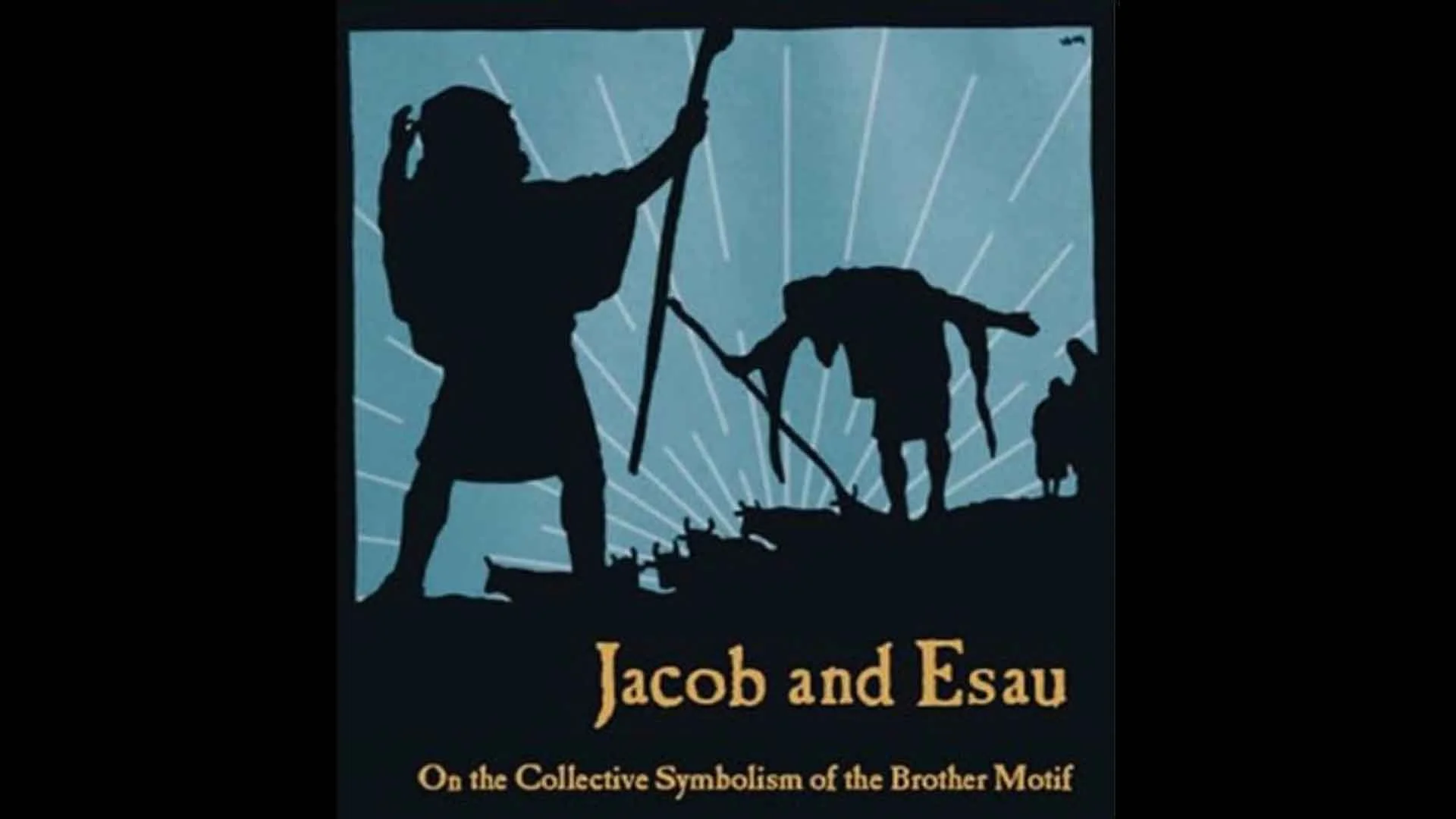
The Hands and the Face
This essay adjudicates between two working drafts that were made to be joined and would not join and completes the adjudication with a mechanism drawn from a paper of my own that appeared to belong to another field altogether. The first draft treats Erich Neumann's collective Shadow and the trajectory of genocide after Auschwitz; the second reads Jacob's disguise, Isaac's blind hands, and the night at the Jabbok; my own paper explains why rabbinic culture took Greek drugs and instruments and declined the humours, the tripartite soul, and the teleological demiurge. The quarrel between the two drafts runs in three registers — a categorical method against the irreducible face, retrospective wisdom against a living recoil, and divine hiddenness as covenantal event against concealment as the constitutive condition of a world — and the third paper resolves all three by supplying a mechanism: detachability.
A remedy travels alone; a system arrives with its theology. Six claims carry the argument.
First, an archetypal grammar may describe the operation a persecutor performs upon persons and may never describe the persons; the Genesis material is the brake this rule requires, and Sandmel's bar against both false parallels and false absences is the evidentiary discipline that goes with it.
Second, assimilation and scapegoating are opposite poles of one axis, since both abolish distinction — one erasing the boundary between Jew and gentile from within and by choice, the other erasing the boundary among Jews from without and by decree; the assimilationist's wish was granted in the wrong currency.
Third, emancipation was a detachability wager that failed twice over: the goods were bundled, and the buyer was not the party competent to decide what travelled alone.
Fourth, the standard resolution of the assimilated Jew's ambivalence toward the Ostjude — that Auschwitz collapsed the distinction and voided it — is a resolution donated by the murderer, and I withdraw it.
Fifth, tzimtzum and hester panim belong to different grammars, ontological and covenantal, held together on the Maimonidean precedent of two criteria in one skull without synthesis; the Chabad ordering in which withdrawal precedes sin permits both without allowing either to console.
Sixth, genocide's decisive step is jurisdictional rather than rhetorical — the manufacture of a person about whom the law has been made silent — which is what the psychology of projection underdescribes.
A central section asks what has become of the archetypal engine Jung named Wotan in 1936: deterritorialized, leaderless, mechanically amplified and far faster, while the grammar it drives is unchanged and its vocabularies have merely rotated.
The essay closes at Peniel, where reconciliation is one meeting of faces, two separate roads, and a limp; and at the covered blood, which the crematoria were built to prevent from crying.