
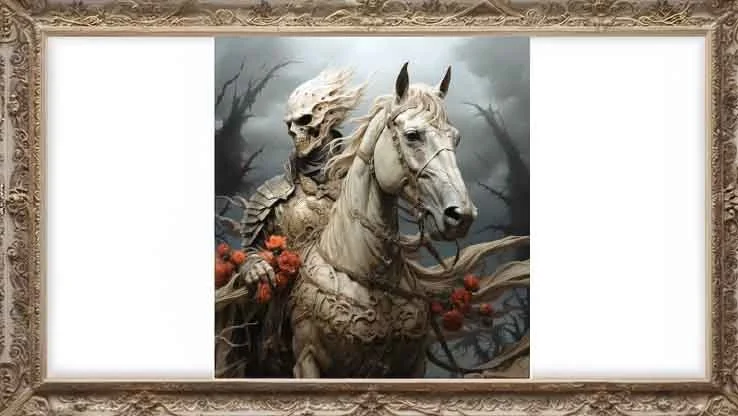
Makom, Tzimtzum, and the Collapse of the Horse-and-Rider Parable/Mashal
This essay argues that the rabbinic designation of God as Makom—"He is the place of the world, but the world is not His place" (Bereishit Rabbah 68:9)—functions not as a tidy preservation of divine transcendence but as a controlled detonation of spatial metaphysics. Read alongside the Chabad polemic against a literal reading of tzimtzum and in conversation with Elliot R. Wolfson’s apophatic phenomenology, the Midrash discloses a topology in which nothing stands outside divine being even while divine essence infinitely exceeds every manifestation. The familiar parable/mashal of horse and rider, deployed by the Midrash itself, presupposes precisely the dualism it is meant to instruct, and consequently collapses under its own weight. What emerges from this collapse is what I term, with Wolfson, an apophatic cosmism: an ontology of concealed immanence whose clinical analogue is the therapeutic space. Drawing on my earlier work on divine presence and concealment, sacred and profane space, and the patient as sacred text,1–6
Part I argues that the therapeutic encounter is not a neutral interpersonal zone hospitable to occasional religious experience, but a region ontologically suspended within Makom—a place where rupture itself becomes a mode of disclosure.
Part II, an Addendum, descends from this philosophical claim into the operational disciplines of clinical posture, sacred listening, the topology of the clinic, the figure of the wounded healer, and the formation rather than mere training of clinicians.