
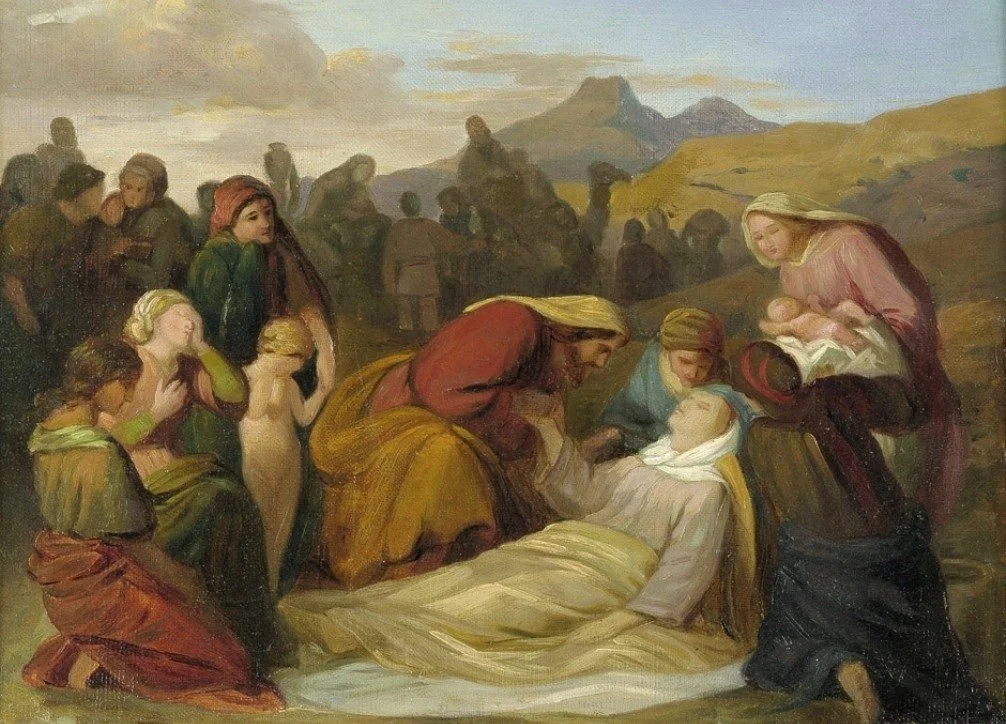
Ben-Oni and Binyamin
Genesis 35:18 records two names for one child. Rachel, dying in childbirth on the road to Ephrath, calls her son Ben-Oni, “son of my sorrow”; Jacob renames him Binyamin. This essay reads the two names as two irreducible theological languages, testimony and futurity, and argues that neither may be allowed to silence the other. Drawing on the double sense of the Hebrew ʼon (sorrow and vigor), on Jeremiah’s Rachel who refuses to be comforted, and on the rabbinic tradition that gives her the decisive word in an argument with God, it contends that religious hope becomes ethical only when it remains answerable to the sufferer’s own account. The argument engages Job, Lurianic Kabbalah, Adorno, Levinas and Arthur Frank. It then turns to the author’s poem “In the Dying of the Leaves,” whose autumnal imagery is undone by the memory of the Shoah, and to the physician’s obligation not to rename a patient’s pain as providence. The essay is preceded by the poem “In the Dying of Mama Rachel” and followed by two addenda. Addendum II surveys ancient, rabbinic, medieval, Kabbalistic and modern interpretations of the naming of Benjamin, among them Rashi, Ramban, Radak, Bekhor Shor, the Netziv, Elchanan Samet, Jonathan Sacks and Avivah Gottlieb Zornberg. It shows that the tradition already divides between readings in which Jacob’s name cancels, translates or preserves Rachel’s. Addendum I presents, in Hebrew and English, the forty-two biblical, talmudic, midrashic and targumic sources (S1–S42) on which the poem and essay draw.