The law says:
Not here.
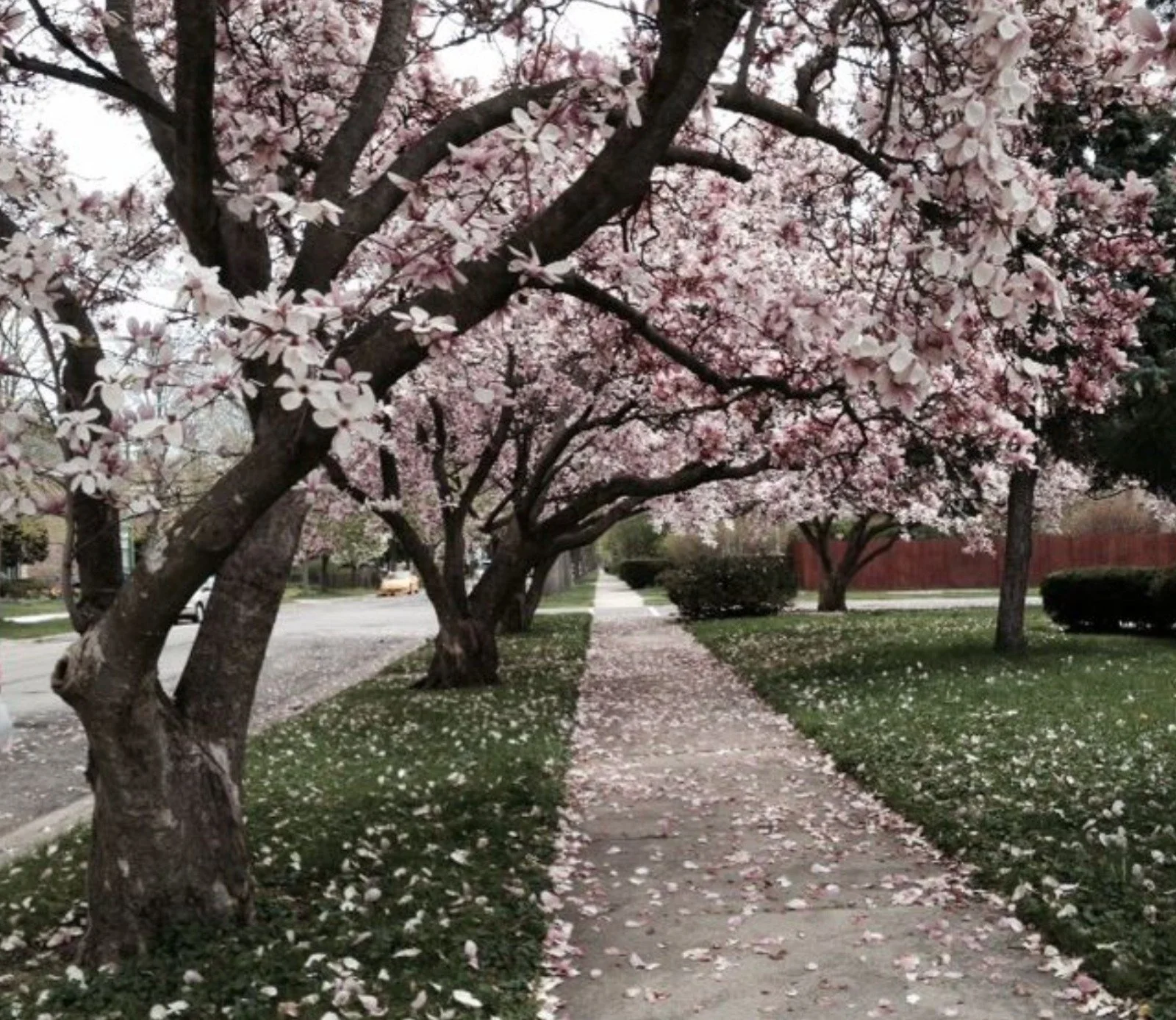
Not on these pink flames
that rise each April like a forgotten promise
at my daughter’s door.
The Halacha points down the street
to the sanctioned tree,
the one bearing fruit,
obedient, categorized, fit for blessing.
Its branches have pedigree.
Its petals pass inspection.
But my soul—
my unruly, suspect soul—
stops before the magnolia.
Four of them
bathing my daughter’s home in pink fire,
as though dawn had descended
and taken root in wood.
Four sudden revelations
burning against the cold grammar of winter,
opening only briefly,
as if beauty itself feared arrest.
And I want—God, how I want—
to whisper the words there, the beracha
בָּרוּךְ אַתָּה ה׳ אֱלֹקֵינוּ מֶלֶךְ הָעוֹלָם
שֶׁלֹּא חִסַּר בְּעוֹלָמוֹ כְּלוּם
וּבָרָא בוֹ בְּרִיּוֹת טוֹבוֹת וְאִילָנוֹת טוֹבוֹת
לֵיהָנוֹת בָּהֶם בְּנֵי אָדָם
to place the ancient blessing
not where the code permits
but where astonishment erupts.
What is this ache
if not the old quarrel?
Lithuania against Mezhibuzh.
Vilna against Berditchev.
The measured line of law
against the story that spills over its edge.
The Litvak counts species.
The Hasid hears the tree sing.
One asks: Is it permitted?
The other: Is it alive?
And beneath both
something older stirs—
Jacob wrestling the angel,
Korach murmuring in the camp,
the Ishbitzer bending rules
to rescue a spark.
For what is antinomian longing
if not the intuition
that sometimes the living God
appears precisely where the border says no?
where law draws a fence
and longing leans against it
like a prisoner listening for music.
For perhaps the boundary
is not always where holiness ends,
but where it grows dangerous.
And perhaps my desire
to bless the magnolia
is not rebellion against Torah
but a grief
that beauty has overflowed its category.
For what if the Holy One hides
not only in what law can name
but in what exceeds naming?
What if the no
is sometimes the veil,
not the final word?
What if the border itself
is where God waits—
as at the edge of Eden,
as at the mouth of the abyss,
as in the broken places
where Rebbe sent his seekers
to find the song inside silence?
These magnolias know nothing of tractates.
They do not cite precedent.
They bloom in holy disobedience.
Their pink is argument.
Their fragrance, a heresy.
And my unsaid berachah
Is a transgression born—
not of contempt,
nor appetite,
but love—
where the code cannot follow.
For two weeks
they make a midrash of excess,
then vanish—
leaving only the wound of having seen.
And I wonder
whether the forbidden blessing
already exists
in the silence before speech.
Whether my desire to bless them
is itself a bracha.
Whether transgression,
is sometimes the only fidelity
to a deeper command.
Because I confess:
I have always trusted
the living thing over the rule,
the pulse over the code,
the burning bush over the taxonomy of shrubs.
I have always suspected
that God hides
not only in the permitted fruit tree
but in the unsanctioned blossom
that breaks your heart.
So I stand before the magnolias
with the blessing caught in my throat,
obedient lips, rebellious spirit,
and perhaps that tension itself
is my religion:
to obey the law
while aching toward its subversion,
to remain inside the covenant
while leaning toward the wild edge,
to know the words are forbidden
and still hear them flowering—
where one spends a lifetime
before the gate,
asking permission to enter,
while the gatekeeper says:
not yet.
What if one can die
so faithful to the threshold
that one never touches
the living fire beyond it?
Then the magnolia troubles me
like a Kafkan summons.
Because the law says:
Bless the fruit tree.
But the pink blaze at my daughter’s house
stands there like a door
opened only once a year.
And I fear
that walking past it
to find the sanctioned tree down the street
may be, in some secret court,
a failure of attention.
Blessed are You…
…for making beauty
too brief
to be contained by law.