Julian Ungar-Sargon

  • Home
  • Theological Essays
  • Healing Essays
  • Podcast
  • Poetry
  • Daf Ditty
  • Deep Dive Ditty
  • Videos
  • Publications
  • Military Service
  • Dominican University
  • Home
  • Theological Essays
  • Healing Essays
  • Podcast
  • Poetry
  • Daf Ditty
  • Deep Dive Ditty
  • Videos
  • Publications
  • Military Service
  • Dominican University
Julian Ungar-Sargon copy 3.jpg

Daf Ditty

A wide-ranging commentary on the daily page of Talmud.

Bava Batra 110: לְעוֹלָם יַשְׂכִּיר אָדָם עַצְמוֹ לַעֲבוֹדָה זָרָה

jyungar October 13, 2024

For the source text click/tap here: Bava Batra 110

To download, click/tap here: PDF

In connection with the Gemara’s mention of Jonathan, who served as a priest for Micah, the Gemara quotes additional statements of the Sages concerning that episode.

Jonathan said to them: This is the tradition that I received from the house of my father’s father: A person should always hire himself out to idol worship and not require the help of people by receiving charity, and I took this position in order to avoid having to take charity.

The Gemara comments that this maxim was misunderstood by Yehonatan, for its true intent was that a person should accept work that is not what he ordinarily does (avoda she-zara lo) rather than accept charity. In support of this assertion the Gemara relates something that Rav once said to Rav Kahana – you should be willing to skin animals in the marketplace and get paid, and you should not say that it is below the dignity of an important person such as yourself.

We explore the life scholarship and tragic times of Isaac ben Jacob Canpanton (1360–1463) (Hebrew: יצחק קנפנטון). He lived in the period darkened by the outrages of Ferrand Martinez and Vicente Ferrer, when intellectual life and Talmudic erudition were on the decline among the Jews of Spain.

Campanton's disciples,( including Reb Yosef Caro!!) themselves outstanding figures of the expulsion generation, bequeathed this speculative method to their students in the yeshivot they founded throughout the Ottoman Empire. Another infamous student was Alfonso de Zamora .

There is disputed evidence that he betrayed ZARZA, SAMUEL IBN SENEH: who was burnt at the stake.

Tags 55th
Comment

Bava Batra 109: ?וּמִשְׁפַּחַת אֵם אֵינָהּ קְרוּיָה ״מִשְׁפָּחָה״

jyungar October 13, 2024

For the source text click/tap here: Bava Batra 109

To download, click/tap here: PDF

The rabbis wish to discuss inheritance guidelines as they were set out in yesterday's daf. Who is thought to be the first to inherit and why? What is meant by the word "family" in some of our texts? Why are wives not the first inheritors? When do women inherit and why? The rabbis provide proofs both through their texts and through their lines of questioning for the logic of the guidelines in our Mishna.

We explore the issue of matrilineal inheritance.

Tags 55th
Comment

Bava Batra 108: דְּאַתְחוֹלֵי בְּפוּרְעֲנוּתָא לָא מַתְחֲלִינַן

jyungar October 11, 2024

For the source text click/tap here: Bava Batra 108

To download, click/tap here: PDF

Our new Perek begins with the following question regarding inheritance priorities:

A new Mishna teaches us that some people are permitted to inherit from and bequeath to others. Others are permitted only to bequeath to someone or to inherit from someone. One group of people are not permitted to inherit to or bequeath from anyone.

The Gemara begins by clarifying the order of the list in the mishna. What is different, i.e., what is the reason, that the mishna teaches: A father with regard to his sons, as the firstexample? Let it teach: Sons with regard to their father, as the first example. The Gemara explains why this would be preferable: One reason is that we do not want to begin with a calamity, as the death of a son during his father’s lifetime is a calamity; therefore, it would have been appropriate to begin with the example of sons inheriting from their father.

We explore the laws of inheritance.

Tags 55th
Comment

Roman ditch on Hadrian's Wall

A ditch flanked Hadrian's Wall Link to the north. To the left is Hadrians Wall National Trail which runs 135 km from Bowness-on-Solway to Wallsend Link. Carraw Farm NY8471 can be seen on the skyline. The Military Road B6318 lies to the right.

Bava Batra 107: אַדַּאֲכַלְתְּ כַּפְנְיָיתָא בְּבָבֶל

jyungar October 10, 2024

For the source text click/tap here: Bava Batra 107

To download, click/tap here: PDF

The Mishna had stated: The seller accepts the place (outside of the field being sold) for the fence, a wide ditch and a narrow ditch. The Gemora cites a braisa: The wider ditch is placed on the outside (further away from the fence) and the narrow one is placed on the inside (outside the fence, but close to it), and both of them are made behind the fence in order that an animal should not jump over the fence.

The Gemora asks: Why don’t we just make the wide ditch, and there would be no need for the narrow one? The Gemora answers: Since it is wide, an animal might stand in it and jump.

We explore the fields and ditches of antiquity from Sumer to Egypt, from Palestine to the Ohio Valley.

Tags 55th
Comment

Bava Batra 106: אַף כָּאן בְּגוֹרָל

jyungar October 9, 2024

For the source text click/tap here: Bava Batra 106

To download, click/tap here: PDF

The Gemora discusses allocation of inheritance and splitting an estate:

The Gemora first cites a braisa, in which Rabbi Yosi says that when brothers split their inherited estate, once one of them received his share by lottery, all the brothers have taken possession of their portion.

Rabbi Elozar says this halachah is learned from the original division of Eretz Yisroel among the Jews. Just as they took ownership by lottery, so any division by lottery confers ownership to the participants.

We explore the legal status of lottery and the midah of Sodom.

Tags 55th
Comment

Bava Batra 105: אָמַר שְׁמוּאֵל: זוֹ דִּבְרֵי בֶּן נַנָּס

jyungar October 8, 2024

For the source text click/tap here: Bava Batra 105

To download, click/tap here: PDF

The Gemara asks: And does Shmuel actually agree with ben Nanas ? But doesn’t Shmuel say: Concerning the ruling of the Sages that the landlord and the tenant should divide the intercalated month between them, we are dealing with a case where the landlord came to collect the rent in the middle of the month.

Rather, it must be that Shmuel actually meant to say that this is the statement of ben Nanas, but he, Shmuel, does not agree with him that one should attend to the latter expression.

In fact, he is in agreement with the Sages who maintain that two contradictory expressions create a case of uncertainty.

We explore the world of Talmudic logic from jneusner to Jacobs to Levinas.

Tags 55th
Comment

Since much of Europe was devastated by war, powerful lords and ladies built fortified castles where they could live, along with their respective staff. These massive plots of land became known as manors. A manor was self-sufficient, meaning that everything needed to survive could be located on the property.

Bava Batra 104: יַחְלוֹקוּ אֶת חֹדֶשׁ הָעִיבּוּר

jyungar October 7, 2024

For the source text click/tap here: Bava Batra 104

To download, click/tap here: PDF

We end our daf with a new Mishna. It teaches about what should be done if a seller contradicts himself in his contract. He might say that he is selling a plot of land that was precisely measured with a rope, more or less. The "more or less" nullifies his earlier statement about a precise measure. To correct this error, there must be at least a quarter-kav per se'a surplus.

Apropos land contracts we explore the world of manorialism and how it compared with feudalism both ending under the hegemony of the crown.

Tags 55th
Comment

Bava Batra 103: מִדָּה בְּחֶבֶל

jyungar October 6, 2024

For the source text click/tap here: Bava Batra 103

To download, click/tap here: PDF

Mishnah two continues to deal with error’s made in the measurements of a field and the rules regarding returning the difference in such cases.

The Gemara suggests: Come and hear a solution from what was taught in the mishna: If one says to another: I am selling you a plot of earth the size of a beit kor, measured precisely with a rope, and he gave him even the slightest amount less that what was stipulated, the seller must deduct the difference from the purchase price of the field and return money to the buyer. If he gave him even the slightest amount more than what was stipulated, the buyer must return the difference to the seller.

Parashat Kedoshim that lay the framework for a life of honest business dealings: those on falsely denying money owed, lying for monetary benefit, and swearing falsely to support illegitimate monetary claims. However, in guiding man to a life of holiness, Parashat Kedoshim does not suffice with a general discussion of the need for honest monetary dealings but goes into specific requirements.

We explore these moral requirements then delve into the moral quandary expressed by the actions in the last chapter of the book of Esther.

Tags 55th
Comment

1865 Human Fetus, Antique Obstetrics print, Anatomy, Embryology

Bava Batra 102: וְהָכָא בְּמַאי עָסְקִינַן – בְּנִיפְלֵי

jyungar October 5, 2024

For the source text click/tap here: Bava Batra 102

To download, click/tap here: PDF

The Gemora says that they would make special graves inside the burial chamber especially designed for nefalim (stillborns). This would indicate that there is in fact a mitzvah to bury a neifel.

The Rema in Hilchos Yom Tov (526:10) writes that one is not allowed to bury a neifel on Yom Tov, rather he should be buried the next day. The source is from the Hagahos Maiomonies who holds that there is no mitzvah to bury a neifel. However, the Magen Avrohom (20) says that in his opinion, there is a mitzvah to bury a neifel.

The Hagahos Maimonides cites the Gemora in Pesachim (9a) which implies that there was a pit that was designated to throw nefalim into, implying that there isn't any mitzvah of kevurah (burial).

The Gr"a also takes this approach - that the fact that they were thrown into a pit indicates that there isn't a mitzvah of kevurah.

We explore the status of stillborns in antiquity.

Tags 55th
Comment

The word “catacomb” derives from the Greek words kata kymbas, used from at least the fourth century CE to refer to a locale along the Via Appia where the ground was hollowed out, forming cavities. The designation came to apply particularly to the few Jewish and many Christian underground funerary complexes that sprang up around Rome between the first and fifth centuries CE.

Bava Batra 101: וּפוֹתֵחַ לְתוֹכָהּ שְׁמוֹנָה כּוּכִין κατάτύμβος

jyungar October 4, 2024

For the source text click/tap here: Bava Batra 101

To download, click/tap here: PDF

During the time of the Mishna, common burial practice was for families to arrange for burial caves. Every family would purchase a rocky area that they would dig out, creating an entrance area surrounded by a series of caves, one for each household in the family. In each cave, burial niches – called kukhin – were chiseled out of the rock.

Each of the kukhin would open into the cave, and the dead body would be placed in it after which the kukh would be sealed with rocks, plaster, etc.

The Mishna on our daf discusses the sale of an ordinary burial cave, which is meant to serve as a family burial plot or catacomb. The Tanna Kamma of the Mishna teaches that an ordinary cave must offer enough room to build a chamber of four amot wide by six amot long, with room for eight kukhin, three on either side and two opposite the entrance. Each of these kukhin must be four amot long, six tefaḥim wide and seven tefaḥim high.

We explore the world of catacombs in antiquity especially those under Herod’s Temple.

Tags 55th
Comment

Bava Batra 100: הַכֹּל הָבֶל

jyungar October 3, 2024

For the source text click/tap here: Bava Batra 100

To download, click/tap here: PDF

The Gemora cites a braisa: No less than seven standings and sittings (standing and sitting ritual performed by the funeral; as part of the funeral procession, they would sit and listen to the leader offer eulogies on the deceased) are to be arranged for the deceased….

On their return from the burial, the mourners would stop after traveling a short distance and would sit to bewail the loss of the deceased. They would then stand and continue journeying for a short while and then repeat the procedure. The mourners perform no fewer than seven standings and sittings in honor of the deceased. These seven correspond to the seven references to “vanity” in the verse:

“Vanity of vanities, says Kohelet; vanity of vanities, all is vanity” (Ecclesiastes 1:2), counting the plural term “vanities” as two references.

We explore the poignant reference to Koheles and its implication for the fleeting nature of life through the eyes of various scholars.

Tags 55th
Comment

Bava Batra 99: גִּינָּה לִפְנִים מִגִּינָּתוֹ

jyungar October 2, 2024

For the source text click/tap here: Bava Batra 99

To download, click/tap here: PDF

Our new mishnah states: One who has ownership of a garden located beyond the garden of another, and also has access rights to it, may enter his garden only at a time when it is usual for people to enter, and may leave only at a time when it is usual for people to leave.

In the case of one who had a public thoroughfare passing through his field, and he appropriated it and instead gave the public an alternative thoroughfare on the side of his property, the halakha is that the thoroughfare that he gave them, he gave them, and they may use it.

We explore the parable of the King’s garden within a garden used by the Mechilta to explain why the reed sea resisted Moshe’s initial command to split fleeing only when the divine appears.

Tags 55th
Comment

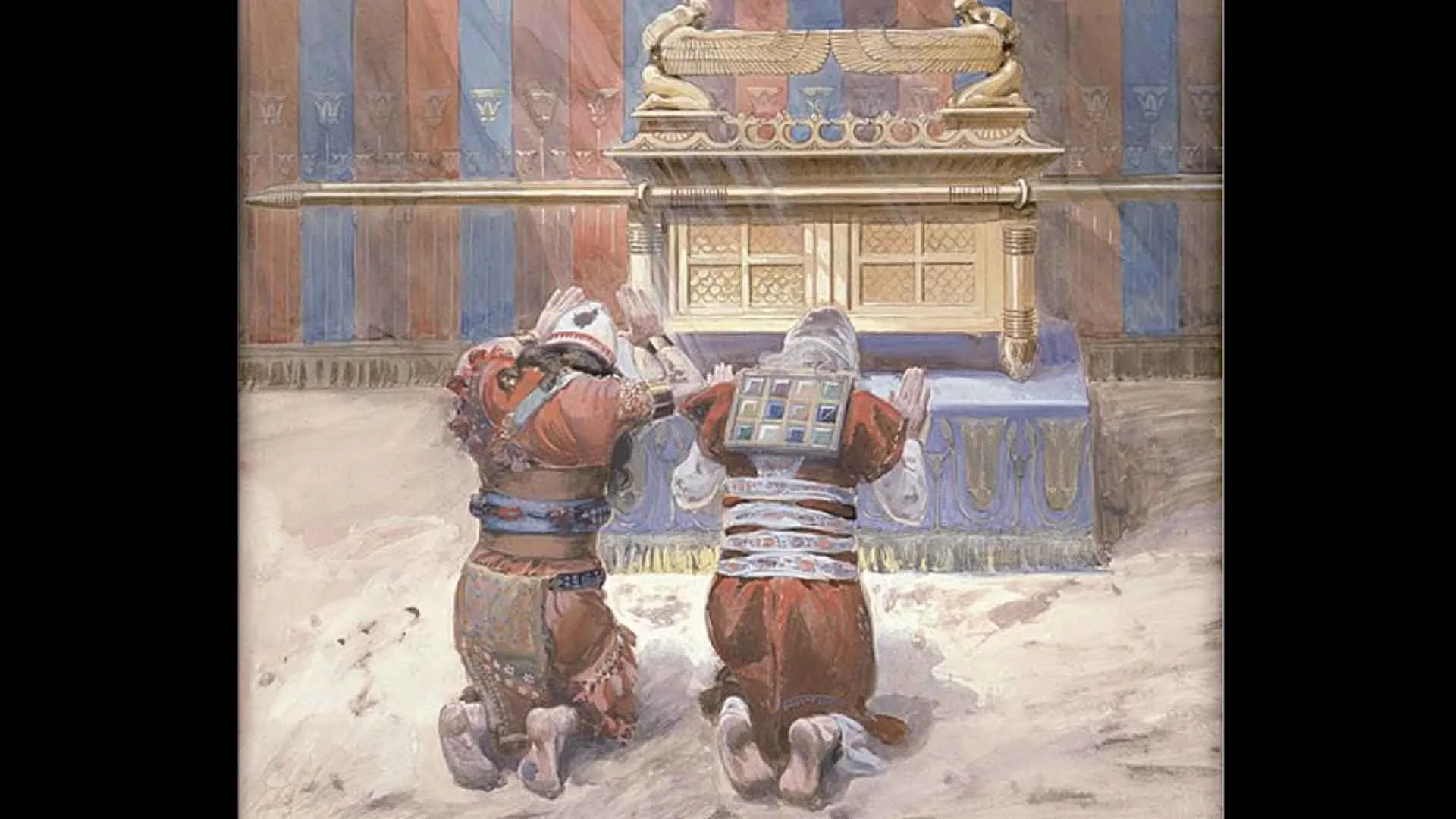
Moses and Joshua in the Tabernacle, James Tissot, 1896-1902

Bava Batra 98: וּפְנֵיהֶם אִישׁ אֶל אָחִיו

jyungar October 1, 2024

For the source text click/tap here: Bava Batra 98

To download, click/tap here: PDF

Rabbi Levi said, and some say it was Rabbi Yoḥanan who said: "This matter is a tradition handed down to us by our ancestors: The space occupied by the Ark of the Covenant and the cherubs is not included in the measurement of the Holy of Holies in which it rested, as miraculously it did not occupy any space at all. “

Rabbenai says that Shmuel says: The cherubs stood miraculously and did not occupy any physical space, as it is stated:

“And five cubits was one wing of the cherub, and five cubits was the second wing of the cherub; ten cubits from the tip of its wings until the tip of its wings” (I Kings 6:24).

We explore the subject of the Keruvim in ancient near east and by chazal.

Tags 55th
Comment

Bava Batra 97: כל הַמִּתְגָּאֶה בְּטַלִּית שֶׁל תַּלְמִיד חָכָם

jyungar September 30, 2024

For the source text click/tap here: Bava Batra 97

To download, click/tap here: PDF

“And moreover, wine is a treacherous dealer; the haughty man abides not” (Habakkuk 2:5),

which is interpreted to mean that the wine of a haughty man will betray him, as it will sour as a punishment for his arrogance. Accordingly, since the wine soured after the buyer purchased it, he cannot place the blame upon the seller.

Citing the same verse Rav Yehuda says that Rav says: With regard to anyone who glorifies himself by wearing a garment of the style worn by a Torah scholar, but in reality he is not a Torah scholar, he will not be brought within the boundary of the Holy One, Blessed be He, in the World-to-Come.

We examine the qualities of a Torah Scholar and humility citing Reb Aharon Lichtensteins’ essay on Daas Torah and comparing with Chaim Grade's portrayal of the Chazon Ish and finally Kafka’s The Trial (Mann com Lande as Am Haaretz).

Tags 55th
Comment

Bava Batra 96: מִי סָבְרַתְּ חַמְרָא הוּא

jyungar September 29, 2024

For the source text click/tap here: Bava Batra 96

To download, click/tap here: PDF

The Gemara explains that according to the Chachamim, when one mixes wine sediments with water and later finds that the amount of water in the container is the same as the original amount, the beverage is exempt from Ma'aser. Since the amount of water in the mixture remained the same, the mixture has the status of water, and there is no obligation to separate Ma'aser from water. Rebbi Yehudah disagrees and states that Ma'aser must be separated from the beverage.

We explore the halachos of wine vs grape joice for kiddush and the the rabbinic response to Prohibition.

Tags 55th
Comment

Residence Würzburg - Wine cellar

Bava Batra 95: מַרְתֵּף זֶה שֶׁל יַיִן

jyungar September 28, 2024

For the source text click/tap here: Bava Batra 95

To download, click/tap here: PDF

The mishna teaches: When purchasing a cellar containing barrels of wine, one accepts upon himself that up to ten barrels of souring wine may be present in each hundred barrels purchased.

If he said: I am selling to you this particular cellar, without mentioning the word: Wine, then even if everything he gives him is wine that had turned into vinegar, it has come to the buyer and the sale is valid.

The mishna’s ruling that the buyer must accept that up to ten percent of the wine might be souring does not accord with any of the rulings of the baraita.

We explore the history of wine cellars and the chemistry of wine turning to vinegar, finally. Pro Flusser’s analysis of the parable of new wine in old flasks (Luke).

Tags 55th
Comment

A Plate of Figs by Giovanna Garzoni

Bava Batra 94: מִי יֵימַר דְּלָאו כּוּלֵּיהּ עָרוֹבֵי עָרֵיב

jyungar September 27, 2024

For the source text click/tap here: Bava Batra 94

To download, click/tap here: PDF

A certain amount of dirt should be expected when one purchases produce. The Gemara outlines reasonable amounts of dirt that might be found surrounding different types of produce. But perhaps the dirt is not there incidentally; perhaps the seller placed more than the expected amount of dirt to the container of produce assuming that the buyer would not notice the difference and thus pay more money for less produce.

On our daf, the Gemara brings Rav Huna’s teaching that a buyer can sift the grain that was purchased, and if he finds that there is more than a quarter kav of waste he can demand that the seller replace the entire amount that he had agreed to sell, not only the three-quarters that was to be expected.

We explore the work of Prof. Daniel Boyarin whose influence in the cultural history of rabbinic Judaism and its self definition is now coming under scrutiny.

Tags 55th
Comment

Bava Batra 93: כֵּיוָן דְּמִיעְקָר עָקְרִי לְהוּ

jyungar September 26, 2024

For the source text click/tap here: Bava Batra 93

To download, click/tap here: PDF

What level of responsibility does a supplier have if his failure to supply the item that was ordered leads to other losses or difficulties?

In all of these cases the Tanna Kamma rules that the craftsman who is paid for his work is held responsible to make up the loss.

A buyer is not reimbursed for his money or efforts to plant defective seeds. This is true only in a case where it is readily apparent that the seeds were defective.

We explore food contamination and the ugly facts regarding the kashrut industry.

Tags 54th
Comment

Bava Batra 92: רוֹב הַנִּישָּׂאוֹת בְּתוּלוֹת יֵשׁ לָהֶן קוֹל

jyungar September 25, 2024

For the source text click/tap here: Bava Batra 92

To download, click/tap here: PDF

The sixth chapter opens with a discussion of a sale in which the merchandise does not fulfill the requirements of the buyer. In some cases, a defect in the merchandise entirely nullifies the sale as a mistaken transaction.

In other cases, the defect is considered so common that the buyer should have specified if he did not want it. Similarly, if the merchandise is suitable for several purposes, it may be the responsibility of the buyer to specify the purpose for which he is purchasing the merchandise.

We explore the notion of warranties and Irwin Haut’s analysis of Unjust enrichment.

Tags 54th
Comment

Ruth And Boaz, Gerbrand van den Eeckhout

Bava Batra 91: וַאֲכַלְתֶּם מִן הַתְּבוּאָה יָשָׁן

jyungar September 24, 2024

For the source text click/tap here: Bava Batra 91

To download, click/tap here: PDF

Our daf quotes a baraita that teaches that a person can only leave Israel if basic foods double in price. Rabbi Shimon bar Yoḥai teaches that this is only true if he cannot afford to purchase food at that price, but if he can afford the inflated prices, then he should not leave Israel. In a similar vein, Rabbi Shimon interpreted the story in Megillat Rut as teaching this lesson.

According to Rabbi Shimon, Elimelekh, Maḥlon and Khilyon – the father and two sons who left Israel in a time of famine – were among the leaders of their generation. Their punishment and death is attributed to their decision to abandon Israel during a difficult time.

We explore the book of Ruth and the genealogy of King David from Moabite roots.

Tags 54th
Comment
  • Daf Ditty
  • Older
  • Newer

Julian Ungar-Sargon

This is Julian Ungar-Sargon's personal website. It contains poems, essays, and podcasts for the spiritual seeker and interdisciplinary aficionado.​