Julian Ungar-Sargon

  • Home
  • Theological Essays
  • Healing Essays
  • Podcast
  • Poetry
  • Daf Ditty
  • Deep Dive Ditty
  • Videos
  • Publications
  • Military Service
  • Dominican University
  • Home
  • Theological Essays
  • Healing Essays
  • Podcast
  • Poetry
  • Daf Ditty
  • Deep Dive Ditty
  • Videos
  • Publications
  • Military Service
  • Dominican University
Julian Ungar-Sargon copy 3.jpg

Daf Ditty

A wide-ranging commentary on the daily page of Talmud.

Pesachim 32: Rav Kook’s “Kemach”

jyungar December 23, 2020

For the source text click/tap here: Pesachim 32

To download, click/tap here: PDF

The Mishna (31b) teaches that if the teruma was hametz (i.e. it had been baked into bread), and it was accidentally eaten on Pesaḥ, the person who ate it needs to pay its value together with the penalty – even though hametz on Pesaḥ is ordinarily considered to have no value.

Steinzaltz (OBM) writes that our daf’s argument between Abba Shaul and the chachamim can be explained by a Yerushalmi where the Tanna Kamma understands giving the “holy thing” to the kohen as commanding that a minimum amount (a ka-zayit) must be given to the kohen; only then will the penalty be in place. Abba Shaul understands that the “holy thing” given is the penalty for misusing the teruma itself.

Bezalel Naor, my friend has made significant contributions to the scholarship of Hassidut, and the brilliant insight Rav Kook brought to explain our sugya from the Yerushalmi (cited by Steinzaltz (OBM) above, led us to discuss a recent publication...Pinkesei haRa’ayah.
Tags 8th
Comment

Pesachim 31: The Darker Side of Moneylending

jyungar December 22, 2020

For the source text click/tap here: Pesachim 31

To download, click/tap here: PDF

A Jew borrowed money from a non-Jew, and left some chametz (think whiskey or vodka) in the non-Jew’s house as a collateral. If after Passover the Jew defaults on the loan, the non-Jew remains in the possession of the chametz as a repayment. We therefore can say that the chametz was already in non-Jewish hand on Passover retroactively, and now it is not forbidden for use.

By contrast, if it was a non-Jew who borrowed the money and left his chametz in the Jewish house, then, if after Passover the non-Jew defaults on his loan, the chametz becomes Jewish retroactively, and is therefore forbidden for use, as chametz owned by a Jew on Passover.

This leads us to the notion of moneylending and the fraught relationship between the Jew and the Aristocracy of Europe in financing among other, things its wars.

Tags 8th
Comment

Pesachim 30: What’s a Ma’shehu Between Friends? Avogadro’s Limit

jyungar December 21, 2020

For the source text click/tap here: Pesachim 30

To download, click/tap here:  PDF

However, some things "never" become batel; they are assur even b'mashehu, that is, even in the smallest amount. The classic example of this is chametz which is assur even in the minutest proportions.

THIS REMINDS ME OF HOMEOPATHY! AND AVOGADRO'S LIMIT...

AND JOBI'MS "THE WATERS OF MARCH"

Tags 8th
Comment

A mosaic of Hercules with pet Cerberus. (snarl)

Pesachim 29: It’s a Dog’s Life

jyungar December 20, 2020

For the source text click/tap here: Pesachim 29

To download, click/tap here: PDF

Tags 8th
Comment

Used to punish people for crimes such as swearing or drunkenness. Criminals would sit or stand at a wooden frame and the local people would throw rotten

food or even stones at them. The stocks and pillory were used as a punishment throughout the 16th and 17th centuries. Their use declined in the 18th century. It is thought that the

last time the stocks were used in the UK was in 1872 in Newcastle Emlyn.

Pesachim 28: Stocks and Pillories

jyungar December 19, 2020

For the source text click/tap here: Pesachim 28

To download, click/tap here: PDF

Tags 8th
Comment

Pesachim 27: Netziv on Symbolism of Matza

jyungar December 18, 2020

For the source text click/tap here: Pesachim 27

To download, click/tap here: PDF

The Netziv turns our notion of chametz/matza on its head

What is the symbolism that leaven and unleaven represent in the Temple?

Leaven represents fulfillment, a process which has gone its due course. The ultimate and supreme form of flour and water is a leavened loaf.

Unleaven, on the other hand, is "not yet" what it aspires to be; it figuratively represents the beginning of a yet-unfulfilled process. It is presently immature and unripe. It is in the early stages of a journey.

Tags 8th
Comment

Pesachim 26: Benefit From A Prohibited Item Without Intent

jyungar December 17, 2020

For the source text click/tap here: Pesachim 26

To download, click/tap here: PDF

Consider a case where one is planning to do something permitted, but in the course of it an additional forbidden pleasure comes his way. For example, he plans to travel to a certain destination, but on his way there is an idolatrous temple, from which there comes a fragrant smell of idolatrous spices. Should one avoid this nevertheless?

Tags 8th
Comment

Pesachim 25: Mai Chazit - Whose Blood Is Redder?

jyungar December 16, 2020

For the source text click/tap here: Pesachim 25

To download, click/tap here: PDF

Not only is it forbidden to eat hametz during Pesah, deriving other benefit from it is prohibited as well. In order to develop a deeper understanding of the relationship between eating and deriving benefit from forbidden foods, the Gemara compares hametz to other things forbidden by the Torah, including basar be-halav (meat and milk) and kilei ha-kerem (wheat grown in a vineyard).

One point the Gemara makes very clearly is that in a case of piku’ah nefesh – of danger to human life – we dispense with all of these rules.

Similar to the sugya in Sanhedrin 74, the logic of "whose blood is redder" is examined including the famous diyuk of Reb Chaim of Brisk

Tags 8th
Comment

Pesachim 24: איסור הנאה and Pharmaceuticals

jyungar December 15, 2020

For the source text click/tap here: Pesachim 24

To download, click/tap here: PDF

Tags 8th
Comment

Pesachim 23: Lifnei Iver and Conflicts of Interest

jyungar December 14, 2020

For the source text click/tap here: Pesachim 23

To download, click/tap here: PDF

Governments, international agencies and health systems have an obligation to ensure, to the best of their ability, adequate provision of health care for all.

However, this may not be possible during a pandemic, when health resources are likely to be limited.

Our daf discusses the halacha of “Lifne Iver” prompting a review of talmudic ethics in various modern scenarios ending with COVID vaccination distribution.

Tags 7th
Comment

Pesachim 22: Until Rabbi Akiva Came

jyungar December 13, 2020

For the source text click/tap here: Pesachim 22

To download, click/tap here: PDF

Tags 7th
Comment

Pesachim 21: Benefit from Chametz

jyungar December 12, 2020

For the source text click/tap here: Pesachim 21

To download, click/tap here: PDF

Upon attaining freedom from the physical slavery of Egypt, we rejected the “fleshpots of Egypt” (Shemot 16:3). We rejected the emphasis on physicality, and embrace, as servants of the Lord, a life of simplicity.

Our lives were now “theocentric;” God is at the center, and not our own will and desires. We eat, therefore, not chametz, but matza, “lechem oni,” the simple, poor-man’s bread.

The whole halachic construction and laws and details and minhagim is based on this.

Tags 7th
Comment

Pesachim 20: Accommodations for the Love of the Divine

jyungar December 11, 2020

For the source text click/tap here: Pesachim 20

To download, click/tap here: PDF

Chibat hakodesh is the dispensation with the usual laws of imparting Tum’ah due to the heightened awareness/love for the Mikdash/ Divine which leads us to contemplate the concessions of Divine love comparing Rumi with the Baal Shem Tov.

Tags 7th
Comment

Through the Needle's Eye the Rich Man Came, Grace Carol Bomer (Canadian American, 1948–)

Pesachim 19: Needle in the Flesh, Heart’s Needle

jyungar December 10, 2020

For the source text click/tap here: Pesachim 19

To download, click/tap here:  PDF

Our Daf discusses a needle that was found in sacrificial meat, with the result that the meat is impure, but the hands and the knife are pure. How could that be? This leads us to the poem "Heart's Needle" by pulitzer prize poet W.D Snodgrass and his struggle to remain a father to his daughter...

Tags 7th
Comment

Pesachim 18: Tum’ah, Solids vs Liquids

jyungar December 9, 2020

For the source text click/tap here: Pesachim 18

To download, click/tap here:  PDF

A discussion regarding "Bo Bayom” that fateful day when they appointed Rabbi Elazar ben Azaria, Rabbi Akiva taught: “And every earthenware vessel into which any of them falls, whatever is in it shall be impure [yitma], and you shall break it” (Vayikra 11:33)., the daf discusses differences between liquid and solid states in imparting Tum’ah, which leads us to a review of the mechanics differences in states of matter ….and those of the heart too!

Tags 7th
Comment

Russian icon of Haggai, 18th century (Iconostasis of Kizhi monastery, Karelia, Russia).

Pesachim 17: Haggai and Chanukah

jyungar December 8, 2020

For the source text click/tap here: Pesachim 17

To download, click/tap here: PDF

An esoteric discussion of the kinds of liquids producing tum’ah leads to a citation from Haggai interrogating the priests, which informs Rav Yoel Bin Nun on a wonderful historical review of Chanukah.

Though the sacrifices might be technically pure, sinful acts are equivalent to offering impure sacrifices. Haggai emphasizes that such sacrifices were harmful to the relationship between the Jewish people and God.

Tags 7th
Comment

This crown was engraved with the words "Holy to HaShem." At times, these words were written across two lines, and at times they were fit into one line.

Pesachim 16: “Dust of their Feet”

jyungar December 7, 2020

For the source text click/tap here: Pesachim 16

To download, click/tap here: PDF

The notion that the Kohen Gaold’s Tzitz can expiate certain infractions of tum’aah leads us to the biography of the controversial figure and martyrdom of Yossi ben Yo’ezer

Tags 7th
Comment

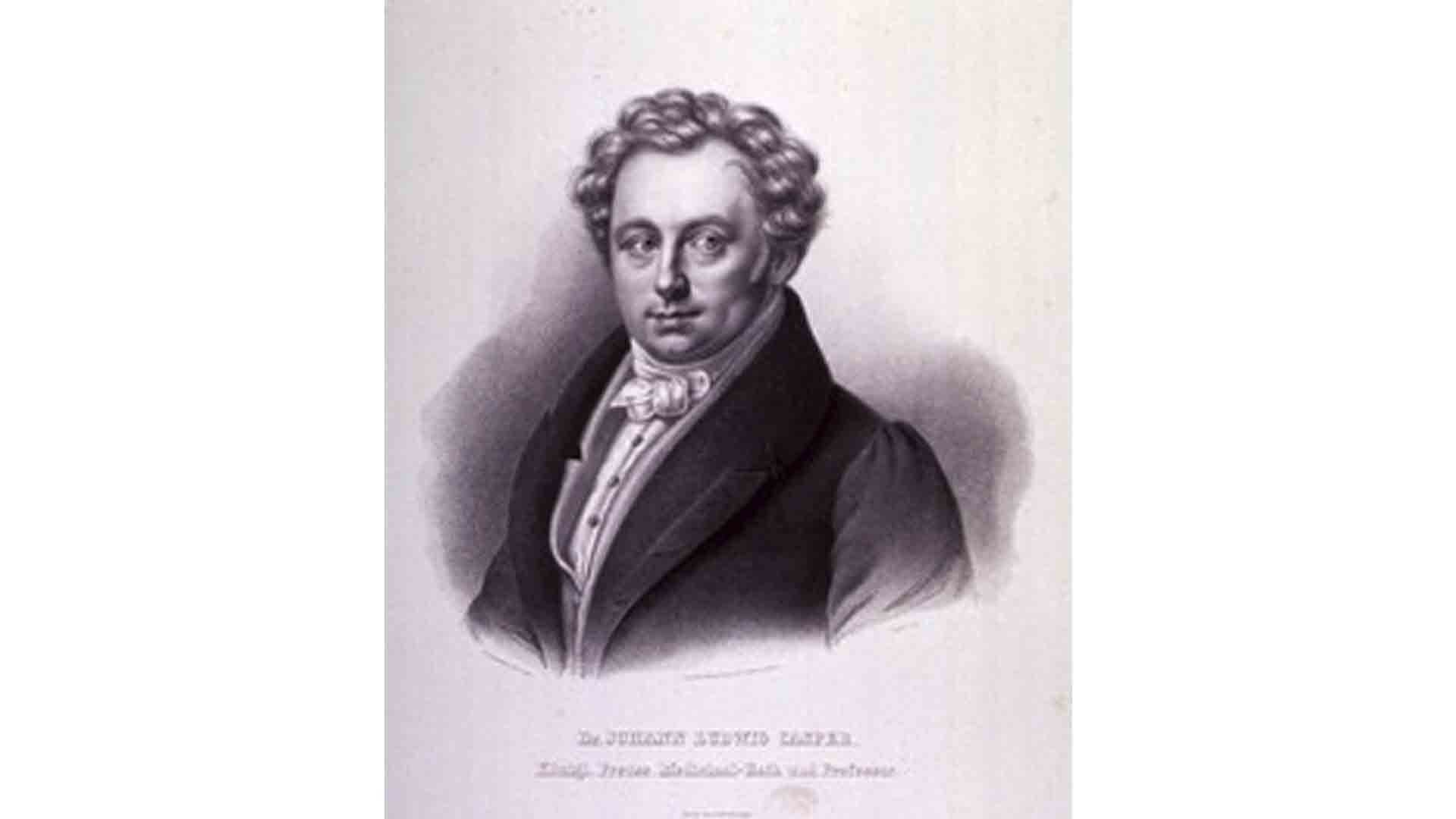
Johann Ludwig Casper by H. Löwenstein, 1832.

Pesachim 15: “A Sword is like a Corpse”

jyungar December 6, 2020

For the source text click/tap here: Pesachim 15

To download, click/tap here:  PDF

Even though I am not a kohen I felt a profound inner revulsion in disturbing the sanctity of the human body when I arrived in medical school in 1969. The dissection lab was divided into groups of 8 medical student with 4 on each side of the corpse for dissection.

Clearly one had to pass this rite of passage (and pass the anatomy examinations) in order to proceed to clinical medicine.

I approached my anatomy instructor, a religious Christian who came down from Cambridge to tutor us, and expressed my concerns.

He fully understood and allowed me to observe the entire 18 months without ever touching the corpse. I felt the divine hand present in this moment.

Tags 7th
Comment

People scrambling to get away from a leper, in their haste the crowd has left an infant on the roadside, the leper strolls by, ringing a bell; representing attitudes to leprosy. R. Cooper. (1885-1957)

Pesachim 14: Tuma as Contagion

jyungar December 5, 2020

For the source text click/tap here: Pesachim 14

To download, click/tap here:  PDF

Even though I am not a kohen I felt a profound inner revulsion in disturbing the sanctity of the human body when I arrived in medical school in 1969. The dissection lab was divided into groups of 8 medical student with 4 on each side of the corpse for dissection.

Clearly one had to pass this rite of passage (and pass the anatomy examinations) in order to proceed to clinical medicine.

I approached my anatomy instructor, a religious Christian who came down from Cambridge to tutor us, and expressed my concerns.

He fully understood and allowed me to observe the entire 18 months without ever touching the corpse. I felt the divine hand present in this moment.

Tags 7th
Comment

Pesachim 13: Elijah Not Welcome Erev Shabbes

jyungar December 4, 2020

For the source text click/tap here: Pesachim 13

To download, click/tap here:  PDF

Perhaps Elijah the Prophet will come on Shabbat and establish prophetically that the teruma is not ritually impure…

But no worry: Our daf speaks of Elijah being unable to arrive on Erev Shabbes or Yom Tov:

I was thinking about Elijah and being welcome after Shabbat in havdala and during the Seder night…and the poem by Yala Korwin: we didn’t dare to sing and open the door for Elijah

How do we relate to Elijah now?

Tags 7th
Comment
  • Daf Ditty
  • Older
  • Newer

Julian Ungar-Sargon

This is Julian Ungar-Sargon's personal website. It contains poems, essays, and podcasts for the spiritual seeker and interdisciplinary aficionado.​