
For the source text click/tap here: Pesachim 22
To download, click/tap here: PDF
Daf Ditty
A wide-ranging commentary on the daily page of Talmud.

For the source text click/tap here: Pesachim 22
To download, click/tap here: PDF

Upon attaining freedom from the physical slavery of Egypt, we rejected the “fleshpots of Egypt” (Shemot 16:3). We rejected the emphasis on physicality, and embrace, as servants of the Lord, a life of simplicity.
Our lives were now “theocentric;” God is at the center, and not our own will and desires. We eat, therefore, not chametz, but matza, “lechem oni,” the simple, poor-man’s bread.
The whole halachic construction and laws and details and minhagim is based on this.

Chibat hakodesh is the dispensation with the usual laws of imparting Tum’ah due to the heightened awareness/love for the Mikdash/ Divine which leads us to contemplate the concessions of Divine love comparing Rumi with the Baal Shem Tov.

Through the Needle's Eye the Rich Man Came, Grace Carol Bomer (Canadian American, 1948–)
Our Daf discusses a needle that was found in sacrificial meat, with the result that the meat is impure, but the hands and the knife are pure. How could that be? This leads us to the poem "Heart's Needle" by pulitzer prize poet W.D Snodgrass and his struggle to remain a father to his daughter...

A discussion regarding "Bo Bayom” that fateful day when they appointed Rabbi Elazar ben Azaria, Rabbi Akiva taught: “And every earthenware vessel into which any of them falls, whatever is in it shall be impure [yitma], and you shall break it” (Vayikra 11:33)., the daf discusses differences between liquid and solid states in imparting Tum’ah, which leads us to a review of the mechanics differences in states of matter ….and those of the heart too!

Russian icon of Haggai, 18th century (Iconostasis of Kizhi monastery, Karelia, Russia).
An esoteric discussion of the kinds of liquids producing tum’ah leads to a citation from Haggai interrogating the priests, which informs Rav Yoel Bin Nun on a wonderful historical review of Chanukah.
Though the sacrifices might be technically pure, sinful acts are equivalent to offering impure sacrifices. Haggai emphasizes that such sacrifices were harmful to the relationship between the Jewish people and God.

This crown was engraved with the words "Holy to HaShem." At times, these words were written across two lines, and at times they were fit into one line.
The notion that the Kohen Gaold’s Tzitz can expiate certain infractions of tum’aah leads us to the biography of the controversial figure and martyrdom of Yossi ben Yo’ezer
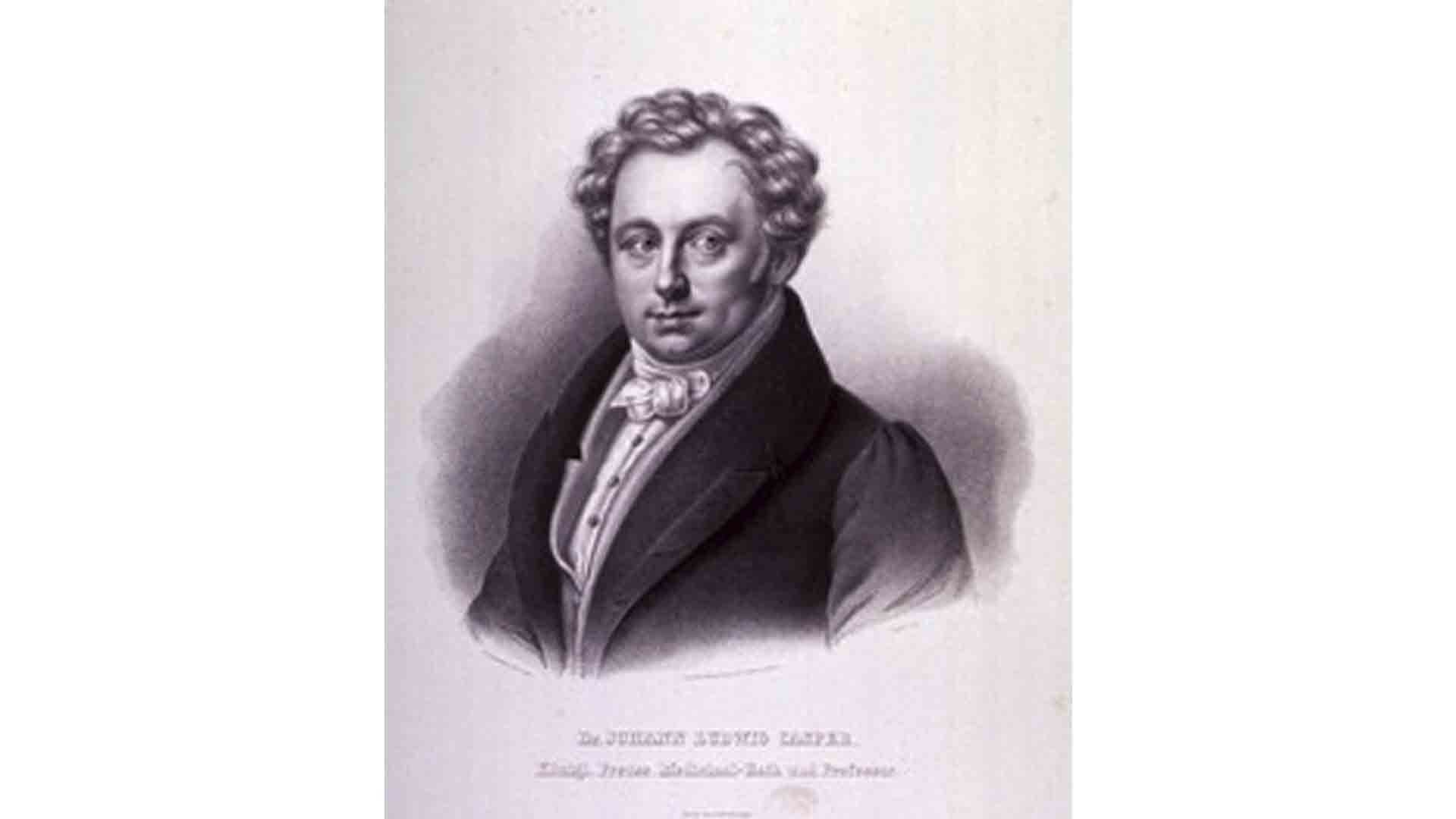
Johann Ludwig Casper by H. Löwenstein, 1832.
Even though I am not a kohen I felt a profound inner revulsion in disturbing the sanctity of the human body when I arrived in medical school in 1969. The dissection lab was divided into groups of 8 medical student with 4 on each side of the corpse for dissection.
Clearly one had to pass this rite of passage (and pass the anatomy examinations) in order to proceed to clinical medicine.
I approached my anatomy instructor, a religious Christian who came down from Cambridge to tutor us, and expressed my concerns.
He fully understood and allowed me to observe the entire 18 months without ever touching the corpse. I felt the divine hand present in this moment.

People scrambling to get away from a leper, in their haste the crowd has left an infant on the roadside, the leper strolls by, ringing a bell; representing attitudes to leprosy. R. Cooper. (1885-1957)
Even though I am not a kohen I felt a profound inner revulsion in disturbing the sanctity of the human body when I arrived in medical school in 1969. The dissection lab was divided into groups of 8 medical student with 4 on each side of the corpse for dissection.
Clearly one had to pass this rite of passage (and pass the anatomy examinations) in order to proceed to clinical medicine.
I approached my anatomy instructor, a religious Christian who came down from Cambridge to tutor us, and expressed my concerns.
He fully understood and allowed me to observe the entire 18 months without ever touching the corpse. I felt the divine hand present in this moment.

Perhaps Elijah the Prophet will come on Shabbat and establish prophetically that the teruma is not ritually impure…
But no worry: Our daf speaks of Elijah being unable to arrive on Erev Shabbes or Yom Tov:
I was thinking about Elijah and being welcome after Shabbat in havdala and during the Seder night…and the poem by Yala Korwin: we didn’t dare to sing and open the door for Elijah
How do we relate to Elijah now?

This diagram illustrates the timeline of retrograde and anterograde amnesia. Memory problems that extend back in time before the injury and prevent retrieval of information previously stored in long-term memory are known as retrograde amnesia. Conversely, memory problems that extend forward in time from the point of injury and prevent the formation of new memories are called anterograde amnesia.
Only one who is expert in keeping time will come to testify regarding a capital case as he is aware that the court will interrogate him. Regarding chametz, however, although everyone must stop eating chametz at the end of the sixth hour, not everyone is an expert at determining the correct time.
This idea of testimony being more accurate leads us to examine memory and testimony and the neurology of recording time.

A difference between a permanent knot and an a slipknot (aniva) leads us to a review of probability theory to explain The difference of halachic opinion regarding tying or untying knots on Shabbat

The Gemara differentiates between the Chulda (marten) on Daf 9 and the Achbar the common mouse whose genetics elsewhere (chullin/Sanhedrin) is described as half animal half earth on our daf. This mud mouse could not procreate and has been described by others in antiquity including Aristotle, Ovid and Averroes.

When imagining the ancient rabbis discussing issues of profound religious importance, we may be inclined to imagine them to be solemn or somber, especially while debating the one of the most severe biblical commandments: to eliminate leavened food from our households on Passover. Rava’s word play and humor remind us that while studying Torah is a serious endeavor, it’s also fun — and sometimes it’s even sarcastic!

In our Daf we explore the concept of envoys in pursuit of a Mitzvah are not harmed:

And how far does this extend in light of the recent Halachick discussion about yeshiva students during the pandemic and yesterday’s Supreme Court ruling on prayer and uses of worship during the pandemic.

The Arizal himself had a custom to scatter ten pieces of bread before his search. Some poskim explain that the reason for this practice is so that some ĥametz will remain after the search, and thus one will not forget to nullify his ĥametz. [1]
I have suggested that the 10 pieces of bread represent the 10 dark sides of the sefirot that are hidden behind our facades of light. “there is no light without darkness” the Zohar tells us. Since leaven represents the “ferment of base desires” the search for these 10 crumbs dramatizes the need to look in the hidden places of our inner psychic homes to expose by the candle/light of the soul, before the drama of the Seder and the deliverance.

And he searched, beginning with the oldest, [so that they not suspect him of knowing where it was], and finishing with the youngest, and the goblet was found in Benjamin's sack.
Gen 44:12

He replied “we have here brothers who sold their own brother” meaning “who are you to talk about thievery!
For the Zohar and the ARI z’l, the betrayal and sale of Joseph becomes a recurring theme throughout Jewish history and the cause of the (protracted) exile.
I think the use of this prooftext about Benjamin reflects the deeper notion that each Pesach we search for the 10 crumbs, we search for the “ferment of base desires” the leavening of ego and self promotion, in fact we are searching for the soul of the brothers, to fix the ongoing betrayal of self and others in the pursuit of ego and its desires.


Our Daf relates the reward of firsts including being told the name of Moshiach (Menachem)
This propelled a historical review of Napoleon’s messianic ambition and the response of the Rebbes
(split) through hagiographical stories. Recent scholars and the fall of the Soviet Union has opened archives which
challenge the century old assumptions about that fateful Rosh Hashonoh 1812


Rebecca Meets Isaac by the Way, James Tissot (c. 1896–1902)