
For the source text click/tap here: Bechorot 34
To download, click/tap here: PDF
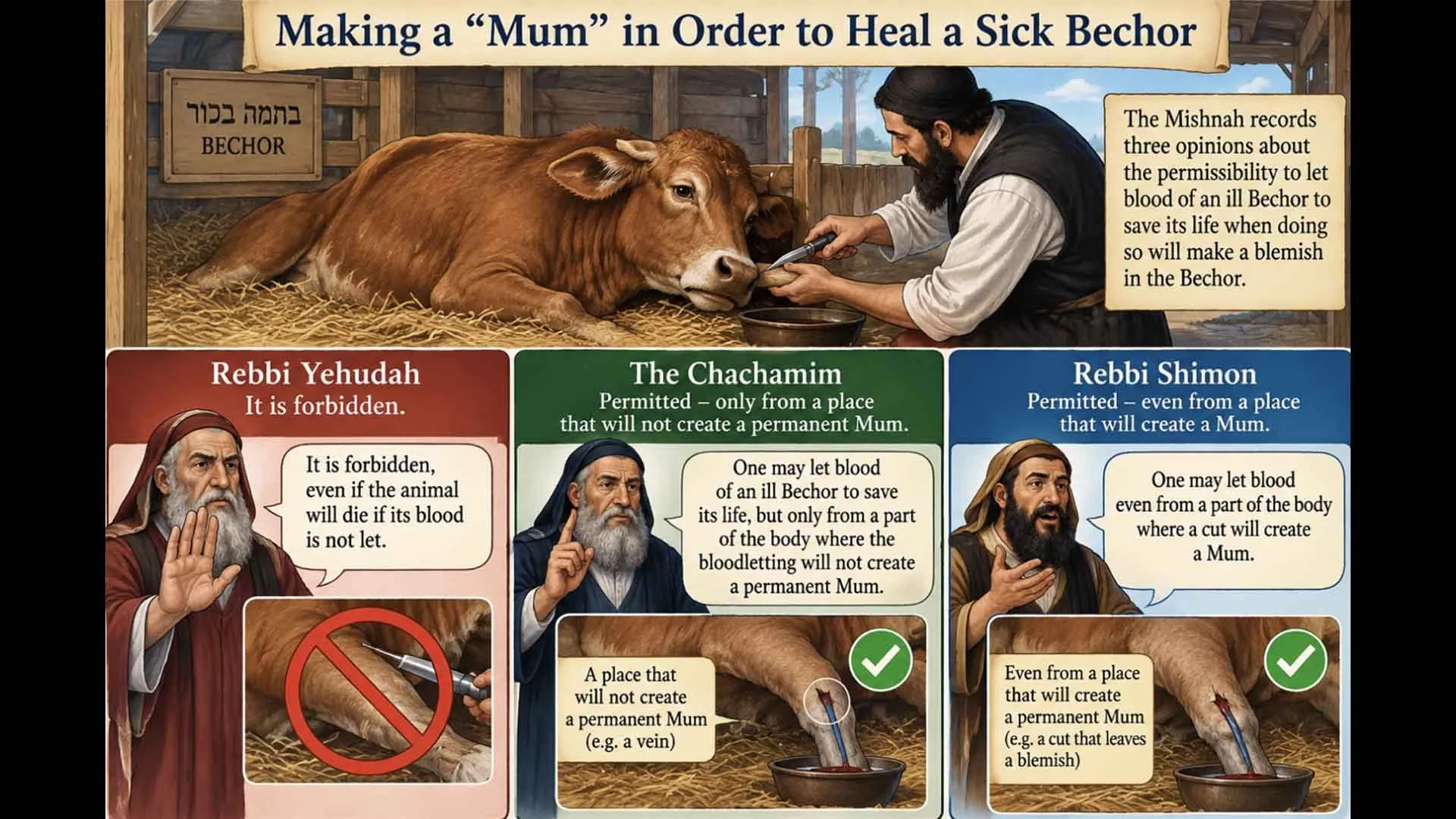
As we have learned, a firstborn kosher animal must be given to a kohen and brought as a sacrifice in the Temple. If the animal develops a mum – a blemish that precludes it from being sacrificed – the animal becomes the property of the kohen who can slaughter it and eat it. The Mishna on our daf teaches that someone who deliberately causes a mum is not permitted to take advantage of the new status of the animal to make use of it. According to the Mishna, “if one makes a slit in the ear of a firstborn animal, he must never slaughter it. These are the words of Rabbi Eliezer. Whereas the Sages say: he may slaughter it on account of another blemish, when it appears on it.”
The Talmudic discussion on our daf concerning the deliberate creation of a physical blemish (mum) in a sick firstborn animal (bekhor) presents a remarkable intersection of sacrificial law, therapeutic intervention, and ethical obligation. The central problem is whether one may intentionally perform a medical procedure that risks destroying the animal's ritual fitness, particularly when withholding treatment might lead to its death.
We argue that the sugya offers a sophisticated model of morally differentiated intervention: an act cannot be judged solely by its physical consequences but must also be evaluated according to its therapeutic purpose, the prior condition of the subject, the likelihood of harm, and the availability of alternatives. Although the law of the firstborn animal cannot be transferred directly to human clinical medicine, its internal reasoning illuminates important questions concerning surgical injury, medical necessity, the distinction between saving life and relieving suffering, and the relationship between religious obligation and professional beneficence. The essay situates the sugya alongside medieval halakhic interpretations and contemporary biomedical ethics, arguing that the concept of a therapeutic blemish represents a productive framework for understanding why medically necessary tissue destruction may constitute healing rather than prohibited injury.