
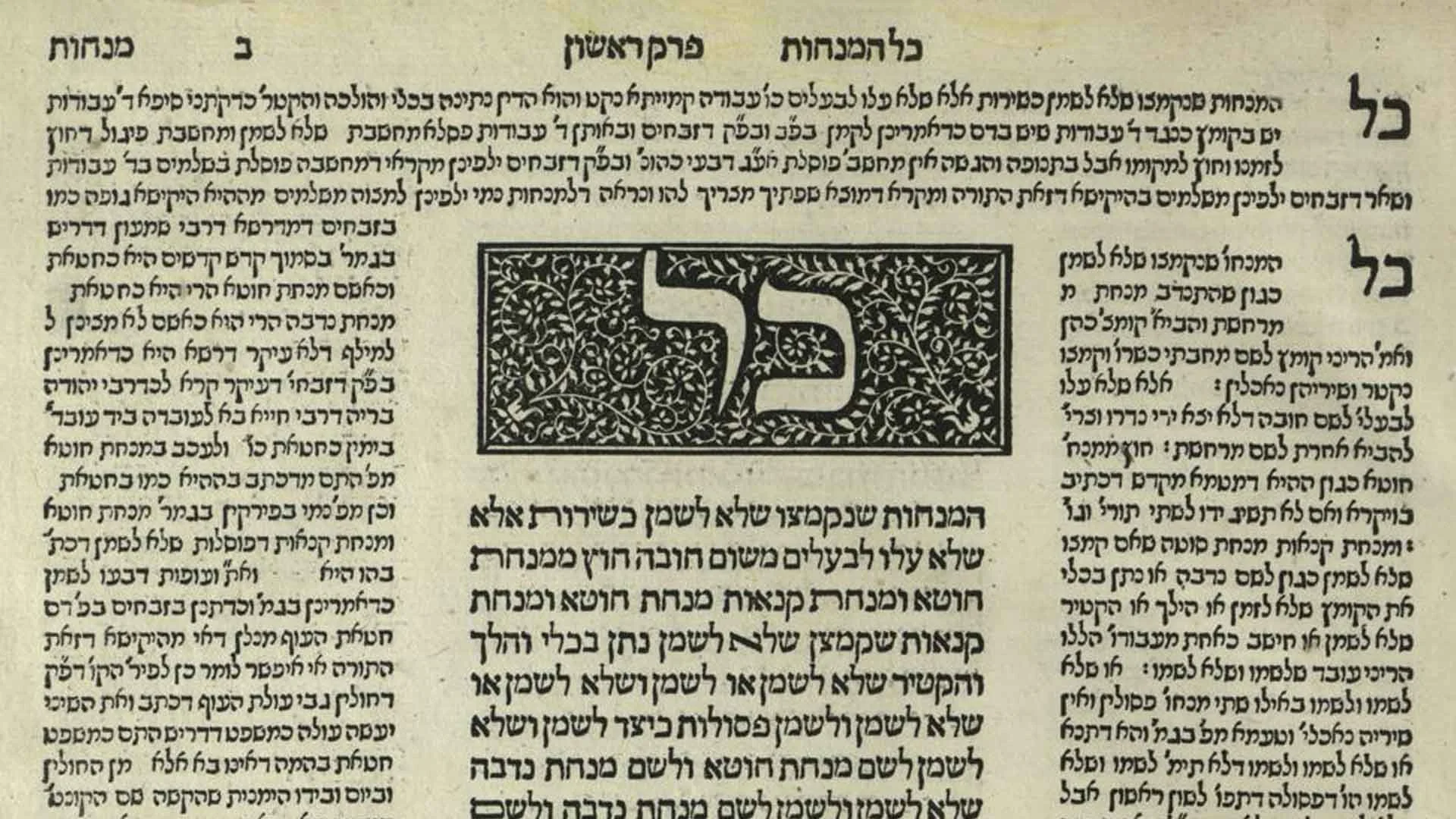
For the source text click/tap here: Menachot 2
To download, click/tap here: PDF
Massekhet Menaḥot and Massekhet Zevaḥim should be viewed as “sister tractates.” Both of them focus on the rules and regulations associated with the sacrificial service, although Massekhet Zevaḥim deals with sacrifices brought from living creatures that are slaughtered (animals and fowl), while Massekhet Menaḥot is about sacrifices that originate in the plant world – menaḥot – meal offerings brought from grains (wheat and barley) and libations of wine and oil.
Just as is the case regarding animal sacrifices, we find a variety of different sacrifices in the general category of menaḥot. There are those that are voluntary, those that are obligatory and those that come to effect atonement for sin; there are those brought by individuals and those brought on behalf of the community. Another parallel to animal sacrifice is the fact that while some parts are burned on the altar, other parts are given to the kohanim to eat. Nevertheless, there are differences, as well. For example, all menaḥot are considered kodashei kodashim – the highest level of holiness and they can only be eaten by male kohanim in the Temple courtyard.
The sacrificial service that we find for the minḥa is similar to that of an animal sacrifice. After preparing the meal-offering the kohen takes a kometz – a fistful – from the mixture, places it in one of the Temple vessels to sanctify it, carries it to the altar and burns it on the altar. From that time the remnants are permitted to the kohanim to eat.