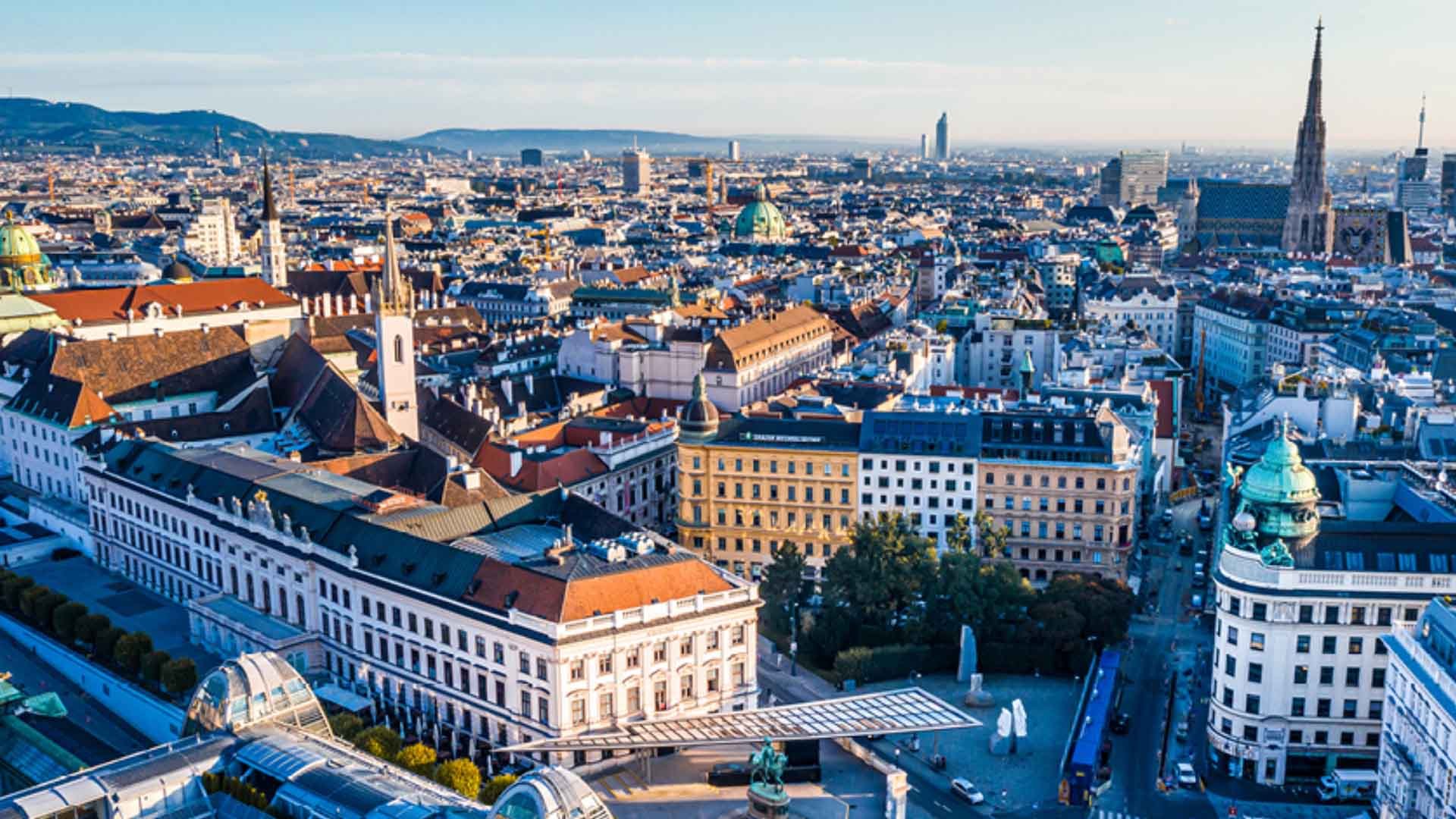
My father spoke of Vienna
city of his birth
as though civilization had an address.
Vienna—
city of civil servants and universities,
of professors, ministries, concert halls,
of art and Kultur,
of music disciplined into architecture,
of architecture disciplined into stone.
Here, he taught us,
was the cultivated world.
He carried that Vienna with him
long after Vienna had ceased
to carry him.
And so, when my sister and I were young,
he insisted that we learn the roots of Kultur:
music, history, painting, books—
the inheritance of Europe
presented to children,
an annual road trip from London
(In his Westminster overdrive(!))
as though beauty might make us safe.
I inherited his pilgrimage.
I took my own children through Europe—
Paris, Florence, Rome, Zurich,
the old squares and cathedrals,
palaces and monuments,
the inevitable bronze general
still mounted above the pigeons,
sword raised toward some forgotten victory.
And always -the Jewish quarter.
A synagogue.
A cemetery.
A plaque on a wall.
Here they lived.
Here they prayed.
Here they disappeared.
I walked those streets with interest,
sometimes sadness,
but mostly the composure of history.
Europe was Europe.
Its stones were old.
Its crimes were old.
Its dead were dead.
Until Vienna.
Here something changes.
Vienna is so clean.
So quiet.
So exquisitely polite.
The trams arrive.
The windows shine.
Young people fill the sidewalks,
drinking wine beneath awnings,
laughing over coffee and cake
Sacher torte
Apfel strudel
Kaiser schmarren
Even sweetness here
has been perfected.
And the memorials are perfect too.
The Jewish sites are marked,
preserved,
manicured.
My grandfather’s name carefully engraved.
Cemetery granite gravestones carefully restored.
Flowers placed where flowers belong.
Everything is civilized.
And yet—
I cannot escape the word:
betrayal.
Not hatred.
Betrayal.
Because hatred would have been easier.
Had Vienna been barbarous,
had it been crude and filthy,
a city of mobs and drunken peasants,
perhaps history could be filed away
under savagery.
But this was the city of Kultur.
The city that knew Mozart.
The city that knew Beethoven,
Mahler, Freud.
The city of universities,
physicians, jurists,
prided civil servants who knew precisely
which form belonged in which file.
A city that understood
the proper fork for dessert
and the proper key for a symphony.
And still—
my father's world vanished.
That is the betrayal.
Not that civilization failed to prevent barbarism.
That civilization itself
opened the door.
Perhaps that is why
the other cities never wounded me this way.
I could walk their Jewish quarters
and remain a visitor.
In Vienna
I am not visiting history.
I am walking through
my father's sentences.
A street name suddenly familiar-Marchettigasse 1, apt 10
A district der zweite bezirk, der sechste bezirk
A synagogue-der Schiffschul der Stumper gasse schul
A cemetery- zentral friedhof
Fragments of stories
I heard before I understood
that they were stories of exile.
And everywhere the unbearable beauty.
The Ringstrasse gleams.
Church bells sound on this quiet Sunday breeze
All else is quiet such perfection in the sun filled deck
A waiter places a coffee, mélange,
upon a silver tray.
Young men and women laugh
where other young men and women
once watched their neighbors disappear.
They did not do it, I tell myself.
Of course they did not.
They were not born.
The waiter was not born.
The lovers drinking beer
beneath the linden trees- graben
were not born.
I know this.
History demands such distinctions.
Justice demands them.
And still the body
does not practice historiography.
Something in me recoils.
From the elegance.
From the pastries.
From the gleaming polished stone.
From the astonishing good manners.
Even from the word Kultur
my father taught me to revere.
And then an ugly thought comes:
Have I committed
a reverse Rassenschande?
Have I allowed memory
to contaminate beauty?
Have I made Viennese-ness itself
unclean—
the coffee,
the music,
the language,
the architecture,
the young faces on the sidewalks—
as though guilt could pass
through generations
like blood?
No.
The word is wrong.
It belongs to them,
to the obscene fantasy
that blood can be pure
and human beings polluted.
I will not inherit
their categories.
But neither will I pretend
that beauty is innocent.
Perhaps what I feel
is something harder:
not racial shame,
but civilizational betrayal.
The knowledge that the highest culture
does not necessarily deepen the soul.
That one may adore Mozart
and despise one's neighbor.
That a university can illuminate the mind
without enlarging the heart.
That bureaucracy can serve civilization
in the morning
and catalogue its victims
in the afternoon.
That a city can be beautiful
and betray everything
its beauty seemed to promise.
My father knew that.
Perhaps that was why
he insisted we learn Kultur anyway.
Not because Vienna had proved
that culture saves us,
but because Vienna had proved
that it does not.
So, I walk.
Past the cafés.
Past the monuments.
Past the immaculate memorials.
I listen to the Oestereicher Deutsch (Wiener Dialekt) around me.
I hear my father's Vienna
beneath this Vienna—
the city he loved,
the city that formed him,
the city that expelled him,
the city he somehow
continued to carry inside him.
And now I carry it too.
Not hatred.
Not forgiveness.
Something more difficult.
I stand before this beautiful clean city
and refuse both
to desecrate its beauty
and to be consoled by it.
Vienna remains beautiful.
That is precisely the wound.
For the deepest betrayal
is not when darkness behaves like darkness.
It is when the lights are burning,
the orchestra is playing Mahler,
the bureaucracy is functioning,
the pastries are perfect,
and civilization,
dressed for the evening opera
betrays its children.