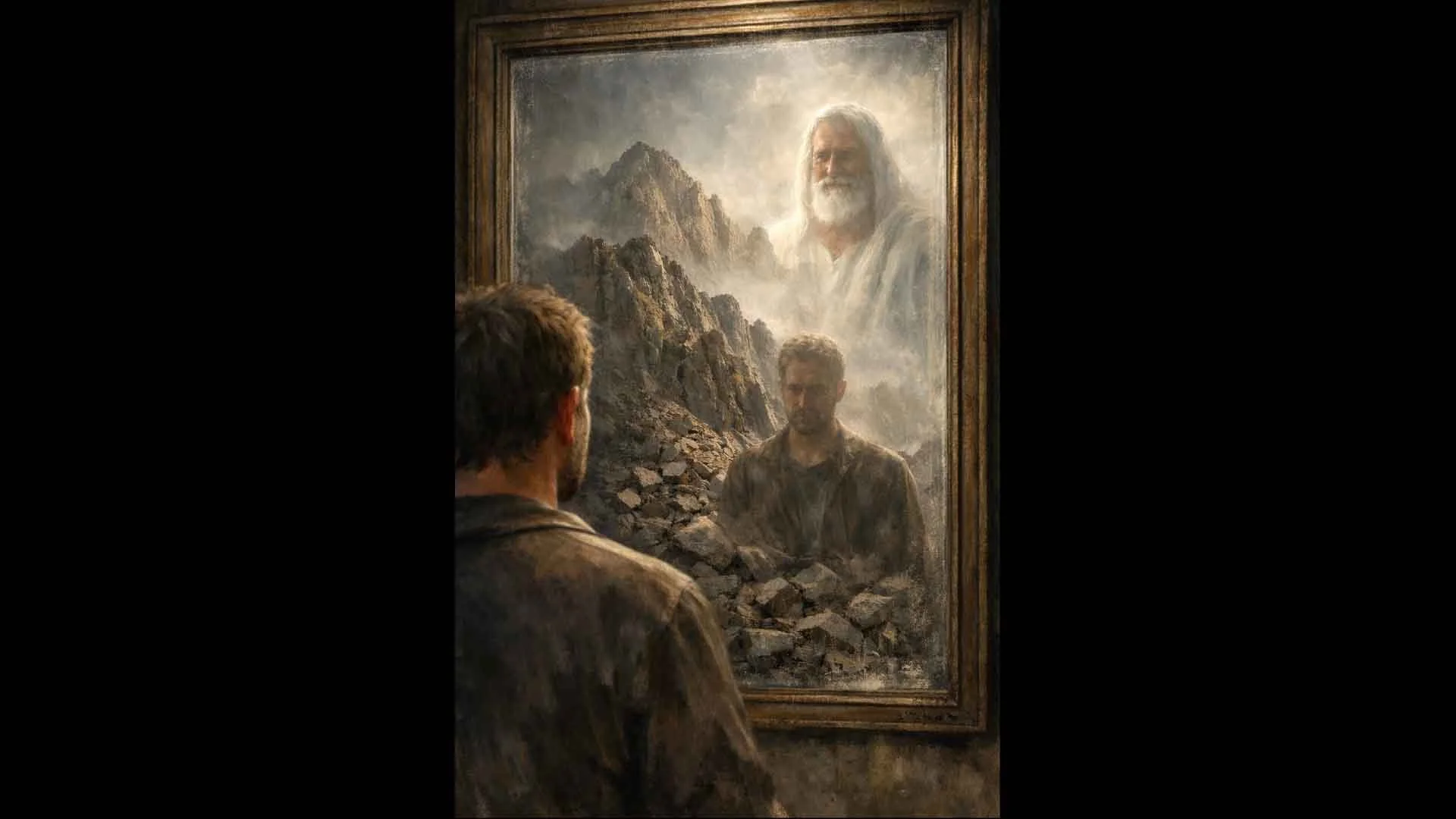
Each morning the mountain waits for me.
Not Sinai—
no thunder, no tablets—
just the accumulated shale of my habits,
the scree of old reflexes,
anger rehearsed until it knows my voice better than prayer,
fear that dresses itself as caution,
desire that insists it is hunger for the good.
I stand before the mirror
as before a range I did not choose
but have learned by heart.
Every ridge has my name on it.
Every shadow knows where I trip.
They taught me to call these defects,
as if they were errors in manufacture,
as if a better craftsman
would have filed me smoother.
But the mirror is honest, not cruel.
It does not accuse.
It only reflects the altitude.
What surprises me still
is not the sight of the mountain,
but the thought that Someone stands
on the other side of the glass,
seeing me see myself.
Not judging.
Not fixing.
Withholding.
A God who knows how to be absent
without abandoning.
Who practices a discipline I cannot:
self-restriction without resentment,
power folded back into patience,
permitting a world where my flaws are possible,
where my failures are not foreclosed by perfection.
I look at my defects
and feel the familiar tightening—
the old urge to conquer,
to dynamite the peaks,
to turn growth into violence.
And then, quieter, another thought:
What if the compassion I am learning
is first being shown to me?
What if this mountain exists
because He chose not to flatten it—
because freedom requires terrain,
because love does not erase difficulty
but makes room for it?
So I stand.
I do not climb today.
I do not repent theatrically.
I simply meet my own gaze
and allow myself to be seen—
flawed, unredeemed, still held.
If He can restrain Himself
enough to let me be unfinished,
perhaps I can restrain myself
enough to be gentle with the one
who wakes up here each morning,
staring at the mountain,
learning—slowly—
how to live in a world
that God Himself chose not to perfect.