Julian Ungar-Sargon

  • Home
  • Theological Essays
  • Healing Essays
  • Podcast
  • Poetry
  • Daf Ditty
  • Deep Dive Ditty
  • Videos
  • Publications
  • Military Service
  • Dominican University
  • Home
  • Theological Essays
  • Healing Essays
  • Podcast
  • Poetry
  • Daf Ditty
  • Deep Dive Ditty
  • Videos
  • Publications
  • Military Service
  • Dominican University
Julian Ungar-Sargon copy 3.jpg

Daf Ditty

A wide-ranging commentary on the daily page of Talmud.

Kiddushin 65: כּוֹפִין וּמְבַקְּשִׁין

jyungar October 17, 2023

For the source text click/tap here: Kiddushin 65

To download, click/tap here: PDF

The Mishna on our daf discusses cases where someone claims to have married another person and the alleged spouse denies that the marriage had taken place. In cases where it is one person’s word against the other, the ruling is that the person who claims that the marriage took place cannot marry any of the other person’s immediate relatives (e.g. their alleged brother-in-law or sister-in-law), while the person who denies that the marriage took place can marry anyone – including immediate relatives of the alleged spouse.

We further explore eidut le-kiyum ha-davar as well as the ethics of sexuality using Kant and Hermann Cohen as our guides.

Tags 42nd
Comment

Kidnapped German Shani Louk

Kiddushin 64: אֵין קִדּוּשִׁין תּוֹפְסִין בְּחַיָּיבֵי לָאוִין

jyungar October 16, 2023

For the source text click/tap here: Kiddushin 64

To download, click/tap here: PDF

Of great concern to the Torah is keeping up the honor and purity of the Jewish women.

Thus, in two places, the Torah lists forbidden sexual relationships (see Vayikra, Chapter 18 and Chapter 20:10-24), most of which are incestuous relationships. For these relationships, the punishment will be either karet (being “cut off” from the community, i.e. a symbolic death sentence) or mitat beit din (a capital offense).

Our daf presents the rejected position of Rabbi Akiva, who disagrees with Shimon ha-Temani and rules that any sexual relationship that is forbidden by the Torah – even a simple prohibition that will not carry with it the punishment of karet or mitat beit din – will preclude the possibility of marriage (i.e. not only is marriage forbidden.

We explore the exploitation of captive women in antiquity and in Devorim (Ki Setzei) informing us how to process the unspeakable horrors perpetrated last week in Israel.

Tags 42nd
Comment

Kiddushin 63: עַל מְנָת שֶׁיִּרְצֶה אַבָּא

jyungar October 15, 2023

For the source text click/tap here: Kiddushin 63

To download, click/tap here: PDF

If someone says to a woman, and says, “Become betrothed to me on condition that my father consents,” if the father agrees, the kiddushin is valid; otherwise, it is not. If the father died, she is mekudeshes. If the son died, we teach the father to say that he does not want (for this will retroactively uproot the kiddushin, and she will not fall for yibum).

We continue our exploration of conditional betrothals.

Tags 42nd
Comment

Kiddushin 62: הֲרֵי אַתְּ מְקוּדֶּשֶׁת לִי לְאַחַר שֶׁאֶתְגַּיֵּיר

jyungar October 15, 2023

For the source text click/tap here: Kiddushin 62

To download, click/tap here: PDF

A new Mishna teaches us that a woman is betrothed even if her husband believed he was marrying a priest but she is a levite, or vice versa. As long as this omission was not intentional, the betrothal holds. However, if a man says that he will betroth a woman after something else has happened - for example, if you/I convert, if you/I are emancipated, after your husband or sister dies, when you are able to perform chalitza, or when another man's wife gives birth to a female - in all of these cases, there is no betrothal.

We review the sugya of R. Meir who holds that a kinyan (an act of acquisition) can be done on something which is "lo ba la-olam" (not yet existant).

According to this view, a person can conclude a transaction which, under the existing conditions, is halakhically invalid, and the transaction will take effect when conditions permit.

Tags 42nd
Comment

https://www.alephbeta.org/playlist/mystery-of-half-tribe-ofmanasseh

Kiddushin 61: תְּנַאי שֶׁאֵינוֹ כִּתְנַאי בְּנֵי גָּד וּבְנֵי רְאוּבֵן

jyungar October 13, 2023

For the source text click/tap here: Kiddushin 61

To download, click/tap here: PDF

The Mishna on our daf brings the opinion of Rabbi Me’ir, who requires a set of rules according to which the condition must be made in order for it to be effective. Turning to a conditional agreement that appears in the Torah, Rabbi Me’ir argues that any condition that is made that does not follow the rules of the agreement between the tribes of Re’uven and Gad with Moshe, has no effect on the agreement.

We explore this demand and the source critical material analysis of Num 32.

Tags 42nd
Comment

Kiddushin 60: עַל מְנָת שֶׁאַרְאֵךְ מָאתַיִם זוּז

jyungar October 12, 2023

For the source text click/tap here: Kiddushin 60

To download, click/tap here: PDF

Our new mishah(s) states If someone says, “You are betrothed to me on the condition that I will give you two hundred zuz,” she is betrothed to him and he should give the money. If he says, “on the condition that I give you the money from now until thirty days,” if he gives it within the thirty days, she is mekudeshes; otherwise, she is not. If he says, “on condition that I have two hundred zuz,” she is mekudeshes if he has the money. If he says, “on the condition that I will show you two hundred zuz,” she is mekudeshes if he shows her the money.

We explore the intrusion of money in marriage and its breakdown…

Tags 42nd
Comment

Kiddushin 59: מַעֲשֶׂה מוֹצִיא מִיַּד מַעֲשֶׂה וּמִיַּד מַחְשָׁבָה

jyungar October 11, 2023

For the source text click/tap here: Kiddushin 59

To download, click/tap here: PDF

Reish Lakish raised an objection to Rabbi Yoḥanan: All vessels descend into their state of contracting ritual impurity by means of thought. Although an unfinished vessel cannot become ritually impure, if the craftsman decided not to work on it any further, it immediately assumes the status of a completed vessel and can become ritually impure. But they ascend from their state of ritual impurity only by means of a change resulting from an action. A ritually impure vessel, once it undergoes physical change, is no longer ritually impure.

We explore the idea of thought vs action in early Jewish/Christian theology and the work of Michael Wyschogrod.

Tags 42nd
Comment

Kiddushin 58: שֶׁנָּהַג בּוֹ מִנְהַג רַמָּאוּת

jyungar October 10, 2023

For the source text click/tap here: Kiddushin 58

To download, click/tap here: PDF

The third Perek of Kiddushin begins with the following scenario:

A person who sends an agent out to betroth a woman on his behalf and then the agent betroths the woman to himself. The second section deals with a man who betroths a woman but sets the betrothal date to occur in thirty days. The question is, if someone else betroths her within those thirty days, is she betrothed to the first man or to the second?

The Gemara relates: Ravin the Pious was appointed an agent and went to betroth a woman to his son, but in the end he betrothed her to himself. The Gemara raises a difficulty: But isn’t it taught in the aforementioned baraita: What he did is done, but he has treated him in a deceitful manner? שֶׁנָּהַג בּוֹ מִנְהַג רַמָּאוּת How could a pious individual act in this fashion?

We explore the limits of halachic deceit שֶׁנָּהַג בּוֹ מִנְהַג רַמָּאוּת and the conflict between the letter and spirit of the law with Prof Daniel Statman’s analysis.

Tags 42nd
Comment

Kiddushin 57: עַל־פְּנֵ֥י הַשָּׂדֶֽה

jyungar October 9, 2023

For the source text click/tap here: Kiddushin 57

To download, click/tap here: PDF

As we learned on yesterday’s daf, objects that appear to have value, but whose use is forbidden by Jewish law, cannot be used for kiddushin, which can only take effect if the object that is transferred from the husband to his wife has some minimal value. The Gemara on our daf examines each of the examples cited in the Mishna as being assur be-hana’ah – objects from which someone cannot derive any benefit – and searches for a source for them.

The Gemora had stated: One verse comes to include the metzora bird that is set free in the category of permitted birds. Another verse comes to include the slaughtered metzora bird in the category of forbidden birds.

The Gemora asks: Perhaps it is exactly the opposite!? Rava answers: It is not logical to assume that the Torah said that the bird should be sent away in a matter where it will create a stumbling block (for if this would be the bird that is forbidden, someone might mistakenly find this bird and eat it, for there is no way to recognize that this was a metzora bird).

We explore the Metzorah bird ritual and its ANE parallels.

Tags 42nd
Comment

Kiddushin 56: דּוֹרֵשׁ כׇּל אֶתִּין שֶׁבַּתּוֹרָה

jyungar October 8, 2023

For the source text click/tap here: Kiddushin 56

To download, click/tap here: PDF

Shimon Ha’amsoni, and others say that it was Nechemia Ha’amsoni, would expound on every word es that was written in the Torah. (This means that he would teach what the word es was coming to include.) When he reached the verse that states you shall revere es Hashem your G-d, he stopped expounding on the word es.

Shimon Ha’amsoni felt that it is impossible to equate the reverence of Hashem to anything else, so he retracted from all of his previous interpretations of the word es. When questioned by his students what would happen to all the words es that he had expounded upon previously, Shimon Ha’amsoni replied, “Just as I received reward for expounding on those words, I will receive reward for retracting my interpretations.

Rabbi Akiva arrived later and expounded the verse to mean you shall revere es Hashem your G-d, to include Torah scholars. Just like one is obligated to revere Hashem, so too, one must revere Torah scholars.

We explore the hermeneutical approach of Rabbi Akiva (vs Rabbi Ishmael).

Tags 42nd
Comment

Kiddushin 55: מִירוּשָׁלַיִם וְעַד מִגְדַּל עֵדֶר

jyungar October 7, 2023

For the source text click/tap here: Kiddushin 55

To download, click/tap here: PDF

Our Daf continues its discussion of the desacralizing of consecrated property. We learnedin a mishna there (Shekalim 20a): If there was an animal fit for the altar that was foundstraying, from Jerusalem and as far as Migdal Eder, and similarly if it was found within that distance from Jerusalem in any other direction, it is presumed that the animal came from Jerusalem. Most of the animals in Jerusalem were designated for offerings, and presumably this one was as well. Males are presumed to be burnt-offerings, as only males can be brought as burnt-offerings. Females are presumed to be peace-offerings, as it is permitted to bring a female peace-offering.

Where was Migdal Eder and how far from Jerusalem? How was it related to Rachel’s tomb and why did it become so central to the birthplace of Jesus?

Tags 42nd
Comment

As the navel is set in the centre of the human body, so is the land of Israel the navel of the world…situated in the centre of the world, and Jerusalem in the centre of the land of Israel, and the sanctuary in the centre of Jerusalem,and the holy place in the centre of the sanctuary, and the ark in the centre of the holy place, and the Foundation Stone before the holy place,because from it the world was founded.

Midrash Tanchuma

Kiddushin 54: אַבְנֵי יְרוּשָׁלַיִם

jyungar October 6, 2023

For the source text click/tap here: Kiddushin 54

To download, click/tap here: PDF

Our daf deals with further Mei'lah examples...Rabbi Yishmael bar Rabbi Yitzḥak said: With regard to stones of the walls and towers of Jerusalem that fell, one is liable for misuse of property consecrated to the Temple by using them; this is the statement of Rabbi Meir.

This indicates that according to Rabbi Meir, the use of even such stones renders one liable, despite the fact that it is not possible for people to avoid benefiting from them.

We explore symbolism of the stones of Jerusalem and the Kotel.

Tags 42nd
Comment

Kiddushin 53: מָעוֹת הֵיאַךְ יֵצְאוּ לְחוּלִּין

jyungar October 5, 2023

For the source text click/tap here: Kiddushin 53

To download, click/tap here: PDF

The mishna teaches: And if he betrothed a woman with consecrated property belonging to the Temple treasury, if he does so intentionally, he has betrothed her, and if he does so unwittingly, he has not betrothed her; this is the statement of Rabbi Meir. Rabbi Yehuda says the opposite: If he did so unwittingly, he has betrothed her, but if he does so intentionally, he has not betrothed her.

According to the Mishna (52b) a portion from an animal that was brought as a sacrifice in the Temple cannot be used as kesef kiddushin. This is true for both kodashei kodashim – sacrifices like a sin-offering where the meat is given to the kohanim – as well as for kodashim kalim – sacrifices like a korban shelamim, where the meat is divided between the kohanim and the owner of the sacrifice.

We review the THE LEGAL CHARACTER OF JEWISH MARRIAGE in the works of SAMUEL HOLDHEIM and Zecharia Fraenkel’s response from the more conservative position.

Tags 42nd
Comment

Hebrew Palestine Israel Photo Postcard Rabbi Meir Baal Hanes Tomb

Kiddushin 52: מֵאִיר שָׁכַב, יְהוּדָה כָּעַס, יוֹסֵי שָׁתַק

jyungar October 4, 2023

For the source text click/tap here: Kiddushin 52

To download, click/tap here: PDF

A number of rulings of the tanna, Rabbi Meir, are quoted by the Gemara, which leads Rabbi Aha bar Hanina to report that it was well-known that Rabbi Meir’s intellect towered over the rest of his generation.

Why then didn’t the Sages establish the halakha in accordance with his opinion? It is because his colleagues were unable to ascertain the profundity of his opinion.

He was so brilliant that he could present a cogent argument for any position, even if it was not consistent with the prevalent halakha…The Sages were unable to distinguish between the statements that were halakha and those that were not.

We explore further (see Daf Ditty Nazir 49) the literary and mythological figure of this great Tanna.

Tags 42nd
Comment

Kiddushin 51: קִידּוּשִׁין שֶׁאֵין מְסוּרִין לְבִיאָה

jyungar October 3, 2023

For the source text click/tap here: Kiddushin 51

To download, click/tap here: PDF

Will a marriage that cannot lead to a sexual relationship, referred to by the Gemara as kiddushin she-lo nimseru le-bi’ah, have any validity? The Talmudic sages Rava and Abaye disagree on this point. Abaye believes that such kiddushin will lead to marriage; according to Rava such kiddushin will have no significance.

Rava’s source is a teaching that he received from bar Ahina who pointed out that the Biblical passage describing marriage states clearly that a man takes a woman and sleeps with her (see Devarim 24:1), indicating that without the potential for a sexual relationship the marriage has no meaning.

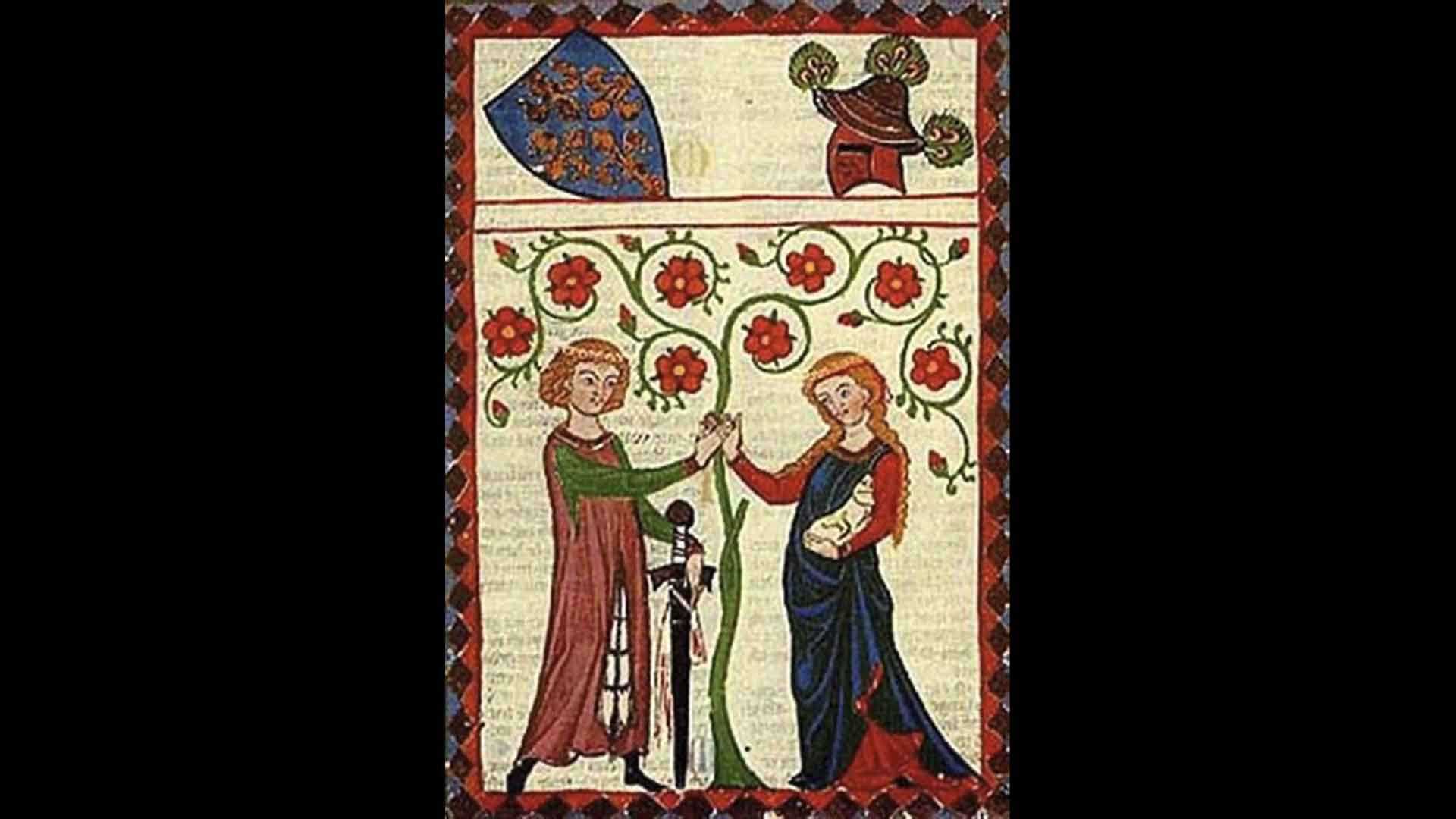
We explore the history of courtly love including C.S. Lewis' analysis in the Allegory of Love.

Tags 42nd
Comment

Kiddushin 50: אַף עַל פִּי שֶׁשָּׁלַח סִבְלוֹנוֹת DONATIO PROPTER NUPTIAS

jyungar October 2, 2023

For the source text click/tap here: Kiddushin 50

To download, click/tap here: PDF

Our mishnah talks about a man who performs an invalid act of kiddushin and then later on sends presents to the woman whom he tried to betroth. The question is, is the sending of presents equivalent to a renewed and now valid act of betrothal, or are the presents not considered as effecting betrothal?

If he betroths two women with the value of a perutah, or one woman with less than the value of a perutah, even if he subsequently sends gifts, she is not betrothed, because he sent them on account of the first kiddushin, for he has sent those presents only based on his earlier kiddushin (but they are not intended to effect a new kiddushin). The same halachah would apply to a minor who betroths a woman (and sends her bridal presents afterwards).

We explore Donations between spouses, prohibited at the time of Justinian Law called DONA´TIO PROPTER NU´PTIAS

And Kyle Harper’s analysis of marriage in the late antique period.

Tags 42nd
Comment

Kiddushin 49: עֲשָׂרָה קַבִּים חׇכְמָה

jyungar October 1, 2023

For the source text click/tap here: Kiddushin 49

To download, click/tap here: PDF

The Gemara relates that if a person, who until this time was wicked, betroths a woman on condition that he is righteous we are concerned with the possibility that he had thoughts of teshuvah.

Minchas Chinuch (1) questions whether teshuvah can be done without verbally confessing (וידוי) one’s sins. He cites our Gemara as proof that teshuvah without a verbal confession is effective.

Since the Gemara does not relate that he verbally confessed his sins, it would seem that his teshuvah is accepted and he can now be described as righteous by merely having thoughts of teshuvah.

We look at this notion of Teshuvah then review Shakespeare’s view of marriage.

Tags 41st
Comment

Kiddushin 48: יַיִן וְנִמְצָא חוֹמֶץ

jyungar September 30, 2023

For the source text click/tap here: Kiddushin 48

To download, click/tap here: PDF

The Mishna lists six cases. One is where a man says to a woman, “Be mekudeshes to me with this cup of wine,” and it ended up being honey. A man says to a woman, “Be mekudeshes to me with this cup of honey,” and it ended up being wine. A man says, “Be mekudeshes to me with this silver dinar,” and it ended up being gold. A man says, “Be mekudeshes to me with this golden dinar,” and it ended up being silver. A man says, “Be mekudeshes to me on condition that I am rich,” and he is actually poor. A man says, “Be mekudeshes to me on condition that I am poor,” and he is actually rich. In all of these cases, the kiddushin is invalid.

We continue the review of Laurie Novick’s analysis of Nissuin.

Tags 41st
Comment

Kiddushin 47: בָּזוֹ וּבָזוֹ וּבָזוֹ

jyungar September 29, 2023

For the source text click/tap here: Kiddushin 47

To download, click/tap here: PDF

The Gemara comments: It is taught in a baraita in accordance with the opinion of Rava: If one said to a woman: Be betrothed to me with the fruit of an oak tree, i.e., an acorn, with a pomegranate, and with a nut, or if he said to her: Be betrothed to me with these, if combined they are worth one peruta, she is betrothed.

Rav teaches that, “Ha-mekadesh be-milveh, einah mekudeshet – a marriage cannot be accomplished by means of a loan.” This means that if a man lends money to a woman, he cannot tell her that instead of paying back she can simply keep the money if she agrees to marry him. The explanation offered by the Gemara for this rule is that “Milveh lehotza’ah nitnah – a loan is meant to be spent by the borrower.”

We explore the means of Kiddushin via a loan with Rav Baruch Gigi’s analysis and Laura Novick’s majestic analysis.

Tags 41st
Comment

Jacob Meeting Rachel, Pier Francesco Mola

Kiddushin 46: אָדָם יוֹדֵעַ שֶׁאֵין קִידּוּשִׁין תּוֹפְסִין בַּאֲחוֹתוֹ

jyungar September 28, 2023

For the source text click/tap here: Kiddushin 46

To download, click/tap here: PDF

The very first Mishna in Massekhet Kiddushin taught that if marriage is to be carried out by an exchange of money (or an object of value), it must minimally be worth a peruta.

If a man says to a woman, “Become betrothed to me with this date” (which he gives her), and then (giving her another date), he says, “Become betrothed to me with this one,” if any one of the dates was valued as a perutah, she is mekudeshes. But if not, even if together they equal a perutah, she is not mekudeshes. If, however, he says, “Become betrothed to me with this, with this and with this,” if the dates combined are valued at a perutah, she is mekudeshes, but if not, she is not mekudeshes. If she was eating them one by one (as soon as one was given to her, she ate it), she is not mekudeshes unless one of the dates was valued at a perutah.

We explore the The historical context within which to read the Talmudic discussions of kiddushin by Prof. Michael L Satlow

And Rabbi Dov Linzer’s analysis.

Tags 41st
Comment
  • Daf Ditty
  • Older
  • Newer

Julian Ungar-Sargon

This is Julian Ungar-Sargon's personal website. It contains poems, essays, and podcasts for the spiritual seeker and interdisciplinary aficionado.​