Julian Ungar-Sargon

  • Home
  • Theological Essays
  • Healing Essays
  • Podcast
  • Poetry
  • Daf Ditty
  • Deep Dive Ditty
  • Videos
  • Publications
  • Military Service
  • Dominican University
  • Home
  • Theological Essays
  • Healing Essays
  • Podcast
  • Poetry
  • Daf Ditty
  • Deep Dive Ditty
  • Videos
  • Publications
  • Military Service
  • Dominican University
Julian Ungar-Sargon copy 3.jpg

Daf Ditty

A wide-ranging commentary on the daily page of Talmud.

Beitzah 33: Goose Gizzard and Giblets

jyungar October 3, 2021

For the source text click/tap here: Beitzah 33

To download, click/tap here:  PDF

Rava rules that one may not use a piece of wood from a broken utensil as firewood on Yom Tov since the wood was not prepared for such use before Yom Tov. The Gemara infers from here that Rava must follow the view of Rebbi Yehudah, who prohibits objects like this as Muktzah on Yom Tov.

The Gemara questions this assumption from another statement of Rava. The Gemara relates that on Yom Tov, Rava told his servant to roast a goose and throw the intestines to a cat. The Gemara understands from this statement that Rava follows the view of Rebbi Shimon, who argues with Rebbi Yehudah and permits one to move an object on Yom Tov for the sake of animals, even though the object was designated for human use and not for animals before Yom Tov.

Rashi (DH Kivan d'Mesrechi) writes that the goose intestines were still fit for human consumption on Yom Tov.

We examine the cultural and culinary history of goose gizzard and giblets and the human desire to stuff geese...for the sake of foie gras...

Tags 17th
Comment

Beitzah 32: Opening Bottles

jyungar October 2, 2021

For the source text click/tap here: Beitzah 32

To download, click/tap here: PDF 

The Gemara discusses opening sealed vessels on Shabbos by cutting or destroying them on Shabbos. As Rashi explains, the Gemara addresses whether the Melachah of Stirah (breaking a usable structure) is involved when one opens a container on Shabbos or Yom Tov.

The Gemara's discussion has common practical ramifications. May one open sealed bottles and other types of food containers on Shabbos or Yom Tov?

There are three possible Melachos involved with opening bottles, cans, and other containers on Shabbos and Yom Tov: Stirah (breaking a usable structure), Boneh or Makeh b'Patish (producing a finished, usable vessel), and Kore'a (tearing). An additional Isur d'Rabanan may apply: even if one does not open the container in a way which forms a usable utensil, the Rabanan prohibited opening the utensil under certain circumstances lest one open it with intention to make it into a usable utensil.

We explore the halacha of opening bottles cans and stuff.

Tags 17th
Comment

Beitzah 31: Firewood

jyungar October 1, 2021

For the source text click/tap here: Beitzah 31

To download, click/tap here: PDF 

Since we are allowed to cook on Yom Tov, we are also permitted to add fuel to burning fires. Even so, wood or other fuel that is to be used should be prepared for that purpose before Yom Tov begins; otherwise it is considered muktzeh – set aside for a purpose other than to be burned. What wood is considered prepared for use as fuel on Yom Tov is the topic of discussion of the Mishnayot on our daf.

One of the Mishnayot discusses whether wood can be chopped for use as fuel, even if the wood was prepared for burning before Yom Tov began. As we learned on yesterday’s daf, the crucial question here is whether it appears to be a weekday activity; as such, the suggestion of the Mishnah is to chop the wood in an out-of-the-ordinary manner.

We explore the science of wood stacking and types of wood toxic to use due to dioxin.

Tags 17th
Comment

Beitzah 30: Succah Afterthoughts

jyungar September 30, 2021

For the source text click/tap here: Beitzah 30

To download, click/tap here: PDF 

Our Daf teaches that we cannot take wood from a sukkah on any Festival because this is 'dismantling'. We are permitted to take wood from near the sukka. The Gemara wonders how a sukka differs from a tent, where we are not permitted to use the wood - or even bundles - placed near a tent. The rabbis question whether we might be speaking of a sukka that is not sturdy; they wonder whether we are in fact discussing items that are muktze, set aside.

We return to Succah thoughts as we leave the Succah tomorrow.

Tags 17th
Comment

1937 steam calorimeter was invented at the U.S. National Bureau of Standards to measure the output of steam power equipment. The front of the instrument has

been cut away to show its layers. NATIONAL INSTITUTE OF STANDARDS AND TECHNOLOGY DIGITAL COLLECTIONS

Beitzah 29: Measuring Food

jyungar September 29, 2021

For the source text click/tap here: Beitzah 29

To download, click/tap here: PDF

Because we are able to prepare food on Yom Tov, it is possible for people to find themselves in a situation in which they discover that essential ingredients for the meal are missing. Obviously they can go to their neighbors, borrow raw ingredients, and return them after Yom Tov is over. The last few Mishnayot in our perek relate to such transactions.

In general, it is prohibited to measure on Yom Tov, just as it is prohibited to measure on Shabbos. Thus, one may not measure out how much flour, sugar, or oil to use in a recipe (Shulchan Aruch Orach Chayim 506:1). However, one may approximate how much flour, oil, or sugar is needed. It is permitted to use a measuring cup, as long as one does not fill the cup exactly to its measuring points (Mishnah Berurah 506:3).

We examine the science behind measuring food and calories.

Tags 17th
Comment

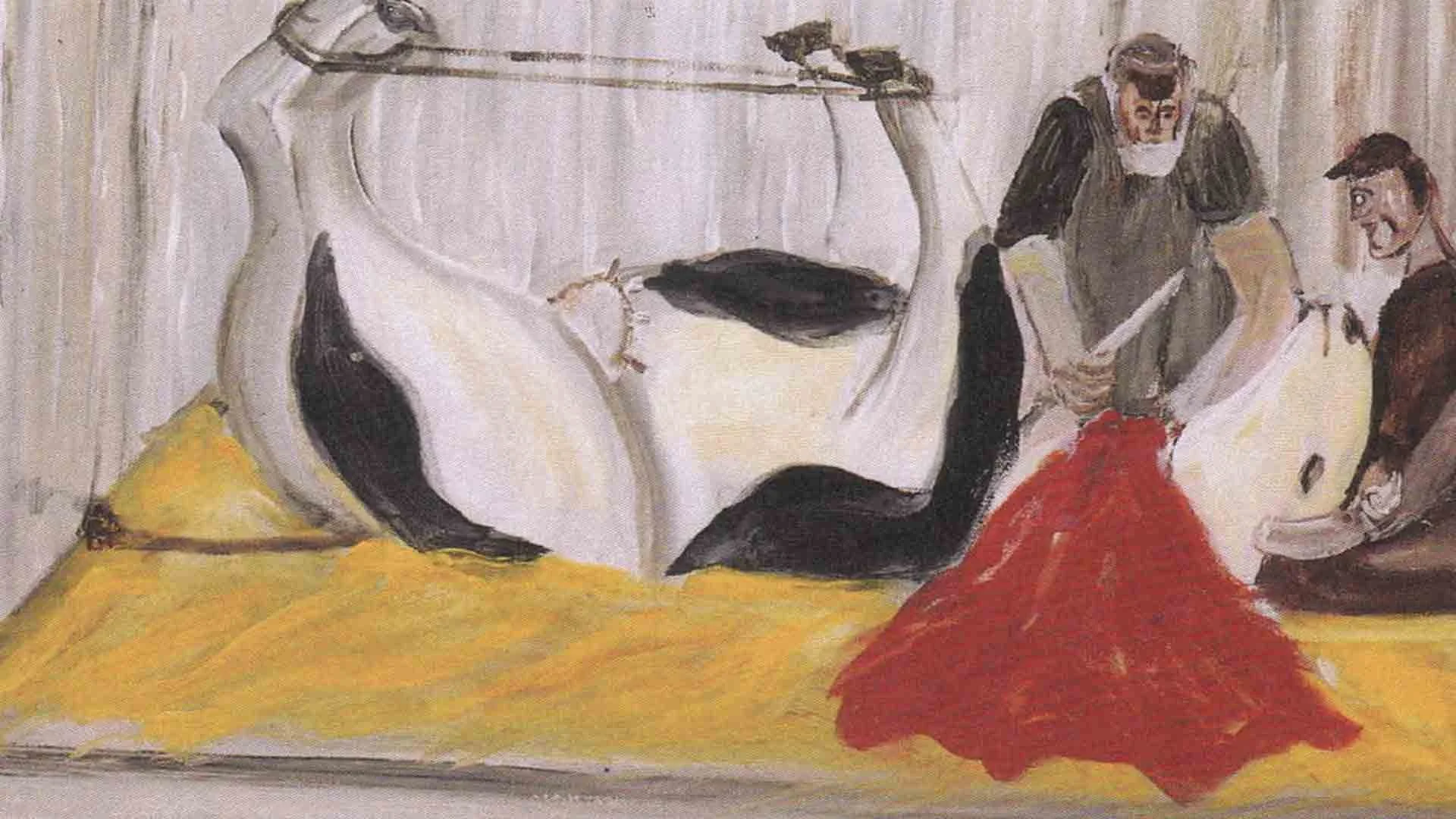
Mayer Kirshenblatt. The Illegal Slaughter(From Mayer Kirshenblatt and Barbara Kirshenblatt-Gimblett, They Called Me Mayer July: Painted Memories of a Jewish

Childhood in Poland Before the Holocaust. University of California Press. n.d. p114)

Beitzah 28: Chalaf

jyungar September 28, 2021

For the source text click/tap here: Beitzah 28

To download, click/tap here:  PDF

The debate on our daf concerns weighing out meat at the butchers on Yom Tov. All agree that the butcher cannot just weigh out meat as usual, using weights on the scale, because that looks too much like conducting business as usual. They also all agree that one can go to a butcher and get meat on Yom Tov. This is necessary to ensure that the average person has access to fresh meat so that he can enjoy his Yom Tov to the fullest extent. As a solution to the problem of the butcher weighing out the meat, Rabbi Judah says that the butcher may use other utensils on the other side of the scales. For instance, if he knows that his chopping knife weighs 2 kilo, he can weigh out meat according to the weight of his knife. This looks different enough that everyone will know that he is not engaging in business as usual.

The Mishnah on our daf forbids sharpening a knife on Yom Tov, but the Gemara permits it under certain circumstances.

The Gemara says that one may not bring a Shochet's knife to a Chacham to have it inspected on Yom Tov, but a Chacham may inspect his own knife.

We discuss the famous controversy about the slaughtering knives between hassidim and Mitnagdim .

Tags 17th
Comment

Beitzah 27: Animal Death

jyungar September 27, 2021

For the source text click/tap here: Beitzah 27

To download, click/tap here: PDF

This mishnah deals with what may be done with a beast (a cow, sheep, goat or bull) that has died on Yom Tov.

If a beast died [on Yom Tov] it may not be moved from its place.

Since the beast died and was not slaughtered, it cannot be eaten. Since it cannot be eaten there is nothing that one may do with it on Yom Tov. Hence, it is muktzeh. All that he can do is leave it in its place and then when Yom Tov is over he can cut it up, use its hide and feed dogs with its meat.

We discuss animal death and the science of global animal death and its relationship to wild animal welfare. We end with the curious play by Peter Schaffer "Equus" and a boy's mutilation of a horse analysed by his psychiatrist.

Tags 17th
Comment

"The Cave Beneath the Holy Rock, Jerusalem" by Carl Haag, 1859

Beitzah 26: Cisterns

jyungar September 26, 2021

For the source text click/tap here: Beitzah 26

To download, click/tap here:  PDF

A first-born animal – a behor –is considered to be holy to the Temple (see Shmot 13:12)

In the event that the animal develops a permanent blemish – a mum –then it is no longer kodesh and it can be eaten normally by kohanim.

Since under normal circumstances a behor cannot be eaten, it is not considered an animal that is ready for use on Yom Tov.

Nevertheless, the Mishnah (25b) teaches that according to Rabbi Yehudah, in the event that a behor falls into a pit, an expert can be lowered into the pit to check whether the animal has developed a mum.

If, in fact, such a mum ispresent, then the animal can be slaughtered and eaten by kohanim on YomTov.

Rabbi Shimon disagrees. He believes that unless the mum was recognized before Yom Tov began, the animal cannot be used forfood on Yom Tov.

Thus there would be no point in having an expert check the animal for a mum on Yom Tov itself so it would be forbidden to do so.

The pit referred to is a bor...or cistern...which leads us to examine the history of water cistern engineering in the ancient world an the intriguing discovery of 29 cisterns under the Har habayit.

Tags 17th
Comment

Beitzah 25: Who Chose Whom?

jyungar September 25, 2021

For the source text click/tap here: Beitzah 25

To download, click/tap here: PDF 

The Gemara considers another aspect of the character of the Jewish people. It is taught in a baraita in the name of Rabbi Meir: For what reason was the Torah given to the Jewish people? It is because they are impudent, and Torah study will weaken and humble them.

A Sage of the school of Rabbi Yishmael taught the following with regard to the verse:

ב וַיֹּאמַר, יְהוָה מִסִּינַי בָּא וְזָרַח מִשֵּׂעִיר לָמוֹ--הוֹפִיעַ מֵהַר פָּארָן, וְאָתָה מֵרִבְבֹת קֹדֶשׁ; מִימִינוֹ, אשדת (אֵשׁ דָּת) לָמוֹ.

2 And he said: The LORD came from Sinai, and rose from Seir unto them; He shined forth from mount Paran, and He came from the myriads holy, at His right hand was a fiery law unto them.

Deut 33:2

“From His right hand went a fiery law for them” The Holy One, Blessed be He, said: Based on their nature and character, these people, the Jews, are fit to be given a fiery law, a hard and scorching faith.

Rabbi Yishmael's school taught that we Jews have fiery natures requiring a fiery law. Others suggested that we were given the Torah to mitigate our wrath, for no nation could withstand us without the observance and study required by Torah law.

We examine the closeness of Am Yisrael through the eyes of orthodox and nonsectarian minds

Tags 17th
Comment

My Dog Mr. Binky

Beitzah 24: Pets

jyungar September 24, 2021

For the source text click/tap here: Beitzah 24

To download, click/tap here:  PDF

Rabah bar Rav Huna explains that the Mishnah in Shabbos (106a) which forbids trapping a bird even when it is already in an enclosed area (such as a house) refers to a "Tzipor Dror." RASHI (DH b'Tzipor Dror) explains that the reason why the bird is not considered already captured while it is in the house is because it flies from one corner of the house to the other and escapes one's attempt to capture it.

Rashi earlier (DH Chayav), however, explains that the bird mentioned in the Mishnah is not considered captured because it escapes through the windows, and not because it flees from corner to corner. Why does Rashi give a different explanation for why the bird is not considered captured while it is in the house?

The Gemara initially suggests that the difference between the state of being captured and the state of being free depends on the type of enclosure in which the bird is found.

We look at the issue of Pets and the ambivalent attitude to dogs in particular.

Tags 17th
Comment

Stokke Xplory 6 Stroller - Red/Black/Black

Beitzah 23: Strollers on Yom Tov?

jyungar September 23, 2021

For the source text click/tap here: Beitzah 23

To download, click/tap here:  PDF

image3.png

When a stroller is pushed over sand or soft earth a groove may be left in the path of the wheels and one can question whether such a practice is permitted on Shabbos because it is similar to plowing, one of the thirty-nine prohibited melachos. 

 The Gemara (1) frames the issue of dragging a bench or couch on the dirt as a dispute between R’ Yehudah and R’ Shimon. R’ Yehudah maintains that an unintended outcome is prohibited whereas R’ Shimon holds that it is permitted.

We explore the use of the stroller on Yom Tov, and we revisit the issue of the eruv on shabbat.

Tags 17th
Comment

Beitzah 22: Smoking On Yom Tov

jyungar September 22, 2021

For the source text click/tap here: Beitzah 22

To download, click/tap here:  PDF

We are learning about how Festival halachot are different from halachot of Shabbat.

The rabbis teach us about varied ideas, from food preparation to lighting incense.

The rabbis discuss a number of interesting arguments regarding each of Rabban Gamliel's leniencies. It seems that these leniencies are in no way 'short cuts'.

Fragrance is discussed similarly. Rabban Gamliel would prepare an incense vessel or pan before Shabbat or the Festival and then plug its holes. The following day, the holes were unplugged and it would seem that the room perfumed itself. This is permitted, though the rabbis are concerned about leniencies that might encourage people to put incense directly on top of burning coals on sanctified days.

On the topic of "incense" we discuss smoking and vaping on yom tov and the rest of the year.

Tags 17th
Comment

The First Marauding Army - The soldiers of Count Mansfield live upon the country

Beitzah 21: Baleshet

jyungar September 21, 2021

For the source text click/tap here: Beitzah 21

To download, click/tap here: PDF 

Rav Huna was asked to rule on the following question: when the government requires villagers to bake for soldiers who are stationed in the area, are they permitted to do so on Yom Tov?

When Rabbi Yehudah ben Bava asked where he had been, Shimon explained that a baleshet had come to the town and threatened to steal the possessions of the inhabitants. To save the town a calf was butchered and prepared, and the baleshet left them in peace. Rabbi Yehudah ben Bava objected to this story, pointing out that the passage permitting cooking on Yom Tov (Shemot 12:16) only allows it lahem – for you – not for non-Jews. As the Gemara explains, in this case the animal that was prepared for the baleshet was not kosher, so it could not have been eaten by Jews and the entire preparation was for non-Jews only.

The term baleshet apparently refers to an army unit that was sent to search for valuables (in modern Hebrew the word balash means a detective). Usually these units were employed in enforcing payment of taxes, which made it essential for the local communities to stay on good terms with them, since their broad mandate often allowed them to stray well-beyond their official tasks into violence and looting.

We cite a dream of the gaon Rav Ayyash of Algiers in which saw a girl saved the city...from a baleshet...in 1775.

Tags 17th
Comment

Beitzah 20: Semicha (On The Korban)

jyungar September 20, 2021

For the source text click/tap here: Beitzah 20

To download, click/tap here:  PDF

A Tanna taught in front of Rabbi Yitzchak bar Abba that the verse which says that Aharon offered the olah (on the 8th day of milu'im) and performed its service kamisphat – like the rule teaches that he followed the rules of a voluntary olah. This teaches that one must lean on obligatory olah just as on a voluntary one. Rabbi Yitzchak bar Abba told him that this braisa follows Bais Shamai, who do not learn the requirement of leaning for an obligatory shelamim from a voluntary one, as Bais Hillel, who do learn it, would also learn leaning for an obligatory olah from a voluntary one.

We explore the sugya of semicha and the modern scholars' approach to the history of semicha. According to Solomon Zeitlin, the subject of the Zugos's dispute is not over physical Semicha on an animal, rather it is over the reliance on and the authority of the Chahcomim. In other words, how much to be "סומך" on the Chachomim's traditions and innovations in Halacha.

Some scholars have suggested that the preserved dispute is whether or not rabbinic ordination required the laying of the hands on the student's head.

Tags 17th
Comment

Beitzah 19: Yom Tov Korbanot

jyungar September 19, 2021

For the source text click/tap here: Beitzah 19

To download, click/tap here:  PDF

In our discussions of food preparation on Yom Tov, we have learned that even though several of the 39 forbidden activities on Shabbat are basic to food preparation, they are permitted on Yom Tov based on the passage in Shemot 12:16. How about sacrifices brought in the Temple? Obviously, korbanot that are part of the commandments of the day must be brought, but what about other sacrifices?

In the Mishnah on our daf, Bet Shammai and Bet Hillel disagree about whether various sacrifices can be brought on Yom Tov. According to Bet Shammai, a korban olah, which is totally burned up, cannot be brought. A korban shelamim, however, can be brought, since parts of it will be eaten by the kohanim and by the owner, making it not only a sacrifice, but also food preparation, which is permitted on Yom Tov. Nevertheless, they forbid performing semikha on the animal.

We review attitudes to korbanot including the analysis of Dr Yitzhak Feder of inner biblical changes...

Tags 17th
Comment

Beitzah 18: Tevilah

jyungar September 18, 2021

For the source text click/tap here: Beitzah 18

To download, click/tap here:  PDF

During Temple times, those who were fulfilling the mitzvah of aliyah la-regel – pilgrimage to the Temple on the holidays of Pesach, Shavuot and Sukkot – needed to immerse themselves in a mikvah in order to ensure a high level of ritual purity. What happened when Yom Tov fell out on Sunday? Could the immersion be done on Shabbat in preparation for the holiday?

Much of the daf wonders whether we can immerse items in ritual baths - including women ending their menstrual cycles - on Yom Tovim or Shabbatot. The rabbis question different items and their degrees of ritual impurity. They are careful to evaluate whether or not an action might be violating a halacha related to Shabbat. For example, we are not allowed to bathe on Shabbat. Is immersing a form of bathing?

The Beraisa states that one who is obligated to immerse in a Mikvah may immerse in the usual manner even on Tish'ah b'Av and on Yom Kippur.

We trace how that became forbidden and some modern retooling of the ritual of immersion for spiritual seekers of non orthodox traditions.

Tags 17th
Comment

Beitzah 17: Loopholes

jyungar September 17, 2021

For the source text click/tap here: Beitzah 17

To download, click/tap here:  PDF

We learned that when a Holiday (Yom Tov) falls out on a Friday, one is allowed to cook for the needs of the Yom Tov, but not for the Shabbat right after it. However, if one leaves a little food over from Thursday (called eruvei tavshilin) then cooking for Shabbat becomes permitted.

The Ra’avad explains that the idea of the eruv tavshilin – literally “a combination of foods” – is to prepare a meal for Shabbat at a time when it is permissible, and then food that is made on Yom Tov can be combined with that food in preparation for Shabbat.

We examine the halachot of ET and discuss loopholes in rabbinic Judaism.

Tags 17th
Comment

The Israelites Collecting Manna from Heaven, Rudolf von Ems (Austrian, 1200–1254) The J. Paul Getty Museum, L.A.

Beitzah 16: Neshama Yeseirah

jyungar September 16, 2021

For the source text click/tap here: Beitzah 16

To download, click/tap here:  PDF

The concept of some form of expanded soul being afforded the Jew during the weekly Shabbat already appears in our daf (Beitza 16a), where Resh Lakish states:

The Holy One, Blessed be He, gives man an additional soul on the eve of Shabbat, and at the end of Shabbat He takes it back, as it says (Shemot 31:17): “shavat va-yinafash” — once Shabbat ends, woe (vai) to the spirit (nefesh) which is lost.

Resh Lakish derives from the phrase “shavat va-yinafash” that after Shabbat ends, one loses a little part of one's soul, referring to the additional soul that accompanies the Jew on Shabbat. Nefesh literally means spirit, but here it is a verb. It refer to some internal form of refreshment and even restoration that affects the inner part of one's personality.

The Chasam Sofer points out that there is a fundamental difference between Shabbos and the other Yomim Tovim. On Shabbos, the Ribono shel Olam and kedusha [holiness] arrives, whether we are ready or not, and whether we are prepared or not. The mere fact that it is Shabbos invests us and imbues us with a certain kedusha.

We further explore the nature of the unique gift of the Shabbat.

Tags 17th
Comment

Beitzah 15: Reb Eliezer's Teaching Method

jyungar September 15, 2021

For the source text click/tap here: Beitzah 15

To download, click/tap here:  PDF

We are told a fascinating story about Rabbi Eliezer the Great, who watched groups of students leave as he lectured on the halachot of Festivals. As each group left, he became more angry and called to the departing group that they must have a pittas, a barrel, a jug, a jar, a cup waiting for them - they must be hungry and are compelled to leave. When the sixth group left, he told them that only a curse was waiting for them as they did not value learning Torah over the call of sustenance. Finally, the remaining students were afraid of Rabbi Eliezer. He reassured them, giving them a blessing (including giving food to the poor) going forward to enjoy their meals.

The Gemara questions why Rabbi Eliezer was critical of the students who left if they were leaving to provide for their physical needs which is a mitzvah of being joyous on Yom Tov. The Gemara answers that Rabbi Eliezer maintains that rejoicing on Yom Tov is merely optional.

This story is difficult to understand and many points require clarification.

Tags 17th
Comment

Guinean women stamping into a large mortar.

Beitzah 14: Mortar and Pestle

jyungar September 14, 2021

For the source text click/tap here: Beitzah 14

To download, click/tap here:  PDF

The Mishnah on our daf discusses the preparation of spices and salt. We find that Bet Shammai insist that some change be made in the way spices are ground up (grinding is one of the activities ordinarily forbidden on Shabbat), while Bet Hillel allow grinding to be done normally.

Both agree, however, that salt should be ground in an out-of-the-ordinary way – by using a wooden pestle rather than the standard stone pestle.

In the Gemara, Rav Huna and Rav Chisda argue about the distinction made between spices and salt. One says that salt is a basic need – all cooking requires salt – so it should have been prepared before the holiday began; spices, on the other hand, are not necessarily required for cooking, so they can be prepared as needed. The other explains that salt retains its flavor, so it could have been prepared before the holiday began. Spices, which lose their strength once they are ground, can be prepared as they are needed, even on the holiday.

We examine the grinding of spices and the history of the mortar and the pestle. (and the Slavic tale of the baba Yaga!)

Tags 17th
Comment
  • Daf Ditty
  • Older
  • Newer

Julian Ungar-Sargon

This is Julian Ungar-Sargon's personal website. It contains poems, essays, and podcasts for the spiritual seeker and interdisciplinary aficionado.​