Julian Ungar-Sargon

  • Home
  • Theological Essays
  • Healing Essays
  • Podcast
  • Poetry
  • Daf Ditty
  • Deep Dive Ditty
  • Videos
  • Publications
  • Military Service
  • Dominican University
  • Home
  • Theological Essays
  • Healing Essays
  • Podcast
  • Poetry
  • Daf Ditty
  • Deep Dive Ditty
  • Videos
  • Publications
  • Military Service
  • Dominican University
Julian Ungar-Sargon copy 3.jpg

Daf Ditty

A wide-ranging commentary on the daily page of Talmud.

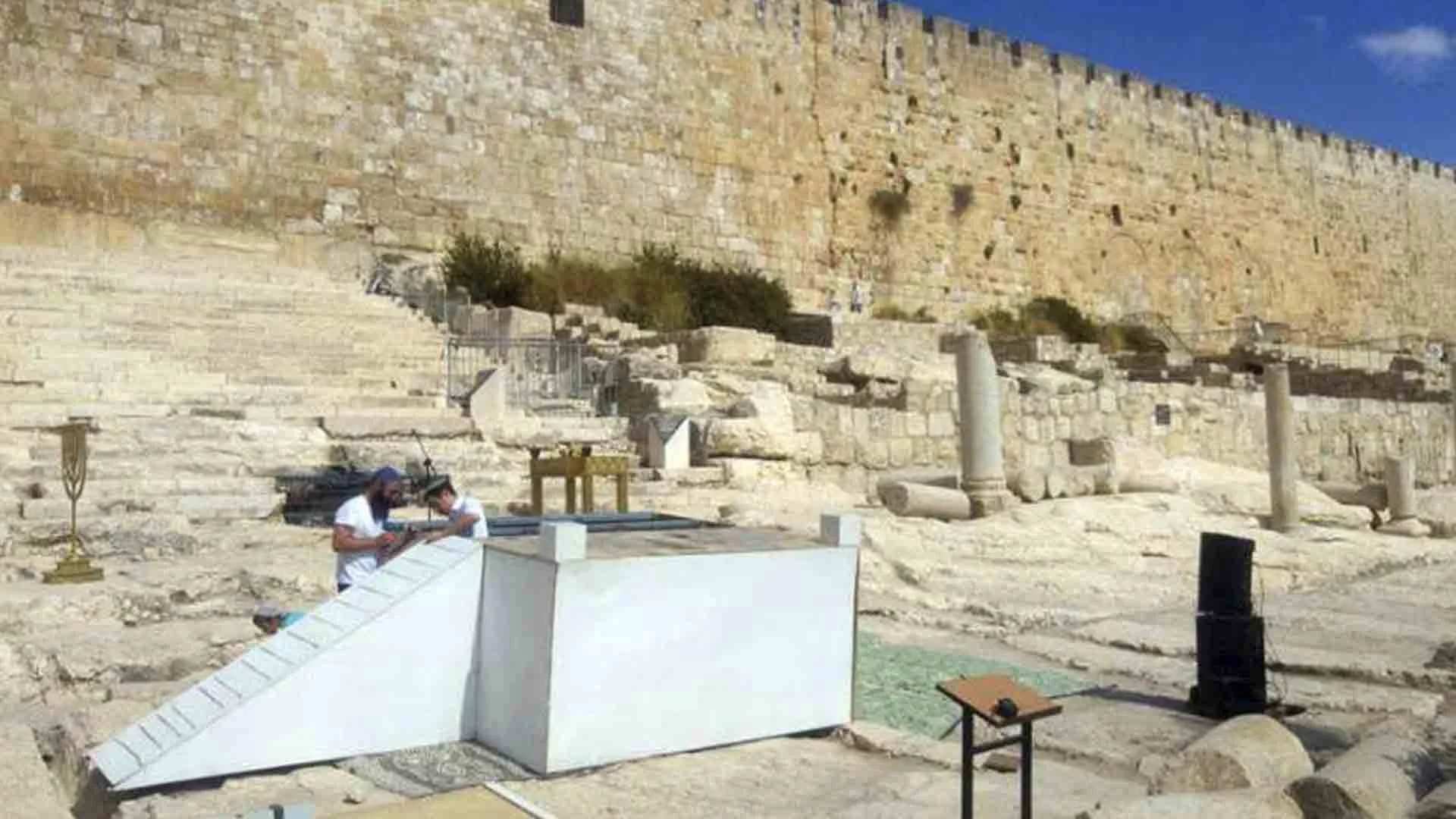
The model of the altar sits at the foot of the stone stairway leading up to the Hulda Gates in the Temple Mount's southern wall, which in Temple times was one of the main passages through which pilgrims would ascend the Mount.

Sukkah 48: נִיסּוּךְ הַמַּיִם

jyungar August 24, 2021

For the source text click/tap here: Sukkah 48

To download, click/tap here: PDF

The Mishnah describes the nisukh ha-mayim – the water libation on Sukkot – which was done together with the daily tamid (“perpetual” communal sacrifice) in the morning. Water was brought from the Shiloah spring up to the Temple with great fanfare. The kohen would take the jug of water, walk up the ramp to the altar and turn left, where there were two bowls – sefalim – that drained into the foundation of the Temple. The bowls were for the nisukh ha-mayim on Sukkot and for the nisukh ha-yayin, the wine libation that accompanied many of the sacrifices.

The kohen was instructed to raise up his hand so it would be clear that he was doing the avodah (service) properly. This was instituted because a kohen once poured the water on his feet instead of on the altar, and the enraged crowd pelted him with the etrogim that they were holding in their hands.

We explore the nature of the Chag of Shmini Atzeres and the possibility of legislating "happiness" (in a post holocaust age, Yonippur War and COVID) and the use of Hoshana/Hosana in the New Testament.

Tags 16th
Comment

"The Feast of the Rejoicing of the Law at the Synagogue in Leghorn" (Solomon Alexander Hart/The Jewish Museum)

Sukkah 47: “Regel Bifnei Atzmo”

jyungar August 23, 2021

For the source text click/tap here: Sukkah 47

To download, click/tap here: PDF

In the Land of Israel, the holiday of Sukkot is seven days long and the “eighth day” of the holiday is Shemini Atzeret, which is a separate holiday, as indicated by the fact that it does not have the mitzvot of lulav, of sukkah or of the water libation. The situation outside of Israel is more complicated, since during the time of the Mishnah when the announcement of the new month was made by the bet din ha-gadol in Jerusalem, it was sent by messenger. Therefore, places outside of Israel could not be sure when the holiday actually began, and because of this uncertainty, they kept two days of Yom Tov. Diaspora communities continue keeping this tradition to this day, even though we now operate with a set calendar and all communities know when the new month and the holidays fall out based on the calendar.

Based on this, the “eighth day of Sukkot” presents something of a problem. Should we treat it as a separate holiday or is it still considered part of Sukkot?

We examine the halachic issues and the chassidic/mitnaged differences in customs and the famous (and shocking) visit of Smauel Pepys to the Bevis Marks Synagogue in 1663 on Simchas Torah!

Tags 16th
Comment

Sukkah 46: Birchas Lulav vs Succah

jyungar August 22, 2021

For the source text click/tap here: Sukkah 46

To download, click/tap here: PDF

We have already established that outside of the Temple, on a biblical level the mitzvah of lulav is only on the first day of the holiday; our tradition of taking the lulav and etrog for the entire seven days of Sukkot is zecher le-Mikdash – a commemoration of the Temple where it was a mitzvah to take the lulav every day of the holiday (see Sukkah 41).

This is summed up in our Gemara, where Rabbi Yehoshua ben Levi declares that only the first day is the mitzvat lulav (the commandment of lulav); the rest of the week is mitzvat zekenim (the commandment of the Sages).

“Rav Yehuda said in the name of Shmuel: lulav, seven; and sukkah, one” (Sukkah 45b). So begins a discussion as to how often we are to make a bracha on these mitzvoth. Shmuel, the Gemara explains, is of the view that since there is one continuous mitzvah to sit in a sukkah for seven days and nights, “all seven are like one long day”; and hence, a bracha is recited only once. However, the mitzvah of lulav is applicable only by day, and not at night; and thus, each new day requires a new bracha.

Tags 16th
Comment

Sukkah 45: Hoshana

jyungar August 21, 2021

For the source text click/tap here: Sukkah 45

To download, click/tap here: PDF

A new Mishna tells how willow branches were part of the Sukkot rituals. Motza, a town close to Jerusalem, would provide very long willow branches which would stand at the sides of the altar. The branches were tall enough to drape above and over the Altar. With shofar blasts, people would circle the altar once each day and call out, "HaShem, Hoshia Na! HaShem, HaSelicha Na!" (Psalms 110:25) and possibly more.

The Talmud Yerushalmi explains that this was done in remembrance of the victory in Yericho (see Yehoshua chapter 6), when the Jewish people circled the city once a day for six days and seven times on the seventh day before the walls of the city collapsed.

We explore this most enigmatic and mysterious of the Succot rituals and how it is expressed in different modern versions of the siddur depending upon how much discomfort there is with anthropomorphism (analogy) and kabbalah (mimesis).

Tags 16th
Comment

Sukkah 44: Chavata

jyungar August 20, 2021

For the source text click/tap here: Sukkah 44

To download, click/tap here: PDF

In our daf we the amoraim dispute the status of the aravah ritual.

According to both of these amoraim, the aravah ritual is attributed to the prophets. However, they dispute the exact nature of how it originated. According to one amora it seems to have been a formal institution enacted by the prophets, whereas according to the other amora, it was a custom, not a formal institution.

Rashi explains that the ramification for this dispute is whether one says a blessing over the aravah ritual.

On the last day of Sukkot, Hoshana Rabba, we beat a bundle of willow branches (actually one is enough) on the floor (SA OC 664:4).

We explore the (midrashic) meaning of this chavata and even the mythic theory of Dr Rabbi Zev Farber.

Tags 16th
Comment

Sukkah 43: Betrayal, Then and Now

jyungar August 19, 2021

For the source text click/tap here: Sukkah 43

To download, click/tap here: PDF

The commandment of the aravah does not appear explicitly in the Torah, and several possible sources are cited, among them that it is a halakha l’Moshe mi-Sinai or that it was established by the prophets. In any case, the Sages felt that it was so important that it was to take place even when the seventh day of the holiday fell out on Shabbat. This ruling disturbed the Baitusim, who went so far as to hide the aravot that had been prepared for use on Shabbat. The Gemara relates that the aravot were uncovered by the local people who handed them to the kohanim to use.

The Baitusim were one of the deviant sects during the second Temple period who did not accept the ruling of the Sages. The Gemara does not make clear what differences existed between the Baitusim and the Tzedukim, although from the stories that appear it is the Baitusim who tried to use trickery in order to uproot the rules of the Sages and impose their rulings on the populace.

We explore another episode of trickery and betrayal in the history of the Venetian community and the tragic history of the troubled Scuola Canton and the pain and suffering caused by the converts….down to our own times during the Nazi deportations.

Tags 16th
Comment

Sukkah 42: Lulav As a Weapon (of Mass Confusion)

jyungar August 18, 2021

For the source text click/tap here: Sukkah 42

To download, click/tap here: PDF

The next day everyone rises early and comes to the Temple, and the attendants throw the lulavim before them. And in the confusion, the people snatch the lulavim and in the process strike one another. And when the court saw that they came to potential danger, they instituted that each and every person will take his lulav in his house and fulfill the mitzva there.

Thinking about how beis din had to rearrange the order due to concerns for people bashing each other with their lulavs!!!

This got me thinking about the hagiographical legends about brotherly love that formed the basis for the site of the temple…

Tags 16th
Comment

Sukkah 41: Bayis Shlishi Who Builds?

jyungar August 17, 2021

For the source text click/tap here: Sukkah 41

To download, click/tap here: PDF

The Mishnah relates that RabanYochanan ben Zakai instituted a Mitzvah d'Rabanan to hold the Arba'as ha'Minimon all seven days of Sukos outside of the Beis ha'Mikdash. The Gemara explains that this enactment was made as a commemoration for the Beis ha'Mikdash("Zecher la'Mikdash").

What is the source for the concept of making aZecher la'Mikdash? The Gemara cites the verse, "For I shall raise up (A'aleh) for you a cure, and from your wounds I will heal you -- the word of Hash-m, for 'abandoned' did they call you: 'She is Tziyon -- no one remembers her'" (Yirmeyahu30:17).

The verse in Jeremiah describes Jerusalem Post-destruction as a wounded outcast, completely forgotten by all who used to care for her. Rabbi Yohanan ben Zakkai reads this verse as requiring us to actively remember this destroyed outcast, in the hopes that it will hasten herhealing.

We explore the question as to How will the Third Beit HaMikdash be rebuilt?There are two accepted approaches to our first question, answering the “how” with regards to the rebuilding of the Temple:

1. The first is that God willr ebuild the Beit HaMikdash in the heavens and when the time is right it will be revealed to the people and lowered down to its final resting place upon theTemple Mount.

2. The second approach is that the Jewish People themselves will take an active stance towards its rebuilding — both physically and literally rebuilding a sanctuary of bricks and mortar to serve as a Temple for modern times.

Tags 16th
Comment

Sukkah 40: Lulav, Sh’viis and Eco-Theology

jyungar August 16, 2021

For the source text click/tap here: Sukkah 40

To download, click/tap here: PDF

Our Gemara continues discussing the rules of the Sabbatical year that were introduced by the last Mishnah (39a) in the context of purchasing an etrog during the shemitta year.

The Gemora had said that the Mishna didn't apply Shemittah rules to the lulav, since it was from the sixth year, implying that in principle Shemittah does apply to a lulav. The Gemora asks why it does, since it is not food, but simply wood, and the braisa says that if one gathered twigs and vines from the field on Shemittah, they only have the sanctity of Shemittah if he did so for animal feed, but not if he is using them as wood.

On our daf, we see the terrible consequences that befall one who trades commercially in the produce of shemittah. If it is not declared ownerless and open to the public, one may not use it. The Chazon Ish, zt”l, struggled mightily to halt the improper use of shemittah produce in Israel in modern times. We will address Rav look's approach elsewhere however we do explore the Arba' Minim in the context of an Eco-Theology proposed by Rabbi Dovid Seidenberg (my friend).

Tags 16th
Comment

Branch of Lemons by Claude Oscar Monet

Sukkah 39: "OVER LA'ASIYASAH"

jyungar August 15, 2021

For the source text click/tap here: Sukkah 39

To download, click/tap here:  PDF

Tosfos rules that one who took the lulav and did not recite the blessing can still do so as long as he has not yet waved the lulav. Although one can fulfill the mitzvah of lulav without waving it, the mitzvah is not deemed to be complete until he waves the lulav. This follows the principle that one can recite a blessing for a mitzvah as long as he has not completed the mitzvah. Thus, one can recite the blessing of netilas yadayim after washing his hands because the mitzvah is not deemed to be complete until one dries his hands.

Rav Judah used the word “over” to mean “before,” in his statement about blessing before a mitzvah. Evidently, the rabbis sense that this is an unusual use of the word. Therefore, they try to look for biblical precedent for the word used in this manner, to mean “before.” They find three verses in which the word or the root עבר is used to mean to go before.

One example of this is regarding the laws of inheritance, where it is said, vhaavartem es nachalaso lebito, and you shall cause his inheritance to pass over to his daughter. The Gemara derives from the usage of the word vhaavartem that HaShem is angered by one who does not leave over a male child to inherit his estate. The same interpretation can be applied here.

Tags 16th
Comment

Sukkah 38: Hallel

jyungar August 14, 2021

For the source text click/tap here: Sukkah 38

To download, click/tap here: PDF

Our Mishna rebukes a person who is illiterate and needs to rely on someone who is not obligated to lead him in prayer. If there is an adult leading the prayer, then the person can respond with the word Halleluya and fulfill his obligation in that way.

The Gemara teaches that the tradition was for the congregation to respond to the prayers of the hazzan with a refrain of Halleluya during those paragraphs of Hallel where that was the key word (Tehillim 113-117). In the portion of Hallel where the refrain was different, the congregational response matched that refrain (e.g. Hodu laShem in Tehillim 118). Already during Rava's time the vast majority of people were literate and were able to recite Hallel without assistance, nevertheless the tradition continued, remnants of which are retained in the recitation of Hallel to this day in many synagogues.

We explore the various origins of hallel....and the development of the hallel chant by Elizabeth Hayes.

Tags 16th
Comment

Sukkah 37: Na’anuim

jyungar August 13, 2021

For the source text click/tap here: Sukkah 37

To download, click/tap here: PDF

-Aside from the simple mitzva of picking up the daled minim (four species) on Sukkot, there is also a mitzva of ni'anu'ah - to wave or shake the lulav during prayers.

 Rabbi Yohanan said: He moves them to and fro to dedicate them to He Whom the four directions are His. He raises and lowers them to He Whom the heavens and earth are His. In the West, Eretz Yisrael, they taught it as follows. Rabbi Hama bar Ukva said that Rabbi Yosei, son of Rabbi Hanina, said: He moves them to and fro in order to request a halt to harmful winds,storms and tempests that come from all directions; he raises and lowers them in order to halt harmful dews and rains that come from above.

The Jerusalem Talmud suggests that waving the lulav is an act of defense – an attempt to ward off the prosecuting angel.

We examine the mitzva and various ta'amim for this most curious of Mitzvot that has kaablistic overtones and magical properties.

Tags 16th
Comment

Sukkah 36: Binding of Arba Minim (and Israel)

jyungar August 12, 2021

For the source text click/tap here: Sukkah 36

To download, click/tap here: PDF

According to some sages, three of the species (all except the etrog) must be bound together. In the mishnah there is a debate whether the cord used to bind the three together must be from the same species as one of the three species. As we shall see in the Talmud, the problem with it being from another type of tree is that when he picks up the lulav, he will be carrying five species—the four mandated ones and the one from which he made his cord. This might be a violation of the prohibition of adding on to the Torah’s commandments. The Torah says four species—it would be prohibited to add a fifth.

The background of this dispute is Nehemiah 8:15, which is quoted below. In this verse Nehemiah and Ezra and the people who have returned to Israel after the first exile seem to interpret Leviticus 23:40 as if it mandates building the sukkah from the four species. However, their identification of the species slightly differs from the normative rabbinic interpretation and from the precise wording of Leviticus. Biblical scholars nevertheless interpret this verse as referring to building the sukkah from the four species.

Since the holiday is not called Sukkot in Nehemiah, but chag, the practice of taking four species is not mentioned, and the key requirement was to build a sukkah made of five species, it seems apparent that the holiday was named Sukkot after 430 BCE, when its practices and significance were changed, and the biblical mandates were placed in the Torah when these changes were made.

Recent scholars such as Ehrlich (a tragic figure unaccepted by both orthodox and reform) suggest an alternative historical development of the chag.

Tags 16th
Comment

Sukkah 35: Corfu vs Corsica (?Mafia) Estrog

jyungar August 11, 2021

For the source text click/tap here: Sukkah 35

To download, click/tap here: PDF

The Torah uses the word “tree/wood” and “fruit” in describing the etrog. According to the midrash, this means that the Torah refers to a fruit whose taste is like the wood of the tree on which it grows. The Talmud seems to think that the wood of the etrog tree tastes just like the etrog itself (never tried this). That’s how we know that the Torah refers to the etrog.

The Rishonim write that the word esrog is derived from the Aramaic word merogeg, which means desirable.

The Ritva points out that the discussion in the Gemara about how to define the passage commanding us to take a pri etz hadar cannot possibly be searching for the true identification of the fruit. By the time of the Gemara it is obvious that there were already long-standing oral traditions that the fruit that had to be taken was an etrog. Our Gemara is simply an attempt to investigate whether the well-known tradition could be shown to have a source in the written Torah, as well.

We explore the mediterranean islands of Corsica and Corfu through the eyes of Rabbi Kaganoff and review the Chazon Ish' issue with esrogim murkavim.

Tags 15th
Comment

Sukkah 34: The Four Species

jyungar August 10, 2021

For the source text click/tap here: Sukkah 34

To download, click/tap here: PDF

Our Mishna chooses to arrange the arba minim in the following order: first the lulav, then the hadas, the arava and finally the etrog. This order is puzzling, as we might have expected that the Mishna would follow the order in which the arba minim are listed in the Torah: "And you shall take you on the first day fruit of a goodly tree, branches of palm-trees, a bough of thick trees, and willows of a brook..." (Vayikra 23:40). The Torah opens with the etrog, and from there on the order is similar to the order found in the mishna: lulav, hadas and arava.

Furthermore without the Oral Law, we would be unable to figure out exactly which four species we are to take. There are many fruits that are quite beautiful, and it is unlikely that many would, on their own, identify pri etz hadar as an etrog. Surely a hadas is not the only plaited tree, and there are many types of willow trees.

We explore the use of the four species as a iconographic motif on coins and in mosaics, as far back as the bar Kochbar revolt.

Tags 15th
Comment

Weeping Willow by Claude Monet, 1918 – 1919

Sukkah 33: Salix Babylonica

jyungar August 9, 2021

For the source text click/tap here: Sukkah 33

To download, click/tap here: PDF

Our daf moves on to the next mishnah, concerning the hadas.

The first two lines are the same as the previous mishnah concerning a lulav. The remainder of the mishnah is specific to the physical qualities of the hadas. The Talmud will discuss these as we proceed over the next few pages.

As the Talmud did with regard to the various parts of the lulav, it asks how we know that the Torah refers to the myrtle. After all Leviticus 23:40 only states “the branches of a thick tree.” How do we know that the tree is a myrtle?

We learn that a tzaftzefa is not kosher for use as an aravah.

What is an arava and what is a tzaftzefa?

We explore the willow/poplar in bible, midrash and the metaphor of the weeping willow in culture.

Tags 15th
Comment

Nerium oleander most commonly known as oleander or nerium, is a shrub or small tree cultivated worldwide in temperate and subtropical areas as an ornamental and landscaping plant.

Sukkah 32: “Psychotic” Hadassim

jyungar August 8, 2021

For the source text click/tap here: Sukkah 32

To download, click/tap here: PDF

Perhaps the most challenging aspect of selecting a Kosher set of the Four Minim is finding Hadassim that are "Meshulashim." This term refers to Hadassim whose three leaves emerge at the same level. There are many opinions regarding the precise parameters regarding Hadassim Meshulashim

Hadas Shoteh !!

Interestingly, the Gemara refers to a Hadas that is not Meshulash as a “Hadas Shoteh,” a psychotic Hadas. An explanation might be that a Hadas that is Meshulash is balanced whereas the Hadas that is not Meshulash is imbalanced.

A characteristic of a mentally healthy person is one who is balanced and one who is not mentally healthy is not balanced.

I love the anthropomorphic projection onto this beautiful myrtle DSM III categories of human mental pathology!

Tags 15th
Comment

Sukkot in Jerusalem. Credit: Ilan Assayag

Sukkah 31: How to Steal Succah!

jyungar August 7, 2021

For the source text click/tap here: Sukkah 31

To download, click/tap here: PDF

A dark story about an old hag and the Reish Galuta :

The Gemara relates: There was a certain "old woman" (savta) who came before Rav Naḥman. She said to him: The Exilarch and all the Sages in his house have been sitting in a stolen sukka. She claimed that the Exilarch’s servants stole her wood and used it to build the sukka. She screamed, but Rav Naḥman did not pay attention to her.

She said to him: A woman whose father, Abraham, our forefather, had three hundred and eighteen slaves screams before you, and you do not pay attention to her? She claimed that she should be treated with deference due to her lineage as a Jew. Rav Naḥman said to the Sages: This woman is a screamer, and she has rights only to the monetary value of the wood. However, the sukka itself was already acquired by the Exilarch.

Reb Zadok has a sweet interpretation about not giving up...

This pericope still bothers me and goes to the deeper question as to the corruption of the resh Galuta, for the way the gemoro portrays the savta as a complaining old hag only begs the moral question as to the theft being permissible in a case of a disenfranchised old woman who wields no political power over the raih galuta....

Tags 15th
Comment

Sukkah 30: Stolen for a Mitzvah

jyungar August 6, 2021

For the source text click/tap here: Sukkah 30

To download, click/tap here: PDF

We begin the third chapter of masechet sukkah. The Mishna (29b) begins "a stolen lulav is invalid", serving as the springboard to the principle of mitzva haba'ah baveriah, a mitzva committed by means of a sin, where the sin negates any potential mitzva.

In explaining this concept the gemara cites G-d Himself saying "I am the Lord, [I] love justice and hate robbery in an olah [offering]" (Isaiah 61:8). A korban olah is one in which the entire animal is offered to G-d. One who steals such receives no personal benefit and offers to G-d what is His anyway. Nonetheless G-d hates such theft and such a sacrifice is worse than worthless. And if G-d hates those who steal in order to offer a sacrifice to Him it stands to reason that He is no fan of those who steal for their own benefit.

Before introducing the four different species by name, the Torah uses the phrase: ‘And you shall take for yourself’ (Leviticus 23:40). In the Midrash (Vayikra Raba, 30:3), playing with this phrase, Rabbi Chiya taught that the lulav, ‘must be rightfully purchased and not stolen.' The notion that this commandment cannot be fulfilled with a stolen lulav is straightforward, and is the subject of a Talmudic discussion too.

But, the Midrash goes on to develop a Mashal/parable. ‘Somebody who uses a stolen lulav, to what can the situation be compared?’ A story is told of a highwayman who waits at a crossroad in order to accost passers-by. One time, an official of the king comes by to collect taxes from the province. The highwayman accosted him and stole everything that he had.

We explore the ethics of mitzvot hab'a be'avera from a variety of perspectives including Marxist.

Tags 15th
Comment

Sukkah 29: Total Eclipse of the (Heart) Sun

jyungar August 5, 2021

For the source text click/tap here: Sukkah 29

To download, click/tap here: PDF

This is a sad baraita. Israel (the “enemies of Israel is a euphemism for Israel) is presented as the abused school child, fearful of every bad sign for he is used to being beaten. Rabbi Meir points out that it is only natural for Israel to assume that a heavenly sign is a bad omen for them and not for the rest of the world, for Israel is the suffering child of God.

We should also perhaps note that this baraita is particularistic—heavenly signs are directed at Israel and not at the whole world. Nature acts on behalf of Israel, albeit as a sign of punishment. Throughout this sugya we would do well to keep track of when heavenly signs are directed against particular nations and when they are directed against all of humanity.

When the sun is stricken it is a bad omen for idolaters; when the moon is stricken, it is a bad omen for the Jewish people, since the Jews calculate (the yearly cycle) by the moon and idolaters calculate by the sun.

RAV YONASAN EIBESHITZ (Ya'aros Devash, volume 2, p. 67b) asks that an eclipse is a natural phenomenon that occurs according to a set astronomical pattern. How can a natural phenomenon be a harbinger of inauspicious times, if it occurs according to a predictable schedule?

We explore briefly the science behind solar and lunar eclipses.

Tags 15th
Comment
  • Daf Ditty
  • Older
  • Newer

Julian Ungar-Sargon

This is Julian Ungar-Sargon's personal website. It contains poems, essays, and podcasts for the spiritual seeker and interdisciplinary aficionado.​