Julian Ungar-Sargon

  • Home
  • Theological Essays
  • Healing Essays
  • Podcast
  • Poetry
  • Daf Ditty
  • Deep Dive Ditty
  • Videos
  • Publications
  • Military Service
  • Dominican University
  • Home
  • Theological Essays
  • Healing Essays
  • Podcast
  • Poetry
  • Daf Ditty
  • Deep Dive Ditty
  • Videos
  • Publications
  • Military Service
  • Dominican University
Julian Ungar-Sargon copy 3.jpg

Daf Ditty

A wide-ranging commentary on the daily page of Talmud.

Yoma 19: The Tears of the Elders

jyungar April 30, 2021

For the source text click/tap here: Yoma 19

To download, click/tap here: PDF

When the preparations of the Kohen Gadol were done, he was transferred by the Sages to the priestly elders who had him take an oath that his performance of the service would be done according to the teachings of the Sages. The Mishna concludes that following the oath, both the Kohen Gadol and the elders who executed it turned away and cried.

The Gemara explains: He turned aside and cried due to the indignity that they suspected him of being a Sadducee; and they turned aside and cried, as Rabbi Yehoshua ben Levi said: One who suspects the innocent of indiscretion is afflicted in his body. The High Priest might in fact be beyond reproach and they may have suspected him falsely.

We review how come he had to kept awake all night and the fear of the Sadducean influence...

Tags 12th
Comment

Mariamne, Wife of King Herod, and Her Children Going to Their Execution, Edward Hopley

Yoma 18: Martha bas Boethus

jyungar April 29, 2021

For the source text click/tap here: Yoma 18

To download, click/tap here: PDF

A High Priest may not marry a widow, but Joshua ben Gamla and Martha are an example of a High Priest married to a widow,although he betrothed her prior to becoming a High Priest. It can be assumed that Martha saw to it that her future husband achieved a high position, and perhaps even used her wealth to bring about the change in the halakhah. The Sanhedirn had not approved his appointment.

Marta bat Boethus was from the illustrious Boethus family, a family of high priests known for their wealth and strength. Her name is used in the Talmud to symbolize thep rototypical rich woman. She was, as well, the wife of the Kohen Gadol R.Yehoshua ben Gamla, one of the few high priests from the Second Temple who is remembered positively by the Rabbis. We contrast her with Miriam/Mariamme a similar tragic woman, who was killed by Herod.

Tags 12th
Comment

Yoma 17: Showbread

jyungar April 28, 2021

For the source text click/tap here: Yoma 17

To download, click/tap here: PDF

The Kohen Gadol receives one of the two loaves that are brought on Shavu'ot and four or five of the loaves of shewbread that is distributed weekly from the shulhan. Rabbi Yehuda HaNasi's position is that he always gets five, since he deserves half of the ten loaves that are distributed, based on the passage: Lev 29...

וְהָיְתָה לְאַהֲרֹן וּלְבָנָיו, וַאֲכָלֻהוּ בְּמָקוֹם קָדֹשׁ: כִּי קֹדֶשׁ קָדָשִׁים הוּא לוֹ, מֵאִשֵּׁי יְהוָה--חָק-עוֹלָם.

The Rashash points out that there is support for the idea that the Kohen Gadol received five loaves of the lehem ha-panim from the story related in Sefer Shmuel (21:4) when David is running away from King Sha'ul, and arrives in Nov, the city of kohanim.

David must rely on his wits (that is, falsely represent himself to the priest at Nob) in order to obtain needed food and weapons.

Tags 12th
Comment

Yoma 16: Defiled Stones of the Altar

jyungar April 27, 2021

For the source text click/tap here: Yoma 16

To download, click/tap here: PDF

Much of our daf  is devoted to a description of the plan of The Temple Mount itself, with detailed descriptions of the area from the Ezrat Yisrael (Court of the Israelites) and south of it. The furthest north that a Jewish person who was not a kohen could enter was the Ezrat Yisrael . Kohanim were allowed in the Ezrat Kohanim (The Priests’ Courtyard), as well.

The Altar was defiled by the Seleucid Greeks when they controlled Eretz Yisroel. Later, the remnants of this Altar were taken and placed into the chamber in the northeast corner of the courtyard.

Those familiar with the story of Hanukkah will remember that after recapturing the Temple from the Greeks, Judah Maccabee and his band purified and rededicated the sanctuary. They also saw that the altar itself had been used to offer impure sacrifices to foreign gods. Could it be purified as well? 

As the stones retained a degree of holiness and could not simply be discarded. Hence: storage in the Temple in a convenient place which, according to the mishnah in Middot, turned out to be a room off of the Hall of the Hearth.

Tags 12th
Comment

Yoma 15: Tamid/Chirality

jyungar April 26, 2021

For the source text click/tap here: Yoma 15

To download, click/tap here: PDF

Earlier, in describing the order of the day of the High Priest in preparation for Yom Kippur, we mentioned that he would “burn the incense and prepare the Menorah.” We can assume that every day the service follows this order. If so, we have a problem: the order of the service in the Tractate “Tamid,” which is specifically dedicated to Temple procedure , is listed differently: first the Menorah and then the incense.

This leads us to a review of the tamid offering and the comment “what does it matter if he sprinkles first on the northeast corner of the altar and then on the southwest corner? Let him sprinkle first on the southwest corner and then on the northeast corner!

It is because the master said: All turns should be only to the right, to the east, sprinkling that which he encounters first.

What doe the preference to the right (chirality) mean, both culturally and scientifically?

Tags 12th
Comment

The Judgement of Solomon, Sir Peter Paul Rubens

Yoma 14: Para (doxical) Aduma

jyungar April 25, 2021

For the source text click/tap here: Yoma 14

To download, click/tap here: PDF

Our Daf on Yoma 14a records a dispute between Rabbi Akiva and the Sages about the meaning of the opening phrase of Bamidbar Chapter 19, verse 19:

והזה הטהור על הטמא

“And the pure will sprinkle on the impure”

According to the Sages, this means that Red Heifer Ash-water loses its spiritual and halakhic potency on something which is incapable of becoming impure.

According to Rabbi Akiva, it means that sprinkling Red Heifer Ash-water on a tamei person makes them tahor, but the person sprinkling becomes tamei.

The Rabbis object to Rabbi Akiva’s argument – isn’t this needlessly paradoxical, they ask? Even if your reading makes sense in the text, shouldn’t we prefer an interpretation that fits with reason?

The struggle between Rabbi Akiva and the sages as to the rational vs textual origin of the Para Aduma is reflected in the chassidic non-rational approach to divine service as reflected in the Chok of Para Aduma as a paradigm for the whole torah.

These Rebbes have redefined the notion of Torah study in the spirit of the Baal Shem Tov.

No longer is the study a mere intellectual approach sufficient. They have raised the stakes of Torah learning to include a mystical inclusion of study and access to the inner light that was hidden for the righteous in the future (midrash) and as explained by the Baal Shem Tov, accessible to the righteous of every generation (not merely for the messianic future) since it is hidden in the Torah.

What are these parts? They do not instruct us how to learn with these tools of the non-rational mind. I can only imagine from two examples.

The first is listening to music. The mind analyzes a complex Bach fugue for its mathematical simplicity and complexity, its genius for troping on the Well-Tempered octave, but at the end of the day the non-dominant hemisphere takes sheer pleasure in listening to the piece without musical analysis.

https://www.youtube.com/watch?v=zdD_QygwRuY

The second example is a love poem. As much as I may analyze the song of songs for its literary marvel, its symmetry, its use of metaphor and metimony at the end of the day I am moved by the sheer majesty of the love poem and how it moves me emotionally.

https://www.youtube.com/watch?v=NGorjBVag0I

Tags 12th
Comment

Yoma 13: Marital Contingency Plans

jyungar April 24, 2021

For the source text click/tap here: Yoma 13

To download, click/tap here: PDF

Just as they prepare a substitute Kohen for the High Priest, so they prepare a substitute wife for him - in the event that his wife will die. Since the Torah said, "He will atone for himself and his house (euphemism for wife)" - he must have one - this is the opinion of Rabbi Yehudah. The Sages, however, say that if so, they would have to prepare another wife, and another wife, and so on, to no end - therefore, conclude the Sages, they don't prepare a second wife for him.

Which leads us to struggle with the rabbinic notion of marriage and high office.

Tags 12th
Comment

Yoma 12: Benjamin’s Anxiety

jyungar April 23, 2021

For the source text click/tap here: Yoma 12

To download, click/tap here: PDF

Why did Benjamin merit the reposing of the Shechinah in his portion? This may be compared to (the situation of) a king, who visited his sons from time to time. Each one said let him stay with me. The youngest said: Is it possible that father will leave my big brothers and stay with me? — whereupon he was completely crestfallen. His father, seeing him in this state, said: I will eat by you and sleep by him. Thus, the Holy One Blessed be He said: The Temple will be in the portion of Benjamin, and sacrifices offered by all of the tribes. This mashal for me, expresses a deep rabbinic imaginative concern for the fate of the youngest son of Jacob once ensconced in the land of Israel.

We review the rabbinic reasons for splitting the mikdash between Jacob and Benjamin

Tags 12th
Comment

Yoma 11: Liminal Spaces and Thresholds

jyungar April 22, 2021

For the source text click/tap here: Yoma 11

To download, click/tap here: PDF

Since the Torah said, " Write the words about God on the doorposts of your house and on your gates ," we understand that just as the gates of your house are included, so too the gates of your courtyards, provinces and cities. However, just as a house, it should be inhabited. For example, strictly speaking a synagogue requires a mezuzah only of the sexton lives there.

What about such a gate that is straight at the bottom but oval at the top? Rabbi Meir says that it still needs a mezuzah, while the Sages say that it does not.

All these discussions leads us to an exploration of thresholds and liminal spaces in hilchot mezuzah (and in TS Eliot)

Tags 12th
Comment

Yoma 10: Sasmagor Worm and Bas Kol

jyungar April 21, 2021

For the source text click/tap here: Yoma 10

To download, click/tap here: PDF

Our Daf asks what rot infests cedar? Ulla said: It is sasmagor, a type of worm. The Gemara asks: What does sasmagor have to do with the Divine Presence during the Second Temple era?

Rabbi Abba said: Just as little remains from a cedar tree infested by this worm, similarly, all that remained from the Divine Presence during the Second Temple period was a bat kol.

Since discussing the worm sasmagor and its effect in destroying the tree yet leaving the appearance on the surface of intactness and wholeness as a metaphor for the bas kol, and the lowering of the level of Schechina manifestation by the time of the second temple… we review Blakes enigmatic poem The Sick Rose…

Tags 12th
Comment

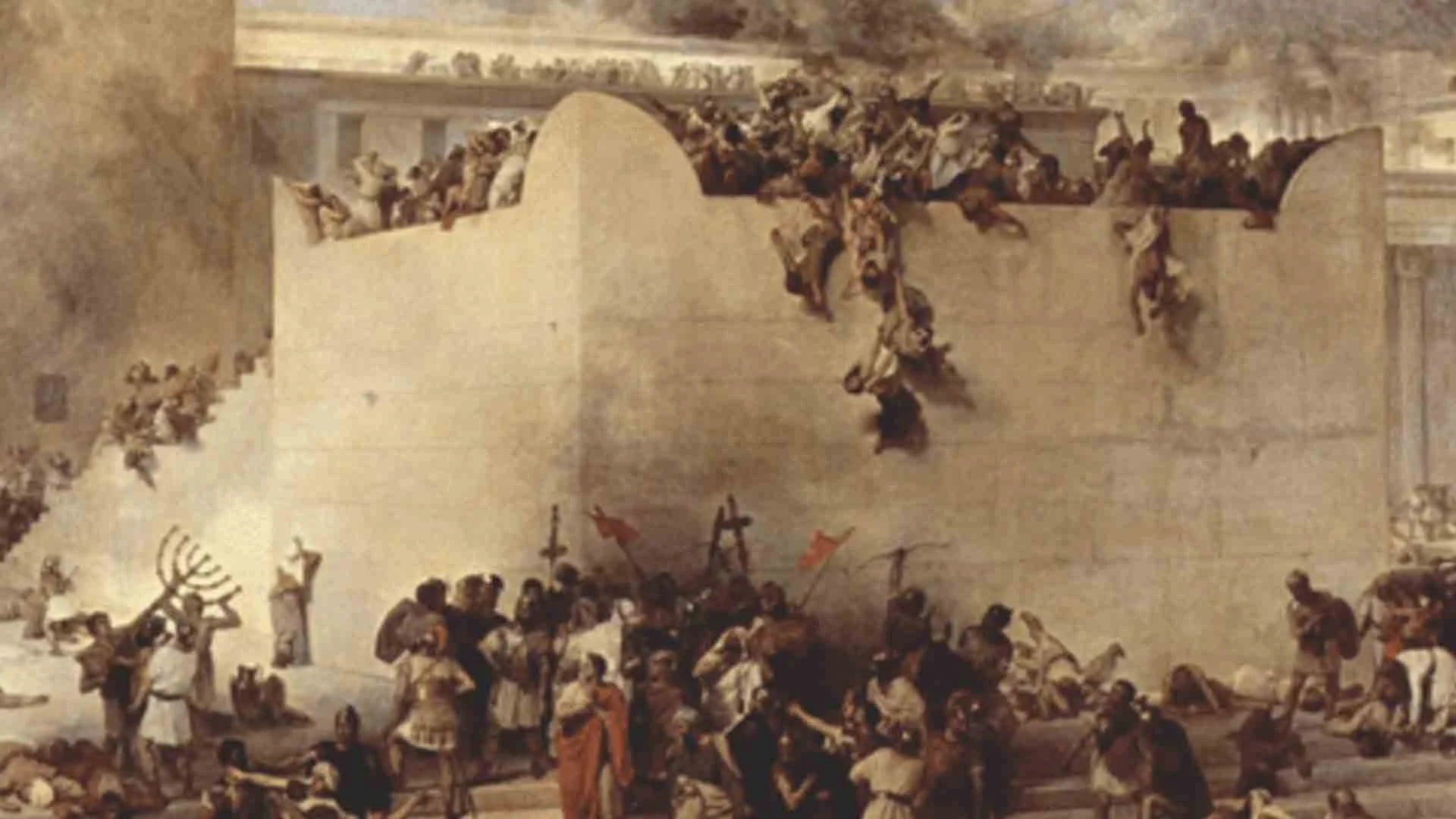
“Destruction of the Temple of Jerusalem” by Francesco Hayez, 1867

Yoma 9: Churban Bayis I vs II

jyungar April 20, 2021

For the source text click/tap here: Yoma 09

To download, click/tap here: PDF

The Gemara on our daf discusses the destruction of two Temples, as well as the Mishkan that stood in Shiloh for a period of time after the Jewish people entered the Land of Israel.

Aside from the wars that brought about the physical destruction of the house of God in each of these cases, the Gemara quotes a well-known tosefta that explains the underlying reasons for their destruction. According to the tosefta, the First Temple was destroyed because of the three cardinal sins of idol worship, forbidden sexual relations, and bloodshed that existed during that period.

The Second Temple, however, was destroyed during a period when the people were involved in Torah study and fulfillment of the commandments. In that case, the tosefta explains, the underlying cause for its destruction was the sin’at hinam – wanton hatred – that existed between the people. This leads us to a critical examination of the difference between the two temples.

Tags 12th
Comment

Yoma 8: Degeneration of Priesthood

jyungar April 19, 2021

For the source text click/tap here: Yoma 08

To download, click/tap here: PDF

The Mishna said that the kohen was sequestered into the Parhedrin chamber. The Gemora cites a braisa in which Rabbi Yehuda says that the original name of the chamber was the chamber of balvati – nobility. However, in later generations, when people would buy the position of kohen gadol, each year a new kohen gadol would arrive and rebuild this chamber. They therefore called it the Parhedrin chamber, in reference to the parhedrin, appointees of the king, who would serve 12 month terms. The term parhedrin referred to a Roman official who was appointed to a position for a single year term. This was commonplace whether the individual was elected by the Senate or if he acquired the position by paying off the right people. Among the officials appointed by this method were those who were responsible for controlling prices on a variety of goods and services. It was not uncommon for people in this position to try to acquire significant wealth by collecting exorbitant taxes during their short terms, well beyond the amount prescribed by Roman law. Since the occupants of the position of Kohen Gadol were more interested in their honor than in the spiritual importance of the position, each of them tore down the office and rebuilt it to show off their wealth and position of authority.

Tags 12th
Comment

Rabbi with Tefillin 1925, Jan Styka (April 8, 1858 in Lemberg – April 11, 1925 in Rome)

Yoma 7: Tzitz and Tefillin

jyungar April 18, 2021

For the source text click/tap here: Yoma 07

To download, click/tap here: PDF

Ex 29:38

38 And it shall be upon Aaron's forehead, and Aaron shall bear the iniquity committed in the holy things, which the children of Israel shall hallow, even in all their holy gifts; and it shall be always upon his forehead, that they may be accepted before the LORD.

Reb Yehuda holds "always" /Tamid means that while he wears it he must constantly be cognizant of its presence and its kedusha. Reb Shimon holds it means that the Tzitz brings Ratzon - appeasement of the Ribono shel Olam" -constantly, even if it is not being worn at that moment.

The Gemara at the end of our daf says that "if we learn like Reb Yehuda, then if the Tzitz, which has the written name of Hashem only once, mandates constant respectful awareness, how much more so this is true for Tefillin which have Hashem's name written twenty one times."

Which leads us to examine the relationship between the two and the influence of "hesech hadaas" prevents us from wearing tefillin all day.

Tags 12th
Comment

Yoma 6: Scholars vs Talmidei Chachamim

jyungar April 17, 2021

For the source text click/tap here: Yoma 06

To download, click/tap here: PDF

As we learned in the Mishna (2a) the High Priest is kept in one of the Temple offices for the week prior to Yom Kippur. Aside from training for the service that he is to perform on the Day of Atonement, this also keeps him away from his house, where there is a possibility that he may become ritually defiled by contact with others. The sequestration leads us to a discussion of leadership, the difference between scholars and Torah scholars and the critique of Gershom Scholem by Norman Lamm.

Tags 12th
Comment

Yoma 5: דָּרֹשׁ דָּרַשׁ מֹשֶׁׁה

jyungar April 16, 2021

For the source text click/tap here: Yoma 05

To download, click/tap here: PDF

As we learned in the Mishna (2a) the High Priest is kept in one of the Temple offices for the week prior to Yom Kippur. Aside from training for the service that he is to perform on the Day of Atonement, this also keeps him away from his house, where there is a possibility that he may become ritually defiled by contact with others.

The sequestration leads us to a discussion of leadership, the public image of the KG and the difference between scholars and Talmidei Chachamim and the critique of Gershom Scholem by Norman Lamm.

Tags 12th
Comment

Yoma 4: Access to the Divine, the Paradox

jyungar April 15, 2021

For the source text click/tap here: Yoma 04

To download, click/tap here: PDF

As we learned previously, the Sages of the Talmud derived the need for a seven-day preparation for the Yom Kippur service from the Torah’s description of the Tabernacle in the desert. An alternative source is suggested by Reish Lakish, who proposes that this rule is derived from the story of Moshe receiving the commandments on Mount Sinai. The Torah describes Moshe as being enveloped by a cloud for six days and entering God’s presence on the seventh day (see Shemot 24:16). This teaches that someone who is about to enter mahaneh shekhinah – the “encampment of God” – needs a week of preparation to do so. The access to the divine then became a mystical trope for Rebbe Nachman in a dazzling commentary to the mist/fog of the cloud. he suggests that it was ONLY the dark impenetrable areas of the self/life and the world where God hides and is to be found accessible...typical of the Rebbe's paradoxical notion of the divine.

The cloud looks like a place lacking clarity. However for the Chassidic Masters the "cloud" is not negative at all. Rebbe Nachman directs our attention to the contradiction of the cloud. On one hand it keeps us away, because we don't see that God is there. It seems that He is not. It is only when we enter the cloud of unknowing that we realize that not only is Hashem "behind" the cloud, but that the cloud itself is a revelation of His love for us, the cloud itself is Torah. The Me'or Eynayim takes it further forcing us to see the divine hand even when we are alienated from Him.

Tags 12th
Comment

Yoma 3: Kivyachol

jyungar April 14, 2021

For the source text click/tap here: Yoma 3

To download, click/tap here: PDF

There is an argument (Yoma 3b)on our daf regarding howwe are to understand the pesukim in the Torah when Moshe is told by Hashem“kach lecha.” Rebbe Yoshiya understands the directive to mean that MosheRabbeinu should use his own funds to purchase whatever items were mentioned inthe pasuk. Therefore, when Moshe Rabbeinu was told to take the spices that areused for the ketores, he was to purchase them from his own funds. The Rashashexplains that generally the spices are purchased from communal funds, but theketores used during the inauguration of the Mishkan was paid for by MosheRabbeinu.Rebbe Yonason disagrees and says that even the spicesused for the ketores during the Mishkan’s inauguration had to be purchased withcommunal funds. The use of the phrase “kach lecha” was meant to convey amessage. “K’vayachol, I want yours more than theirs.” Rashi’s first explanationof the word “Kivyachol” is that the word means “if it were possible.” Hashemtold Moshe “If it were possible for the funds for the ketores to come from anindividual, I would prefer that they come from you instead of from KlalYisrael.” However, it is not possible since the funds for the ketores have tocome from communal sources. It is interesting to note that according to thisunderstanding, the word “Kivyachol” was said by Hashem. 

We examine Rashi's use of the term and extend it to theological implications of the term as a metaphor for A THEOLOGICAL PARADOX: DIVINE POWER AND HUMAN INITIATIVE

Tags 12th
Comment

Yoma 2: Sequestration

jyungar April 13, 2021

For the source text click/tap here: Yoma 2

To download, click/tap here: PDF

Tractate Yoma deals with the Day, that unique day of the year, Yom Kippur. It is a time of special sanctity that exceeds the sanctity of all other Festivals.

Yom Kippur is the day when reality transcends standard boundaries and conventions, as it is stated in the Torah: “For on this day shall atonement be made for you, to purify you; from all your sins shall you be purified before the Lord” (Lev 16:30). It is the Festival celebrating the elimination of all flaws and transgressions and a return to the initial state of purity. The High Priest is instrumental in the rituals of expiation on behalf of the people.

We examine the sequestration of the high Priest for seven days prior to Yom Kippur. And the location of the Lishkas HaParhedrin.

Tags 11th
Comment

Shekalim 22: Shekels and Bikkurim Post Hurban

jyungar April 12, 2021

For the source text click/tap here: Shekalim 22

To download, click/tap here: PDF

The final Mishna in Massekhet Shekalim returns to the rules of the shekalim, and specifically to their status in contemporary times when the Mikdash is no longer standing. Incidentally it also touches on some other halakhot that are dependent on the holiness of the Land of Israel and how they are to be kept in the absence of the Temple.In addition to Korbanos, the Mishnah identifies a number of other Mitzvos that, in the absence of the Beis HaMikdash, can no longer be fulfilled. The Mishnah/ our daf in Shekalim (8:8) mentions two, Shekalim and Bikkurim. Shekalim is obvious given that, according to the Chachomim, the entire purpose of contributing the half-shekel to the public fisc was to ensure the general public's participation and, more importantly, representation in the public Korbanos. Therefore, with no Beis Hamikdash and Korbanos, there is no longer a need to contribute the half-shekel.

The second Mitzvah is Bikkurim, the obligation to bring the first fruits up to the Beis HaMikdash and, after reading the Torah portion related to Bikkurim, leaving them behind for consumption by the Kohanim. Again, in the absence of the Beis HaMikdash this Mitzvah could no longer be performed. This leads us to end the masechta with the Nachem controversy ad Rav Goren.

Tags 11th
Comment

The "Tombs of the Kings", believed to be the tomb of Queen Helene of Adiabene; 19th-century lithograph by William Henry Bartlett

Shekalim 21: Burial Tools/Dolabra

jyungar April 11, 2021

For the source text click/tap here: Shekalim 21

To download, click/tap here: PDF

Rabbi Yose says: They are all ritually pure, except for the basket, and the shovel, and the meritza, which are specifically used for graves, to gather up the bones of the dead. These tools must be presumed to be ritually impure, but in general, vessels are presumed to be pure.

During the Second Temple period people were buried in temporary graves and after their flesh decomposed their bones were moved to permanent family burial caves. The basket was a special one that was used to collect the bones.

The shovel had a wide head and a long handle, held in both hands; when associated with a basket, as it is here, it was used for digging as well as the collection of bones for burial. The meritza in this context was a tool similar to a pickax, also called a dolabra, with which one could extract large stones and then push them into place to close a burial cave.

Tags 11th
Comment
  • Daf Ditty
  • Older
  • Newer

Julian Ungar-Sargon

This is Julian Ungar-Sargon's personal website. It contains poems, essays, and podcasts for the spiritual seeker and interdisciplinary aficionado.​